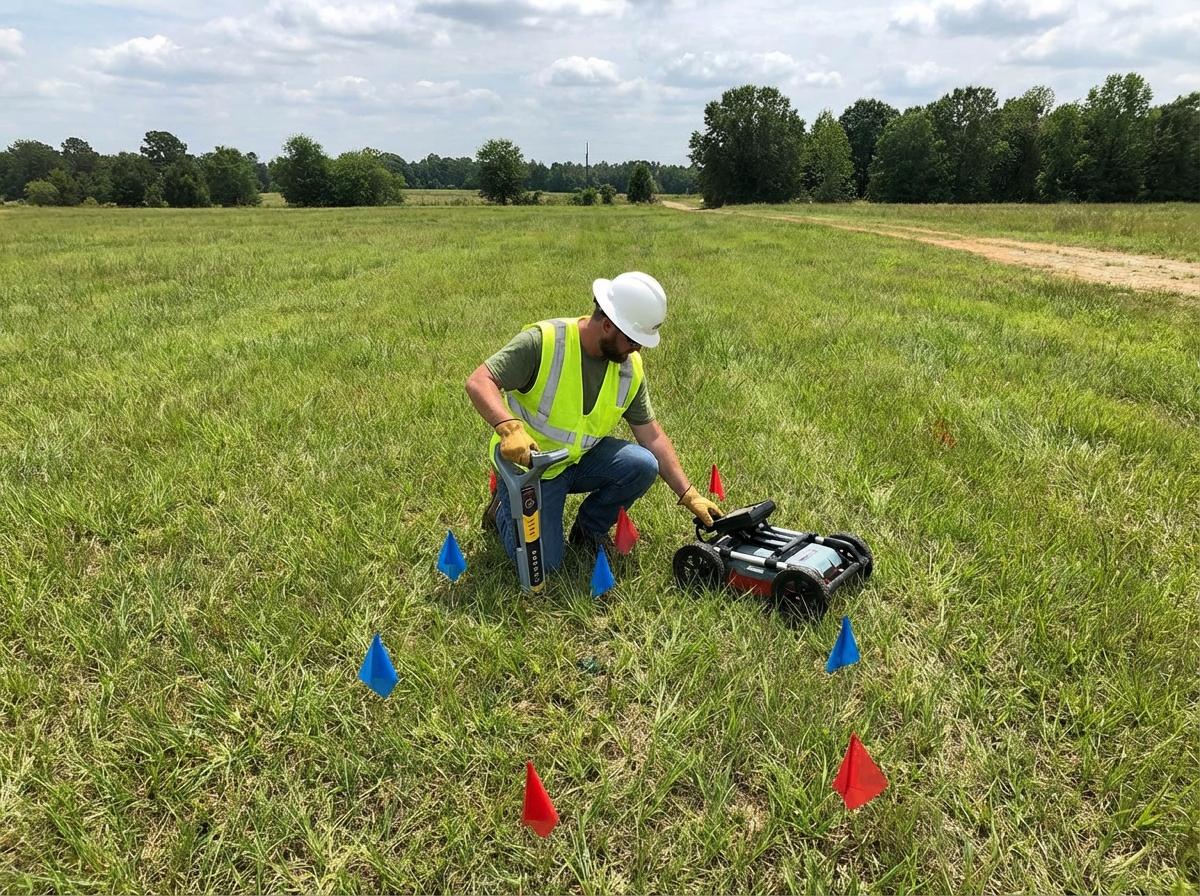
A private utility locating technician marks buried lines before excavation begins – a step that protects field crews and project timelines.
Field service work doesn’t slow down. Schedules stack up, job counts climb, and crews are expected to arrive on-site ready to work. For any operation that involves digging – even something as routine as setting fence posts, running conduit, or installing an irrigation line – there’s one step that can’t get lost in the rush: knowing what’s buried underground.
Underground utility strikes happen far more often than most people in the industry want to admit. The consequences range from costly project stoppages to serious crew injuries to significant legal exposure. And in most cases, the incident traces back to a decision made before the crew ever left the yard.
This article is for field service managers and business owners who run crews that break ground. It covers what utility locating actually involves, when public call-before-you-dig services aren’t enough, and how to build a locate-first approach into your day-to-day job management workflow.
Why underground utility locating is a job-critical step
The numbers aren’t encouraging. According to the Common Ground Alliance’s 2024 DIRT Report, nearly 197,000 underground utility damage incidents were reported in the U.S. in 2024 – roughly 540 per day. The CGA Index, which tracks damage rates relative to excavation activity, rose from 94.0 in 2023 to 96.7 in 2024. That’s the wrong direction, and it’s happening despite years of industry-wide safety campaigns.
Telecommunications infrastructure took the hardest hit – telecom lines accounted for 49% of all reported damage incidents. Natural gas came in at 39%. These aren’t obscure edge cases. They’re the kinds of utilities that run through nearly every commercial and residential job site your crews will ever work.
The financial exposure compounds fast. Excavation-related utility damage costs U.S. businesses and utilities approximately $30 billion annually, according to data from the Common Ground Alliance. That figure includes direct repair costs, emergency response, service disruption, and third-party liability. A single strike on a natural gas line can shut down a job site for days and bring in regulatory scrutiny that takes weeks to resolve.
Bringing in an underground locator service before any ground disturbance is the most direct way to reduce that risk. Professional locators use electromagnetic detection and ground-penetrating radar to identify buried lines your crew can’t see – including private infrastructure that public notification systems don’t cover. It’s not a bureaucratic checkbox. It’s the difference between a job that runs on schedule and one that doesn’t.
811 vs. private utility locating: what field teams need to know
Most field managers have heard of 811 – the national call-before-you-dig service that notifies public utility owners to come mark their lines before excavation starts. Per 811beforeyoudig.com, calling 811 is required by law in all 50 states before any ground disturbance. It’s free, and in most areas, you need to request it two to three business days before the dig window.
What 811 does not cover is where things get complicated. Public 811 notification systems only mark utilities owned and maintained by public utility providers. Private lines – telecom cables on a commercial campus, gas lines serving individual buildings, irrigation systems, electrical feeds on private property – don’t show up. If you’re working at a school, a shopping center, an apartment complex, or any industrial facility, there’s a real chance that significant underground infrastructure exists that no 811 response will ever mark.
The GPRS article on 811 vs. private locating explains this gap clearly. Private locating fills in where public programs leave off – it’s not a replacement for 811, it’s the layer your crew needs when a public locate alone isn’t sufficient.
There’s also a scheduling angle here that doesn’t get talked about enough. The CGA’s 2024 DIRT Report found that excavators had an average 38% chance of being unable to begin work as scheduled due to incomplete or delayed 811 locate responses. That’s a scheduling failure, not just a safety gap. Field managers who treat 811 response time as a fixed and reliable variable are building jobs on shaky ground.
What happens when field teams skip the locate
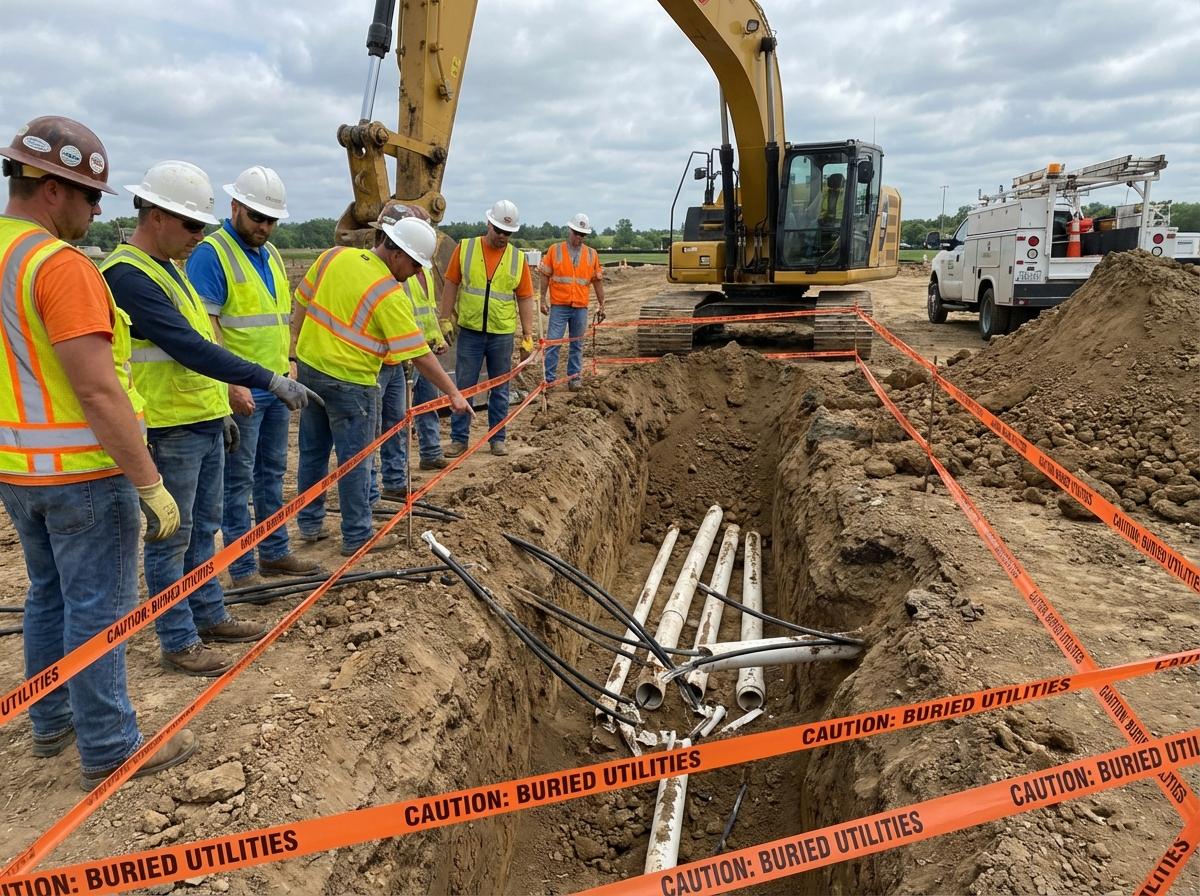
Underground utility strikes cause an estimated $30 billion in annual damage across the U.S. – most of it preventable with a professional locate.
The scenario plays out the same way every time. A crew shows up on site, the job looks routine, and someone decides the locate step can wait or skip entirely. Then a line gets nicked, a gas leak starts, or the site goes dark because a telecom cable got cut. Work stops. Emergency services get called. The client is furious.
The business impact rarely stays contained to the repair bill. Equipment gets damaged. If gas or electricity is involved, crews have to evacuate, and the site is locked down until emergency responders clear it. Insurance claims get filed – and if proper locate procedures weren’t followed, coverage can be disputed. The client relationship takes a hit that’s often harder to recover from than the invoice.
Here’s a number worth keeping in mind: research from Purdue University, cited by Bermex/ACRT, found that professional utility locating services deliver $4.62 in value for every $1 spent. Skipping the locate to save a few hours doesn’t hold up financially when you run the actual math.
The crews making these calls aren’t reckless. They’re under schedule pressure, short on time, and working from job briefs that don’t always flag locate requirements. That’s an operations problem, not just a field safety problem. And it’s one that field managers can actually fix.
How to build a locate-first workflow into your field operations

Field service software can enforce locate verification as a required pre-dispatch step before any dig-related job is released to a technician.
The locate-mark-verify-excavate sequence is straightforward. A locate is requested, a technician marks the lines, the marks get verified on-site before digging starts, and then excavation proceeds within the marked tolerance zones. Ditch Witch’s utility location guide covers the field-level detail well.
Where field service companies run into trouble is treating the locate as the crew’s problem to sort out on the morning of the dig. By then, it’s too late – 811 responses take two to three business days in most states, and a private locate needs to be scheduled and confirmed before the dig window opens. The location decision belongs in the job setup phase, not on the morning of.
Here’s how to build it in:
- Add locate verification to your pre-job checklist. Before any dig-related work order gets dispatched, there should be a confirmed locate on file. Adding this as a required field in your pre-job checklist – rather than a verbal reminder – means it can’t get skipped when things get busy. If you’re building out service checklists, the field service management checklist guide on the FieldProMax blog covers how to structure these requirements systematically.
- Track locate status in the work order itself. Don’t just note that a locate was requested – track the response date, the type of locate (public, private, or both), and whether marks are confirmed before dispatch is released. If you’re not sure how to structure this in your current system, the work order management guide is a good starting point.
- Assign clear ownership. Who is accountable for confirming locate completion before a crew departs? If the answer is “whoever thinks of it,” it will get missed. Assign it explicitly – to a dispatcher, a project coordinator, or a site lead – and make it a required sign-off before the job releases.
Scheduling around locate lead times
The 38% of excavators who couldn’t start on schedule in 2024 due to incomplete 811 responses weren’t just dealing with a safety issue. They were dealing with a scheduling failure that had downstream effects on every job in the queue behind it.
The lead time needs to be factored in at the quoting and scheduling stage, not treated as an afterthought. If a dig is scheduled for a Tuesday, the 811 request needs to go in the prior Thursday at the latest – and that assumes the utility owners respond on time, which they don’t always do. Private locates often require even more lead time if the service provider must be booked in advance.
The most reliable fix is to build a locate lead time into your job templates. If your field service software lets you create job types with required steps or time buffers, use them. A “dig required” job type should automatically flag the need for a locate request and build in the lead-time buffer before the crew is ever dispatched. Better scheduling and dispatch practices for field teams cover how to structure these buffers into your standard workflows.
Two to three days of locate lead time doesn’t feel like much until your crew is sitting idle on a job site waiting for a utility marker who wasn’t booked until the day before. Build it in early, and it costs nothing. Build it late, and it costs you a full day of billable time.
Conclusion
Underground utility locating isn’t just a field safety requirement. It’s an operations issue that starts in the office, with how jobs are set up, how work orders are structured, and how lead times are managed before a single shovel hits the ground.
The field crews breaking ground aren’t the ones who can solve this. The decision to request a locate – and to confirm it before dispatch – belongs to the people managing the job pipeline. Field service managers who build locate verification into their standard workflow catch problems before they become incidents.
Start with your current job templates. If there’s no locate verification step for dig-related work, add one today. Identify the types of jobs that need private locating beyond 811, assign clear ownership of the confirmation step, and build the lead-time buffer into your scheduling before it costs you a job.