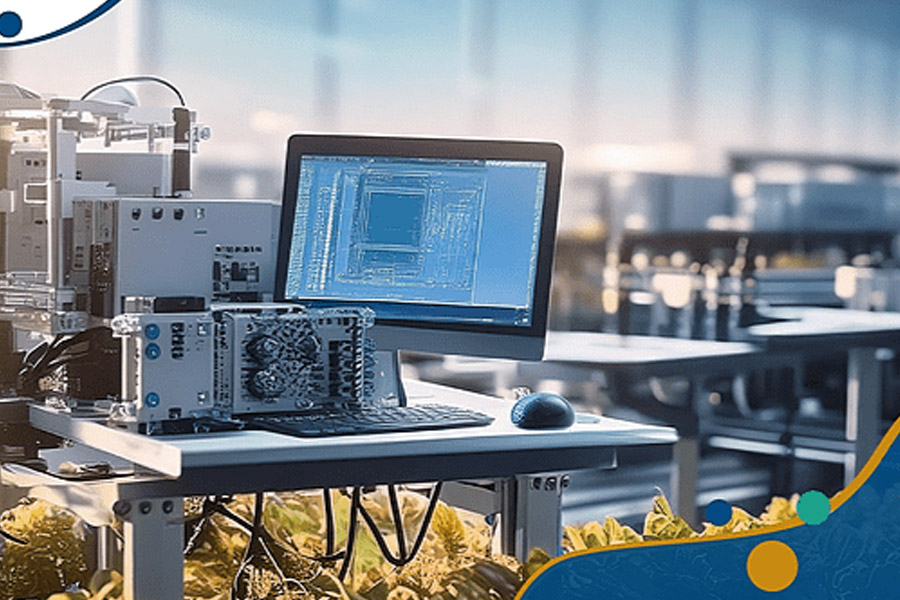
The Evolution of Automated Precision
Modern industries operate on an invisible rhythm orchestrated by control engineering. Decades ago, operators turned valves by hand and monitored gauges with careful eyes. Today, machines calibrate themselves, robotic arms follow trajectories calculated in milliseconds, and furnaces maintain exact temperatures without hesitation. This transformation did not occur by chance—it was guided by the principles of control engineering that transform human intention into consistent automated behavior.
This field’s engineers seek stability like sailors seeking calm waters in waves of fluctuation. All servo motors, flow meters, and temperature probes work together to balance performance and precision. Stability is the calm hum of a process that adapts gently to change.
Beyond the Basics: From Feedback to Autonomy
The art of control systems involves building intelligence that anticipates, coordinates, and optimizes. Feedback control—a diligent observer comparing the planned outcome to the actual result and correcting deviations—is the foundation. Control logic becomes predictive and adaptable as industries become more efficient.
Model predictive control, for example, looks ahead, considering future system states. It is like a chess player planning several moves in advance rather than reacting to the opponent’s current piece. This foresight reduces waste and enhances output, turning what was once mechanical execution into orchestration infused with strategy. Adaptive control goes a step further by learning from the process itself, adjusting tuning parameters as conditions evolve. Such intelligence gives control systems agility, enabling them to thrive amid fluctuations in production demands or resource availability.
The Human Factor in Machine Intelligence
Although algorithms control operation, human ingenuity and interpretation determine improvement. Control engineers connect theoretical models to pipelines, motors, and sensors by translating dynamic behavior into equations. It combines physics and psychology to study how people trust machines.
Operator interfaces, alarm rationalization, and trend visualization influence plant floor decisions. Well-designed control screens empower workers, whereas poorly designed ones overwhelm them. The best implementations cater for human behaviors to make automation clear and easy, complementing human understanding.
Lifecycle Thinking: Sustaining System Performance
A control project is not static. Like living organisms, systems grow, adapt, and require care. Engineers must plan for calibration drift, firmware updates, and environmental wear. Documenting configurations, controlling revisions, and testing patches keep solutions stable over time.
Maintenance strategies increasingly rely on digital twins—virtual representations of machines that reveal how controls perform under simulated events. Through these models, engineers can explore failure scenarios without halting production. In such reflections of reality, predictive maintenance becomes proactive assurance, allowing organizations to identify weaknesses before they manifest as downtime.
Control Across Diverse Industries
The fingerprints of control engineering appear across sectors that seem unrelated. In pharmaceuticals, it ensures dosage uniformity and purity under delicate temperature and pressure conditions. In renewable energy, it synchronizes turbines and converters to maintain reliability as wind and sunlight fluctuate.
Control systems prevent instability and enable autonomy in cars. Electric car motor controllers and brake algorithms use precise feedback loops. Using soil moisture readings, irrigation systems now control water flow in agriculture, making manual oversight smart.
Every industry relies on balance. Where materials move, heat transforms, or motion repeats, control engineering stands as the unseen guardian of efficiency.
Tools and Technologies Enabling Modern Control
The modern engineer’s toolkit is diverse and evolving. PLCs remain fundamental, but their logical frameworks are joined by simulation software and integrated communication protocols that connect plant floors to enterprise systems. Visual programming environments simplify logic development, while scripting languages extend flexibility.
Instead of replacing control laws, machine learning improves pattern recognition. Control parameters may need attention if algorithms detect subtle behavioral changes like a pump vibrating differently or a furnace cycling irregularly. Traditional feedback and statistical awareness create a hybrid intelligence that combines deterministic equations and experiential learning.
Control activities become system-wide cooperation through industrial networks and cloud platforms. Performance data flows continually through real-time monitoring and centralized analytics, enabling transparency and agility.
Designing for Safety and Predictability
Control and safety are linked. Even in failure, engineers design for predictability. Redundant sensors, watchdog clocks, and emergency interlocks allow machinery to detect and act on faults.
Safety integrity levels (SIL) guide how rigorous a system must be based on risk assessment. In high-hazard environments—chemical processing or aerospace—the control strategy operates within strict reliability boundaries. Predictability becomes protection; precision becomes security.
Emerging Directions and Sustainable Priorities
As companies go toward sustainability, control engineering changes. Coordination, load balance, and waste minimization are key to energy efficiency. Smart grids and energy management systems dynamically match supply and demand with real-time control.
The same logic enhances environmental compliance by minimizing process variability that can produce off-spec emissions or resource waste. The pursuit of control now aligns with the global pursuit of sustainable progress. Engineers design not only for stability but for stewardship—systems that harmonize performance with planetary responsibility.
The Art of Measurement and Response
Each control loop relies on measurement. Automation uses sensors for eyes and actuators for hands. The orchestra loses tune when either fails or drifts. To guarantee commands translate into physical change, engineers spend a lot of work confirming sensor calibration, compensating for noise, and modeling actuator dynamics.
The delicate balance reflects human perception and reaction. The control system rapidly modifies its rhythm when it hears irregularities, like a conductor. The invisible interplay between feedback signals and remedial actions keeps operations running smoothly.
Training, Collaboration, and Culture
Control engineering thrives in environments that value continuous learning. The best organizations encourage collaboration between design engineers, production teams, and maintenance staff. Each perspective adds depth—designers know theory, operators know behavior, and technicians know physical limitations.
Controlling as a team leads to sustainable performance. Audits, version control, and documentation keep systems transparent and manageable. When teams comprehend machine logic, challenges become riddles solved by knowledge rather than terror.
FAQ
What distinguishes control engineering from general automation?
Control engineering studies the mathematical and logical principles that regulate system response to change. Automation may entail motion sequencing or operation scheduling, but control engineering keeps each activity steady under disruption.
Why is tuning a control loop so critical?
Tuning determines how quickly and smoothly a system reacts to error. Poor tuning can create oscillations or sluggish responses. Proper adjustment allows processes to maintain setpoints efficiently while minimizing overshoot and variability.
How do digital twins support modern control design?
Digital twins simulate real-time physical systems. Engineers can test control algorithms before implementation, eliminating trial-and-error and commissioning downtime.
What industries benefit most from model-based control methods?
Complex processes and strong variable interactions favor model-based control in chemical production, power generation, aerospace systems, and advanced manufacturing. These conditions require predictive stability beyond feedback.
Can artificial intelligence replace traditional control logic?
AI complements rather than replaces classical methods. Feedback, feedforward, and PID structures remain the cornerstone of reliable operation. Artificial intelligence extends diagnostics and pattern recognition but depends on control engineering fundamentals for safe and repeatable action.
How is sustainability connected to control engineering?
Control efficiency saves energy, resources, and waste. Optimizing performance and minimizing unpredictability helps industries run greener while maintaining quality and productivity.
What makes a control system maintainable over time?
Version tracking, clear documentation, uniform nomenclature, and ordered code architectures provide long-term maintainability. Calibration and training prevent system drift and improve reliability.