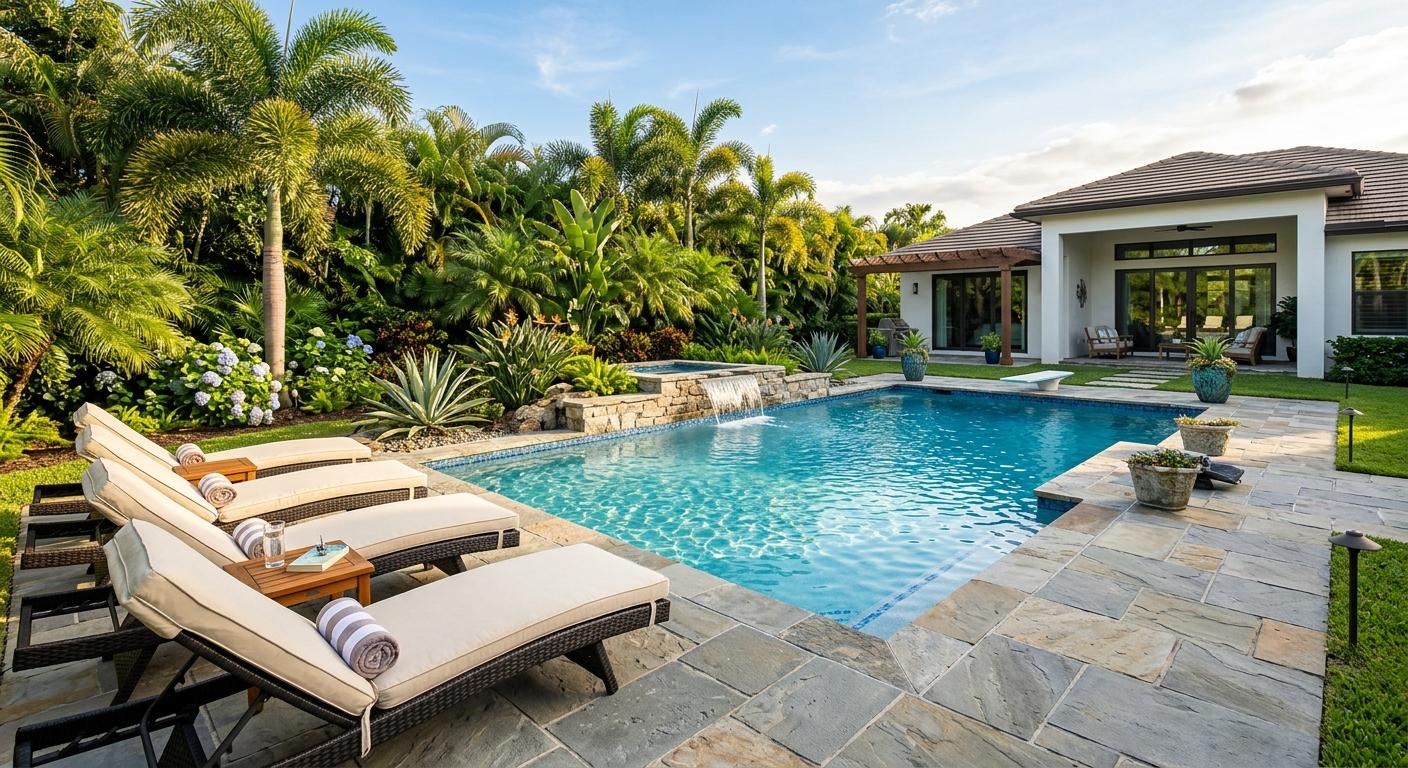
The average inground pool runs $65,909 in 2025, according to HomeGuide – a number that rules out paying cash for most households. That’s more than many people put down on their first home. Yet there are 10.7 million residential pools in the United States, per RenoSys Swimming Pool Statistics (2025), which means millions of homeowners have already worked through this exact problem.
The difference between a pool that gets built and one that stays on the wish list usually comes down to one thing: picking the right financing method. The wrong choice can cost you tens of thousands in extra interest. The right one might barely feel like a financial stretch at all.
Here are seven ways to finance a pool, what each one actually costs, and which homeowner profile each suits best.
1. Pool Loan (Dedicated Swimming Pool Financing)

A dedicated pool loan covers the full installation cost, from excavation through finishing touches.
A dedicated pool loan is purpose-built for this exact project. Unlike a generic personal loan, this product is structured around the costs and timelines of pool construction – lump-sum disbursement, fixed rates, and terms long enough to keep monthly payments manageable.
According to HFS Financial (2025), pool loans now average just over $80,000, with borrowers increasingly selecting longer terms as pool designs grow more complex. APRs run from 6% to 36% depending on credit profile. If your FICO score sits above 740, you can often qualify for rates as low as 5%.
No home equity required. No lien on your property. If you’re a newer homeowner or you simply don’t want to put your house up as collateral, this is the cleanest path to the water.
- Best for: Homeowners without significant equity, or anyone who wants a fixed-rate loan without touching their mortgage.
2. Personal Loan (Unsecured)
A general-purpose personal loan works through the same mechanics as a dedicated pool loan – but the lender pool is much wider. Banks, credit unions, and online lenders all offer them.
APRs range from 6% to 36% with terms typically running 24 to 84 months. Maximum loan amounts often reach $100,000. According to NerdWallet (2025), most lenders want a FICO score of at least 660, with the best personal loan rates going to borrowers at 690 or above.
The trade-off: shorter terms mean higher monthly payments compared to home equity options. If you borrow $65,000 at 12% over 60 months, you’re looking at roughly $1,445 per month. Run those numbers before you commit.
- Best for: Homeowners who want fast approval and no collateral requirement, and who have good-to-excellent credit.
3. Home Equity Loan
A home equity loan lets you borrow a lump sum against the equity you’ve built in your home. Rates are lower than unsecured options because your house is the collateral.
As of early 2026, home equity loan rates average 7.84% to 8.07%, according to Bankrate. That’s a meaningful discount from the upper range of personal loan rates, especially on a $70,000 project. Homeowners hold a record $17.8 trillion in total equity as of Q3 2025, per Federal Reserve Bank of New York data cited by Bankrate, so many households have the equity to qualify.
Budget for closing costs – typically 2% to 5% of the loan amount. On a $70,000 loan, that’s up to $3,500 added to your upfront costs.
The risk is real: miss enough payments, and you’re facing foreclosure on your home. Don’t take this option lightly just because the rate looks attractive.
- Best for: Homeowners with significant equity who know the exact project cost and have a stable income.
4. Home Equity Line of Credit (HELOC)
A HELOC works like a credit card secured by your home equity. Instead of receiving a lump sum, you draw funds as you need them during a draw period – usually five years – then repay over 10 to 20 years.
The average HELOC rate sits at 7.26% as of May 2026, per Bankrate. That’s a variable rate, though, which means it can shift as market conditions change. HELOC limits rose by $25 billion in Q4 2025 alone, according to the Federal Reserve Bank of New York, as more homeowners tapped into record equity levels.
If your pool project includes additional outdoor work, a HELOC makes particular sense. You can draw for the pool, then draw again for the deck or outdoor kitchen later in the same credit line. For ideas on making the most of that outdoor investment, this guide to creating a low-maintenance outdoor space is worth reading before you finalize your scope.
- Best for: Multi-phase backyard projects where costs will arrive in stages, not all at once.
5. Cash-Out Refinance

A cash-out refinance replaces your existing mortgage and frees up a large lump sum for major projects like a pool.
A cash-out refinance replaces your current mortgage with a larger loan. The difference between your old loan balance and the new one comes to you as cash.
This option can work well in specific circumstances – mostly when your existing mortgage rate is already near or above current market rates, or when you’re consolidating higher-interest debt alongside the pool project. If you want to think through how this fits with a broader renovation plan, financing major home upgrades covers the full picture.
The catch in today’s rate environment is significant. If you locked in a 3% mortgage in 2021 and current rates sit above 7%, refinancing turns a cheap loan into an expensive one. On a $350,000 remaining balance, that rate difference costs you roughly $14,000 a year in added interest. A pool should not cost you that much annually.
- Best for: Homeowners whose existing mortgage rate is already high, or those who plan to stay long-term and are comfortable restructuring their entire loan.
6. Pool Manufacturer or Dealer Financing
Many pool builders offer in-house financing or work with a lending partner to offer it at the point of sale. The pitch is convenient – one conversation, one approval, one project.
It can work. Promotional deals sometimes include deferred interest for 12 to 18 months, which looks attractive on the surface. But once the promotional period ends, any remaining balance is often hit with interest that has been accruing the whole time.
Always get a competing quote from a bank or credit union before signing dealer financing. The rate difference can be significant, and the builder won’t point that out to you.
- Best for: Buyers who value simplicity, have a trusted builder relationship, and are disciplined enough to pay off a deferred-interest balance before the promotional window closes.
7. 0% APR Introductory Credit Card
This one only works for specific situations. If your pool cost fits within a credit card limit and you can realistically pay off the full balance within 12 to 21 months, a 0% intro APR card is genuinely interest-free financing.
Once the intro period ends, rates typically climb to 28%-30%. At that point, any remaining balance becomes very expensive debt very quickly.
Above-ground pools average $1,600 to $7,500 according to HomeGuide (2025), which makes the credit card math possible for that segment. For a full inground installation averaging $65,909, this approach isn’t realistic unless you’re covering a small portion of the project cost.
- Best for: Above-ground pool installations or partial financing on smaller scopes where a payoff within the intro window is achievable.
How to Choose the Right Option for Your Situation

Each financing type carries different rate ranges and credit requirements – matching the option to your profile saves money over the life of the loan.
The right choice depends on two things: how much equity you have and what your credit looks like. Here’s the direct framework:
- No home equity, good credit (660+): A pool loan or personal loan is your straightforward path. No collateral, fixed payments, fast approval.
- Significant equity, stable income: A home equity loan at a fixed rate is usually the most cost-effective option for large projects.
- Multi-phase backyard project: A HELOC lets you draw funds across multiple stages without reapplying.
- Low existing mortgage rate: Don’t refinance it. Use a pool loan or home equity product instead.
- Above-ground or small pool: The 0% APR card is worth considering if you can pay it down fast.
One thing worth remembering: according to the National Association of Realtors (2023), inground pools deliver a 56% ROI and can boost a home’s value by up to 7%. This isn’t just a purchase – it’s an asset. But only if the financing cost doesn’t eat that return over the life of the loan.
Pools also come with ongoing costs – chemicals, filters, and seasonal maintenance. Many owners underestimate how much upkeep matters for long-term value, and those overlooked maintenance tasks can add up quickly if you’re not prepared for them.
The Bottom Line
Seven real options exist, and none of them is universally best. If you have equity and a stable income, a home equity loan or HELOC almost always comes out cheapest in total interest paid. If you don’t have equity or don’t want to risk your home, a dedicated pool loan or personal loan keeps the risk off your property while still delivering competitive rates for good-credit borrowers.
Cash-out refinancing can work, but it carries the most risk in the current rate environment. Dealer financing and credit cards are tools of last resort unless the specific promotional terms work clearly in your favor.
Before you call any lender, know your credit score, get a firm quote from your builder, and run the full monthly payment math at two or three different rate scenarios. The pool isn’t going anywhere – take a week to compare before you sign.