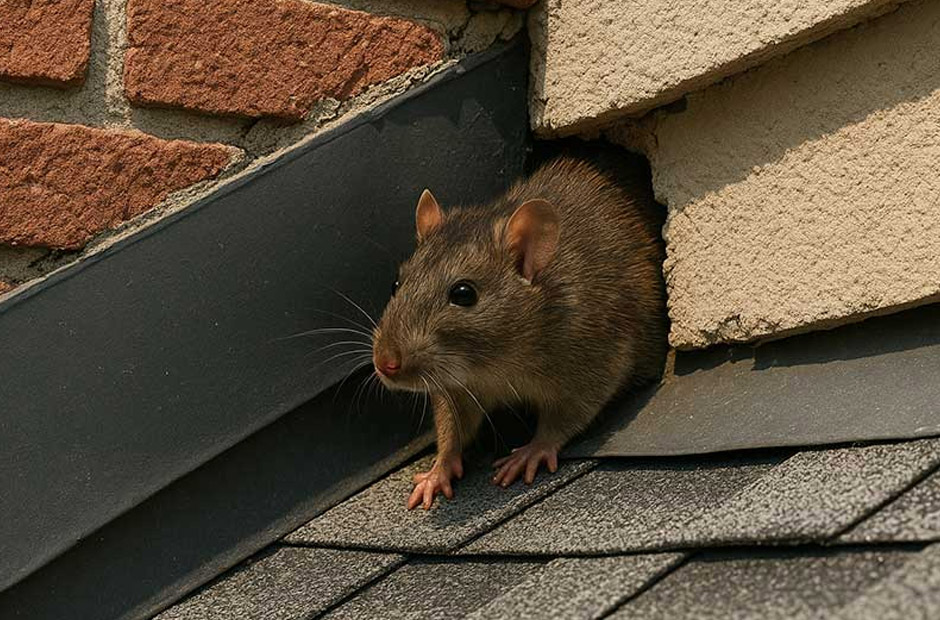
You hear scratching above the bedroom ceiling on a Tuesday in November. By Friday, there is soot along a soffit seam and a chewed corner of a Triscuit box on the counter. That is how a roof rat problem in the Fort Worth area usually announces itself.
The exterminator who showed up that weekend pulled an adult roof rat out of a snap trap in the garage and pointed a flashlight at a thumb-sized gap above the dryer vent. That one rat had been inside for six nights.
Stories like that play out across Tarrant County every fall, when temperatures drop, and rats start looking for warm walls. North Texas has two main culprits: Norway rats burrowing under sheds and woodpiles, and roof rats climbing pecan trees and power lines into attics and soffit gaps.
Effective Fort Worth rodent control is a five-step protocol: inspection, exclusion, targeted trapping, attic decontamination, and lawn repair where Norway rat burrows have damaged the turf. Step one is reading the property the way the rat reads it: entry points along the eaves, droppings in the insulation, gnaw marks on low-voltage wiring, and burrows under outdoor kitchens.
The same protocol applies to homeowners, HOAs, and commercial properties across Fort Worth, Arlington, and Weatherford. A single rat finishes most of its damage before anyone sees the rat itself.
The Crowley story is useful because almost everyone gets the sequence backward.
Key Takeaways
- Roof rats enter through gaps as small as three-quarters of an inch, often through soffit vents and dryer vent housings.
- The first damage in a Fort Worth home is usually to attic insulation and low-voltage wiring, not to food in the pantry.y
- Snap traps placed near visible droppings rarely work because rats follow scent-marked routes along walls, not open floor
- Exclusion work has to happen alongside trapping, otherwise the next rat replaces the one you just removed
- Norway rat burrows compact the soil under turfgrass and need aeration and overseeding to recover.
Entry Through a Three-Quarter-Inch Gap
Roof rats are smaller than people expect, about 7 inches long, slim, and built to climb. A juvenile can flatten through a hole the diameter of a quarter, and an adult can clear anything wider than three-quarters of an inch. Soffit vents, gable vents, dryer vent housings, and the seams where roof flashing meets brick are the usual front doors in a Fort Worth home.
Pecan trees and power lines do most of the rest. A rat climbs the tree, walks the limb that overhangs the roof, and steps onto the shingles. From there, it patrols the eave line until it finds an opening, sometimes on the same night.
The Crowley rat came in through a gap above the dryer vent where the original installer left a half-inch crescent of daylight. Three caulked screws would have closed it in 1998. By 2024, the rat had been using that corridor for at least one full breeding season.
Why the Snap Trap Behind the Refrigerator Sat Empty
Rats run scent-marked routes. They press one side of their body against a wall, follow the same path every night, and avoid the open kitchen floor unless something forces them across it. A snap trap baited with peanut butter and set in the middle of the linoleum reads to a rat the way a folding chair in the middle of a parking lot reads to you: visible, exposed, ignorable.
The captures happen along the runs. Behind a refrigerator coil, against the baseboard of a utility closet, on top of a water heater, on the rafter joist in the attic, where a rub mark shows dark fur grease. Reading the property means walking it slowly with a flashlight and a notebook, looking for droppings clustered in lines and gnaw marks oriented along the grain.
A trap placed inside a rat’s actual route, with no bait at all, can catch a rat in one night. A trap placed where a rat has never walked will sit empty for a month.
Insulation, Wires, and Sunken Lawn Trails
Most homeowners notice rats because of food contamination, a chewed cereal box, or droppings on a counter. The expensive damage is upstairs in the attic, where insulation gets shredded into nesting material and low-voltage wires get gnawed for the satisfaction of grinding teeth that grow four to five inches a year. Insurance adjusters in Tarrant County see attic wiring claims tied to rodent damage every winter.
Insulation loss is the slow bleed. R-value drops by 20-40% in heavily nested attics, and the January heating bill reflects it. Adding the cost of replacing R-38 fiberglass batt insulation across a 1,400-square-foot ceiling makes the math uncomfortable fast.
Norway rats add lawn damage. Their burrows run alongside foundation slabs, under wood piles, and beneath outdoor kitchens, with entrances about two to three inches across and a fan of loose soil at the mouth. Once they leave, the empty tunnel collapses under foot traffic, and the lawn shows sunken trails for months.
Closing the Gaps Before Setting Any Traps
Trapping without exclusion is a treadmill. Remove the rat in the attic on Monday, and a juvenile from the same litter climbs the same pecan limb on Friday. Trapping plus exclusion is the only sequence that permanently ends a rodent problem in a Fort Worth home.
Exclusion work means sealing every gap larger than a quarter-inch around the roofline, replacing torn soffit vent screens, capping the dryer vent with a backflow-resistant cover, screening weep holes with stainless mesh that still allows drainage, and trimming any tree limb within six feet of the roof. Inside the attic, blown-in insulation is inspected for runs, droppings are vacuumed out under HEPA filtration, and entry points from above are foam-sealed and stuffed with copper wool. The two-step protocol of exclusion plus targeted trapping is what licensed teams across Tarrant County actually run.
For Norway rat burrows in the yard, dry ice at the tunnel mouth (carbon dioxide sublimation) is the current standard humane method, followed by aeration and overseeding to restore the damaged turfgrass.
A Practical Sequence for North Texas Homes
A working playbook for a Fort Worth, Arlington, or Weatherford property looks like this:
- Inspect the eave line, soffits, dryer vent, weep holes, slab perimeter, woodpile, and overhanging branches
- Map droppings, gnaw marks, and rub marks to identify active routes inside and outside
- Seal every gap wider than a quarter-inch around the structure
- Set traps along confirmed routes, never in open spaces
- Vacuum out contaminated insulation under HEPA filtration, then replace the R-value
- Treat lawn burrows with dry ice, then aerate and overseed the damaged turf
- Schedule a follow-up inspection sixty to ninety days later, before the next cold snap
That sequence runs about three to six weeks for an average single-family home. It is what separates a one-time removal from a property that stays rodent-free through the next two winters.
The Crowley homeowner called somebody on the Saturday after the snap trap caught the first rat. The exclusion crew sealed nine separate gaps around the roofline, vacuumed two trash bags of compromised insulation, and trimmed the pecan limb that had been the rat highway.
December was quiet. So was January.
Frequently Asked Questions
How do rats get into a Fort Worth house?
Roof rats climb pecan trees, fences, and power lines, then enter Fort Worth homes through soffit vents, gable vents, dryer housings, and roofline gaps as small as three-quarters of an inch. Norway rats push in at ground level through slab gaps, garage thresholds, and crawl space vents. November and December cold snaps drive most fall intrusions across Tarrant County.
Why don’t snap traps near the food catch rats?
Rats follow scent-marked routes along walls and avoid open floor by instinct. A snap trap baited in the middle of a kitchen reads as exposed and gets ignored, even for weeks. Traps catch rats along confirmed runs: behind appliances, against baseboards, on rafter joists, and on top of water heaters. Droppings and rub marks reveal the actual route.
What kind of damage do rats cause inside a North Texas home?
Rodents shred attic insulation for nesting, reducing R-value by 20-40% and driving up winter heating bills. They gnaw on low-voltage wiring, HVAC lines, and irrigation tubing, triggering electrical and water issues. Outside, Norway rats burrow compacted lawn soil and leave sunken trails that need aeration and overseeding. Food contamination is usually the smallest line on the repair bill.
Is one trapping visit enough to solve a rodent problem?
A single trapping visit removes the rat already inside but leaves every entry point open for the next one. Permanent control pairs trapping with exclusion: sealing roofline gaps, capping vents, screening weep holes, and trimming overhanging tree limbs. Most Fort Worth properties need a follow-up inspection sixty to ninety days later, before the next cold snap.
When is rodent season in Fort Worth?
Rat activity inside Fort Worth homes peaks from late October through February, with most intrusions starting after the first hard cold snap drops overnight lows into the forties. Roof rats and Norway rats both move toward warm wall cavities, attics, and slab perimeters as outdoor temperatures fall. Late summer is the right window for exclusion work before they arrive.
What attracts rats to a Tarrant County yard?
Pecan trees with limbs over the roof, woodpiles stacked against fence lines, uncovered compost, pet food left outside overnight, and open garage doors at dusk pull rats in fastest. Outdoor kitchens with grease traps and birdseed feeders compound the problem. Removing access and food storage outside is half the battle before any trap or seal goes up.



