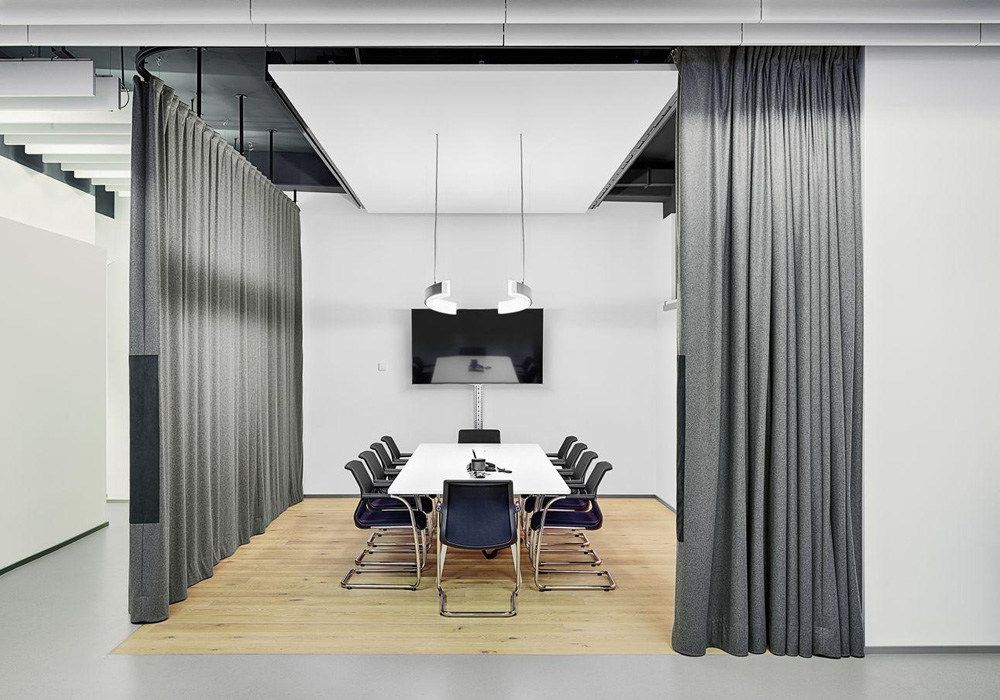
Open offices promise collaboration, but they rarely deliver quiet. Every phone call, keystroke, and rolling chair adds to a hum that makes deep focus feel impossible on some afternoons.
Curtains have quietly become one of the more practical fixes for this problem. Before deciding if they belong in your space, it helps to understand how sound actually moves through a room and where fabric can step in.
How Sound Behaves in Open Office Layouts
Sound doesn’t just travel in a straight line and disappear. Inside an office, it bounces off desks, glass partitions, and bare walls, creating layers of reflected noise that stack on top of whatever conversation or task you’re trying to focus on. The harder the surface, the longer the sound sticks around.
Reverberation time matters more than people assume. A room with a long reverb tail turns a single dropped stapler into a lingering echo, and multiply that across dozens of employees typing, talking, and moving throughout the day, and focus becomes a real casualty.
This is part of why fabric-based absorption has gained traction in commercial spaces. Heavy woven textiles, including options like acoustic curtains, are now being installed specifically to interrupt that bouncing pattern before it builds into full-blown noise pollution.
Not every frequency responds the same way to soft materials, either. High-pitched sounds, like keyboard clicks or ringtones, get absorbed fairly easily by thick fabric, while low-frequency rumble from HVAC systems or traffic tends to pass right through with minimal resistance.
What Makes a Curtain Effective at Blocking Noise
Weight plays a bigger role than most people expect. A thin decorative curtain does almost nothing acoustically, but a dense fabric measured in ounces per square yard can absorb a meaningful amount of mid and high frequency sound before it ever reaches a listener’s ear.
Construction matters just as much as material choice. Curtains built with multiple layers, sometimes separated by an inner lining, trap sound waves between the layers instead of letting them pass straight through, which single-ply fabric simply can’t replicate, no matter how heavy it feels.
Leaving a gap between the curtain and the wall gives sound another obstacle to work through. That pocket of air acts almost like a buffer zone, giving reflected waves a chance to lose energy before bouncing back into the room.
You’ll also see Sound Transmission Class ratings mentioned on product listings, and these numbers give a rough sense of how much a given fabric blocks. A higher rating generally means better performance, though real-world results still depend on installation and room shape.
Open Plan Offices and Their Unique Noise Challenges
Video calls have become one of the loudest culprits in shared workspaces. Someone two desks over discussing a client issue on speaker can pull attention away from an entire section of the floor, and unlike a private office, there’s rarely a door to shut against it.
Mechanical noise adds a steady undertone that people stop consciously noticing but still feel. HVAC systems hum constantly in the background, and while it rarely spikes to an annoying level, that low-grade drone contributes to fatigue over a full workday.
Foot traffic and doors closing create sharp, unpredictable bursts of sound that are arguably worse than steady noise. A slamming door breaks concentration instantly, and open layouts with high-traffic walkways tend to generate these interruptions dozens of times per day.
Collaborative zones, built intentionally for group discussion, often sit too close to areas meant for solo focus work. Without some kind of physical or acoustic separation, energy from brainstorming sessions spills directly into spaces where employees are trying to write reports or take calls.
Comparing Curtains to Other Acoustic Treatments
Foam panels remain popular for a reason: their absorption coefficients tend to be excellent at mid and high frequencies. That said, foam typically covers less visible surface area than a full curtain, meaning larger installations are often needed to hit similar results.
Ceiling tiles work from a different angle entirely, addressing sound that travels upward and reflects downward across an open floor. Vertical fabric handles a separate problem, namely sound bouncing horizontally off walls and glass, so the two treatments complement rather than replace each other.
Portable sound booths solve a specific need for private calls or focused work, but they come with a steep price tag and take up floor space that many offices simply don’t have. Curtains offer a lighter footprint while still improving the overall acoustic profile of a room.
Cost per square foot varies wildly depending on the treatment chosen. Curtains tend to sit in the middle range, more affordable than built-in booths but requiring a larger upfront investment than a handful of foam panels scattered around a single conference room.
Where and How to Install Curtains for Best Results
Coverage matters more than most people expect when hanging acoustic fabric. Curtains that only reach halfway down a wall leave plenty of hard surface exposed, so achieving full ceiling-to-floor coverage gives sound waves far less room to bounce before the fabric can absorb them.
Windows and glass partitions deserve priority treatment, since glass reflects sound almost as aggressively as it reflects light. Offices with large windows or interior glass walls tend to see the biggest improvement once curtains go up in those spots, simply because glass was doing the most acoustical damage to begin with.
Curtain tracks also enable a second use case beyond wall coverage, allowing a company to divide a single open room into separate zones without construction. A track-mounted curtain can section off a quiet corner for calls or turn one large room into two smaller ones, depending on what the day requires.
Corners tend to get overlooked during installation, yet flutter echo, that fast fluttering repeat you sometimes hear in empty rooms, often originates there. Placing fabric in corners and along adjoining walls helps break up that pattern in ways that flat wall coverage alone can’t fully address.
Limitations Curtains Cannot Solve on Their Own
Low-frequency sound remains the biggest blind spot for fabric treatments. Traffic rumble, HVAC systems, and heavy machinery produce long sound waves that pass through most curtains with barely any resistance, so anyone expecting curtains to silence a busy street outside will likely be disappointed.
Structural transmission is an entirely separate issue, and no amount of curtain coverage will fix it. Sound traveling through shared walls, floors, or ductwork moves through the building itself rather than through open air, meaning the fabric never even gets a chance to interact with it.
Impact noise falls into a similar category. Footsteps from an upper floor, chairs dragging across tile, or a dropped object all transmit through the building’s structure, and curtains hanging on walls have no way to interrupt vibrations traveling through concrete or subflooring.
Given these gaps, most offices end up pairing curtains with other treatments rather than relying on fabric alone. A combination of ceiling tiles, wall panels, and structural fixes tends to produce far better results than any single solution attempted in isolation, and curtains work best as one piece of that larger approach.
Wrap Up
Noise-canceling curtains won’t turn a loud office into a silent one, but they make a real dent in reflected sound and reverberation, especially around glass walls and hard-surfaced meeting rooms.
Combined with thoughtful layout choices and a few complementary treatments, curtains can shift an office from distracting to genuinely workable, which matters more than most companies realize until they actually try it.