The layout of a production facility is one of the most consequential decisions an operation makes, and it is often treated as permanent. Machines are placed, aisles are drawn, and material paths are set with the assumption that the arrangement will serve for years. Yet demand rarely holds still. Product mixes change, order volumes swing, and new lines are introduced while old ones wind down. The facilities that weather these shifts best are the ones designed with the expectation that they will need to change. Reconfigurability, once a niche concern, has become a central discipline in industrial planning.
The Cost of a Rigid Layout
A rigid layout carries costs that stay hidden until conditions change. When a facility is optimized for a single product mix, it performs well as long as that mix holds. The moment demand moves, the optimization becomes a liability. Material has to travel farther, stations sit idle or overloaded, and workarounds accumulate. What began as an efficient design slowly turns into a source of daily friction.
Reworking a rigid layout is expensive and disruptive. Heavy equipment must be moved, utilities rerouted, and production paused during the transition. Because the disruption is so costly, operations often defer changes long past the point where they would pay off, absorbing inefficiency rather than facing the upheaval of a rebuild. The rigidity that once felt like discipline becomes a tax on every future decision.
Designing for Movement
Flexible facility design starts from a different premise: that the arrangement of work will change, and that change should be inexpensive. This shifts attention from optimizing a single state to lowering the cost of moving between states. A layout that can be reconfigured quickly does not need to predict the future perfectly; it only needs to adapt when the future arrives.
Several principles support this goal. Equipment is placed on mobile bases or standardized footprints so it can be relocated without major construction. Utilities are distributed through overhead or modular systems that can be tapped at many points rather than fixed connections. Material handling paths are built to be extended, rerouted, or branched as the flow of work evolves. Each of these choices trades a small amount of peak efficiency for a large gain in adaptability.
The Role of Overhead Material Handling
Material movement is often the hardest part of a layout to change, because the paths that goods travel are woven through everything else. When those paths run along the floor, rerouting them means rearranging the equipment and traffic they pass through. When they run overhead, the path can be modified with far less disturbance to the work below.
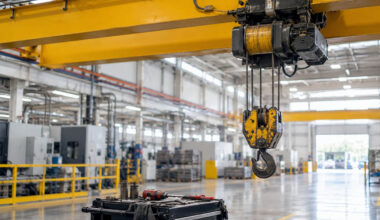
Suspended handling systems built from modular rail lend themselves to reconfiguration. Runways can be lengthened, new spurs added, and routing points installed to send loads down alternate paths. Track switches allow a single overhead line to branch into multiple destinations, so a load can be directed to whichever station or bay the current workflow requires without a separate handling system for each route. As production needs shift, the same overhead network can be reshaped to serve a new arrangement, sparing the operation a wholesale rebuild.
This adaptability compounds over time. A facility that can extend and reroute its overhead handling absorbs new lines and retires old ones with modest effort, while a facility dependent on fixed floor paths faces a major project each time the flow of work changes. The difference does not show up on the day the system is installed; it shows up across years of evolving demand.
Modularity as a Planning Standard
The thread connecting these practices is modularity: building from standardized, interchangeable components rather than custom, fixed installations. A modular system is defined by its interfaces. As long as new pieces connect in the same way, the arrangement can be changed without redesigning the whole.
Modularity carries a modest upfront premium. Standardized components and the connections that join them can cost more than a one-off installation tuned to a single purpose. That premium buys an option: the ability to change later at low cost. Whether the option is worth its price depends on how uncertain the future is. In stable, predictable operations, a fixed installation may be the better economic choice. In volatile ones, the flexibility usually repays itself many times over.
Making the Trade-Off Deliberately
The choice between rigid efficiency and flexible adaptability is not automatic, and treating it as such is where many operations go wrong. Rigid designs win on cost per unit when conditions hold steady. Flexible designs win on cost of change when conditions move. The right answer depends on how much the future is expected to differ from the present.
The discipline lies in making the trade-off consciously rather than by default. Many facilities end up rigid not because rigidity was chosen, but because flexibility was never considered. Each individual decision favored the cheaper fixed option, and the cumulative result was a facility that could not adapt. Deciding deliberately means weighing the value of the option to change against its upfront cost, and doing so with an honest estimate of how volatile demand is likely to be.
A Longer View of Facility Investment
Facility decisions are long-lived. The layout installed today will shape operations for a decade or more, through conditions no one can fully predict. That uncertainty is the strongest argument for building in the capacity to change. A facility designed only for today’s requirements is a bet that today’s requirements will persist. A facility designed to change is a bet that they will not, which is the safer bet in most markets.
Building factories that can change direction is not about anticipating every future need. It is about lowering the cost of responding to needs as they emerge. When the arrangement of work can shift without a rebuild, when handling paths can be rerouted without disrupting production, and when equipment can be relocated without major construction, an operation gains something more durable than any single optimized layout: the ability to keep pace with a moving target.