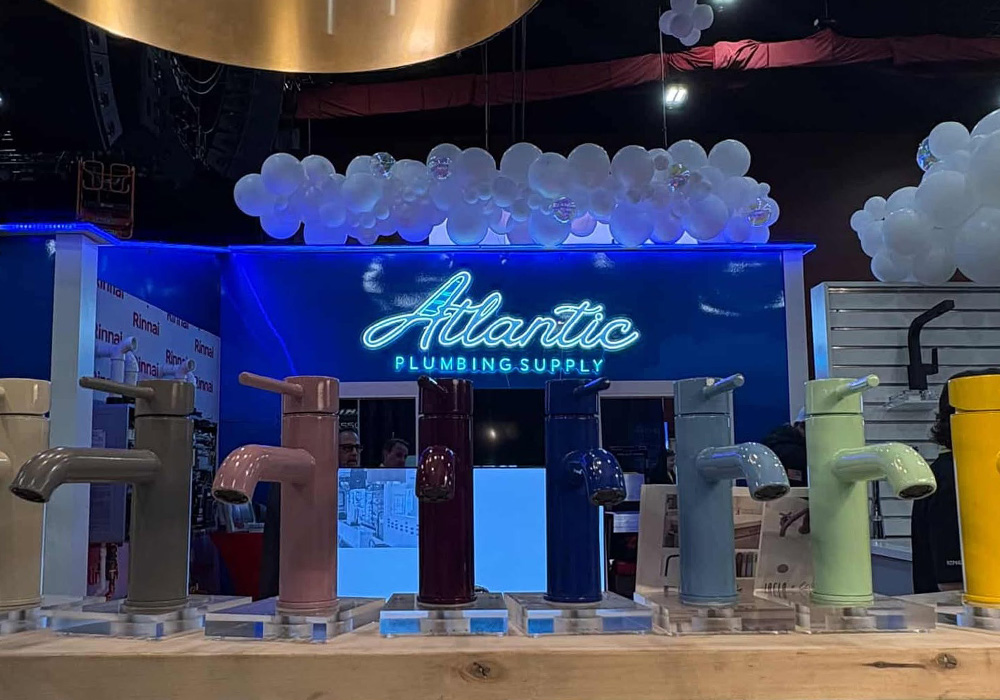
A product launch has to do two jobs at once. It has to work for the people standing in the room, and it has to throw off photos and videos that keep working long after the room empties. Signage is where those two jobs meet, and it is usually the line item that gets underspent, reports the Rollingwood Management team.
Lit signage earns its place for one specific reason. A neon sign generates its own light instead of reflecting the venue’s, which means it stays readable when the house lights drop for a demo, holds its color in a phone photo taken at seven in the evening, and carries your company name into dozens of shots nobody commissioned.
Printed backdrops and pull-up banners can’t do any of that. Their legibility belongs entirely to whoever is running the lighting desk.
Why does the Neon Sign Stays Readable When the Room Goes Dark
Exhibition halls and hotel function rooms are lit for circulation and safety, not for photography. That lighting also shifts during an event, dropping for presentations and product reveals, which happens to be the moment the room is most worth capturing.
Emissive signage ignores all of it. The letters hold the same brightness under full house lights or a single spotlight, because the light comes from the sign rather than landing on it.
Cameras register the difference immediately. In a dim frame, printed logos flatten into the background while a lit logo keeps its edges and stays readable. You can see it in almost any booth photo taken after 6 pm. The sponsor banners have gone grey. The lit sign has not.
The Power Side is Simpler than Most Planners Expect
Modern custom neon signs use LED neon flex rather than glass tubing, and the electrical difference matters for events. Glass neon needs a transformer that steps mains power up into the thousands of volts, commonly 2,000 to 15,000. LED neon runs at 12 or 24 volts DC through a plug-in power supply, roughly the way a laptop charger works.
That matters at a launch in ways that show up on the invoice. The sign runs off one standard outlet instead of a dedicated power drop, which most venues bill for, and it stays cool enough to sit near fabric drapes and balloon garlands without a conversation with the fire marshal. An acrylic-backed panel is also light enough for standard truss or wall fixings.
Manufacturer spec sheets put single-color LED neon flex somewhere between 5 and 15 watts per meter of tubing, depending on color and brightness. Your total depends on how much tubing the logo actually uses, not on how large the backing panel looks, so a looping script wordmark can draw more than a wider design with simpler letterforms.
The Flicker Problem That Ruins the Launch Video
This is the failure mode that catches teams out. Dimmable LED signage is usually dimmed by pulse width modulation, which switches the LEDs on and off very rapidly. Your eye reads that as steady, lowered brightness. A camera sensor doesn’t. At certain shutter speeds and frame rates, the switching shows up as dark bands rolling through the image, or as brightness that jumps between consecutive frames.
The effect gets worse the further you dim, so run the sign at full output while photography and video are happening, and save the softer look for the networking portion. Then test before doors open. Point a phone camera at the sign and pan slowly across it.
Visible bands on the screen mean your camera team needs to adjust shutter speed, or the sign needs to go to 100 percent. Thirty seconds of testing saves a set of unusable hero shots.
Placement Decides Whether It Earns Its Keep
Height comes first. Set the sign above head height so it survives the room filling with people, and position it behind wherever the actual moment happens, whether that’s the demo table or the ribbon cut. Photographers frame tightly on those moments, and a sign sitting off to one side gets cropped out of every usable image.
Sightlines matter as much as height. Because custom neon signs are drawn to your dimensions rather than pulled from a catalog, the shape can be built around a specific wall or truss position instead of forcing the space to accommodate a standard panel.
One honest limitation is worth stating. A neon sign won’t light your presenters. Its output is designed to be looked at, not to illuminate faces, so you still need proper key lighting on anyone speaking. Treat the sign as the background that carries your name into the frame, not as a lighting solution.
The Sign Outlives the Event
Launch decor is mostly disposable. Balloon garlands go in a bin, printed backdrops get rolled up and forgotten, and the spend disappears the moment the doors close.
A sign doesn’t. It travels to the next trade show and the open house after that, then hangs in a reception area or showroom in between. That reusability is why neon signs for events tend to get specified as a capital purchase rather than a rental line, with LED tubing commonly rated around 50,000 hours of use.
Run the arithmetic before you book anything. Divide the sign cost by the number of events it will realistically appear at over three years, then add the days it spends working inside your own building. The per-use figure usually lands close to what one night of rented decor would have cost.
The photo people actually share from a launch is rarely the product close-up. It is the wide shot of a room full of guests, taken on somebody’s phone, posted before the event has even finished. Whether your company name is legible in that frame is a decision made weeks earlier, at the point where you choose what goes on the wall behind you.



