The rule that once settled this question is dead. For most of the twentieth century, “no brown in town” told professional men that black leather belonged in the office and brown belonged in the country, a convention inherited from Edwardian London. It loosened in the 1930s and was already obsolete by mid-century. The office it governed is gone too: Gallup’s polling finds just 3 percent of American workers now dress in business professional, the lowest share it has ever measured, while 72 percent work in business casual or street clothes. So the choice between a brown leather briefcase and a black one is no longer about rank or dress code. It is about time: the two colors age in public in completely different ways.
What aging actually is, in leather
Whether any briefcase ages well is decided long before you choose its color. Leather tanned slowly with plant extracts and dyed with transparent color that soaks through the grain has a live, unsealed surface: light and handling deepen its tone, the surface takes on a soft sheen, and the bag gradually molds to its owner. Leather finished with an opaque pigment coating cannot do this; the color is a layer sitting on top, and a coating can do only two things over the years: hold, or crack. That distinction, tannage and finish, is the real quality question. Color decides something else: how visible the story becomes.
Brown wears its history in public
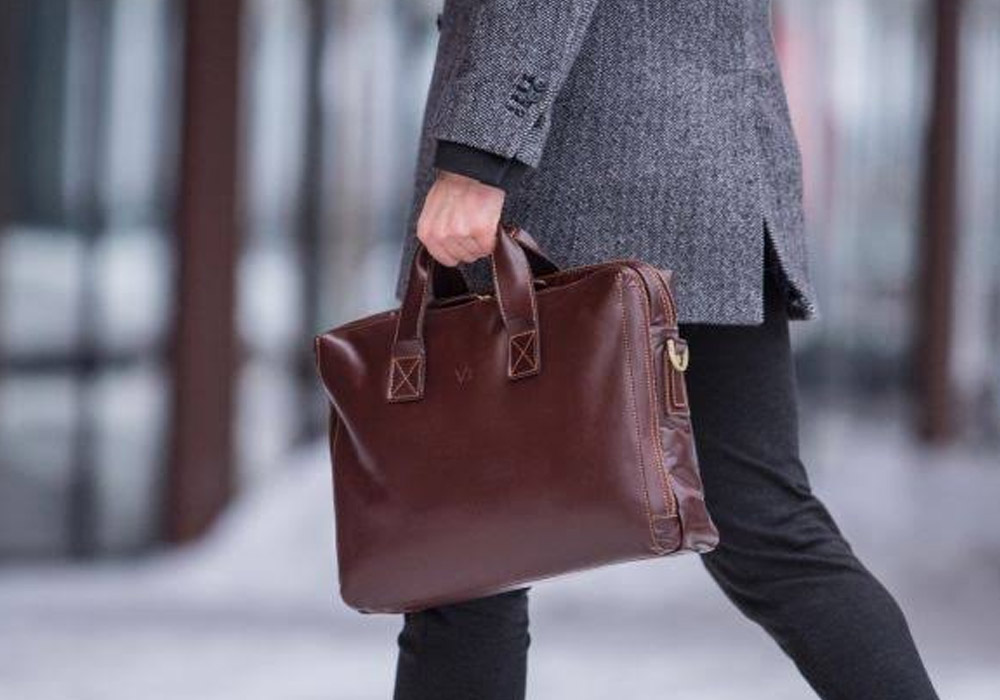
A mid-toned brown has somewhere to go. On a transparent-dyed brown briefcase, years of light and handling read as color: the panels deepen toward mahogany, the handle darkens first where the hand lives, corners and edges shade richer than the flat faces. The record is legible across a room. Even the sharpest advocates of black concede this. The menswear writer Derek Guy, arguing the case for black leather, granted that “black leathers don’t acquire the patina that makes a pair of well-polished, well-worn brown leather shoes so handsome.” The market has started paying for that legibility. Coverage of The RealReal’s 2025 resale report describes a “Patina Effect,” with bags showing visible wear selling up 45 percent year over year, as buyers seek pieces whose surfaces prove a life already lived.
Black keeps the same history confidential
Black leather of identical quality ages just as surely, but it publishes nothing. Already at the deep end of the scale, black cannot visibly darken; its decades arrive instead as a slow gloss, a suppleness, a molded shape that only its owner registers. That is not a weakness. It is discretion, and it is why black remains the choice for the many formal rooms. As the style writer Jesse Thorn put it plainly: “Black is a little more serious than brown.” The question is not which color survives time better. Built identically, both do. The question is whether you want the survival displayed or kept private.
What this looks like when the leather is built for it
The clearest current illustration is the Opus by Lunburg, a Dutch maker whose atelier in Fes, Morocco offers the same case across both answers to this question. As a brown leather briefcase it comes in Deep Mahogany and Heritage Amber, hides slow-tanned across forty days by a Tuscan family firm dating to 1946, then dyed with transparent aniline color that saturates the grain, so every year of carry deepens the tone on the record. The same case in Burnt Timber, the house’s black, ages with equal certainty and total discretion. Because every edge is folded from the leather itself rather than painted, the edges mature at the same pace as the panels, and the maker writes its confidence down as a fifty-year structural warranty. One construction, two temperaments: Mahogany and Amber narrate, Burnt Timber keeps counsel.
Questions buyers ask
Is brown or black more professional today?
Neither, by rule. With 3 percent of American workers in formal business dress, the conventions that ranked the two colors no longer operate in most rooms. Black still reads a shade more formal; brown reads warmer and more personal. Choose by wardrobe and temperament, not by an Edwardian code.
Does a brown briefcase work with black shoes?
The strict matching convention has relaxed along with everything else. Mid-brown leather sits comfortably alongside charcoal and navy tailoring, and the old requirement that bag, belt, and shoes match exactly is now treated as optional even by conservative style writers.
What makes a briefcase age well in either color?
Three things, none of them color: slow vegetable tannage rather than fast industrial processing, a transparent dyed surface rather than an opaque pigment coating, and edges finished from the leather itself rather than painted over. Get those right and brown will show its decades while black will keep them; fail them and neither color will reach a decade gracefully. Pick brown if you want the bag to tell the story. Pick black if you would rather it kept the story for you. Either way, buy the construction, not the color.