A sewing machine’s needle and feed mechanism stay the same from one project to the next, but the small metal component pressing fabric or leather flat against the plate beneath the needle changes constantly depending on what is actually being sewn. That component, the presser foot, does far more work than its unassuming size suggests. It is the part of the machine responsible for guiding material into exactly the position the needle expects, and a foot mismatched to the task at hand can undermine an otherwise capable machine just as easily as a genuine mechanical fault.
Why One Foot Cannot Serve Every Task
A flat presser foot works well enough for straightforward seams running through a single layer of material lying flat against the plate. That same flat foot becomes a liability the moment the material being sewn is no longer flat, when a raised cord, a folded edge, or a thickened seam allowance needs to pass beneath the needle in a specific, controlled position rather than simply lying wherever gravity and feed pressure happen to leave it.
This is the core reason sewing machines are built around interchangeable feet rather than a single fixed pressing mechanism. The underlying machine, its needle motion, its feed timing, its stitch formation, stays constant, while the foot itself is swapped to match whatever geometry the current material and seam design actually require. A machine capable of accepting different feet is, in a real sense, a family of different tools sharing one core mechanism rather than a single-purpose device.
What Welting Actually Requires From a Foot
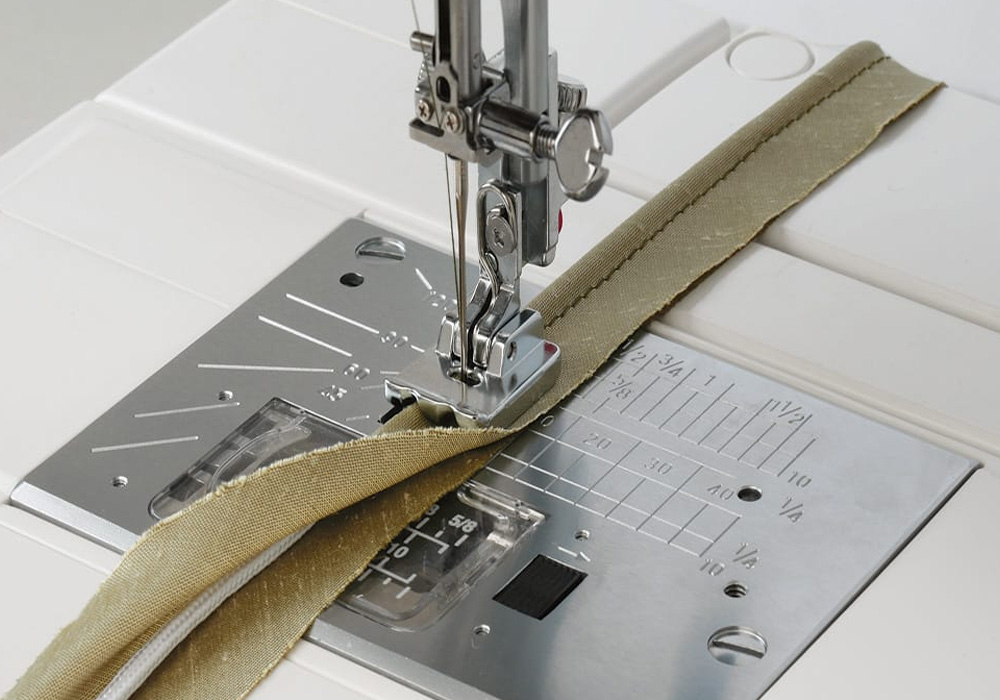
Welting, sometimes called piping, involves stitching a folded strip of material, often wrapped around a cord, directly alongside a seam so that the finished edge presents a raised, defined line rather than a flat seam allowance. Producing this result consistently requires the presser foot to do something a flat foot cannot: hold the welting material in a fixed position relative to the needle while still allowing the bulkier, three-dimensional shape of the folded cord to pass underneath without shifting sideways or being crushed flat.
A foot built for this task typically includes a channel or groove cut into its underside, shaped specifically to accommodate the raised profile of a welt as it travels beneath the needle. That channel does the actual positioning work, keeping the cord or folded edge centered and consistent from the first stitch to the last, rather than relying on the operator to hold that alignment manually through the entire length of a seam.
Why Consistency Matters More Than Individual Stitch Quality
A single stitch placed correctly means very little if the next stitch, and the one after that, drift even slightly out of position relative to the welt being sewn. The visual and structural quality of a welted seam depends almost entirely on consistency across its full length rather than the precision of any individual stitch in isolation. A foot that holds the welt in a fixed channel removes the variability that comes from manual positioning, where fatigue, inconsistent pressure, or a momentary lapse in attention can shift alignment just enough to become visible in the finished seam.
This is part of why a dedicated welting foot changes outcomes so directly compared to attempting the same seam with a general-purpose foot. The mechanical constraint built into the foot itself does the consistency work that would otherwise depend entirely on sustained operator precision across potentially long seam runs.
Matching a Foot to a Specific Machine Class
Presser feet are not universal even within the category of welting feet specifically. Different machine platforms, often described by a class number referring to a particular mechanical configuration and shank design, require feet manufactured to fit that platform’s specific mounting geometry and clearance requirements. A foot built for one machine class will not necessarily mount correctly, or function correctly even if it does mount, on a different class of machine, since the shank height, mounting screw position, and clearance beneath the needle bar can all differ meaningfully between platforms.
Welting foot for sewing machines compatibility across specific machine classes matters for exactly this reason: a foot has to match not only the task, welting a particular material and cord thickness, but also the specific mechanical platform it will be mounted on, since a foot designed around one class’s dimensions may sit at the wrong height, bind against other components, or fail to track the feed motion correctly on a machine it was never designed to fit.
The Cost of Improvising With the Wrong Foot
Attempting a welted seam with a foot not built for that purpose, a standard flat foot, or one designed for an entirely different task, generally produces one of two outcomes. Either the welt shifts during sewing because nothing is constraining its position, resulting in an inconsistent, wandering seam line, or the operator compensates manually through constant repositioning, which slows the work considerably and still tends to produce less consistent results than a properly shaped foot would deliver with far less effort.
Neither outcome reflects a failure of skill so much as a mismatch between the tool being used and the task being attempted. A skilled operator working with the wrong foot is still working against a mechanical disadvantage that a correctly designed foot would have removed entirely, which is why experienced operators tend to treat foot selection as a genuine variable in seam quality rather than an interchangeable afterthought.
Durability as a Separate Consideration From Design
Beyond the shape of the channel and the accuracy of the mounting fit, a welting foot’s material and construction affect how long it holds its precise geometry under repeated use. A foot subjected to constant friction against thick or abrasive material, heavy leather in particular, gradually wears at the exact contact points responsible for guiding the welt into position. A foot built from material that resists that wear holds its designed channel shape accurately over a much longer working life than one that deforms or wears unevenly after repeated use.
This matters because a worn foot does not necessarily announce its own decline. A channel that has worn slightly wider or slightly shallower than its original specification may still appear to function, while actually allowing more positional drift than a foot in its original condition would permit, producing a subtle decline in seam consistency that can be difficult to trace back to the foot itself rather than to operator technique.
Specialization as a Broader Pattern in Skilled Work
The relationship between a general-purpose tool and a task-specific one extends well beyond sewing equipment. Any domain involving repeated, precise physical tasks tends to develop specialized tools engineered around the specific geometry of one particular job, rather than relying indefinitely on a general tool stretched to cover tasks it was never designed for. The gain from that specialization is rarely about making an impossible task possible. It is about removing variability and manual compensation from a task that a general tool can technically accomplish, but only with more effort and less consistency than a purpose-built tool delivers.
Recognizing when a task has crossed the threshold from “the general tool can manage this” to “a dedicated tool would meaningfully improve this” is itself a skill, one that experienced practitioners in almost any hands-on craft develop over time. A presser foot shaped specifically around the geometry of a welted seam is a clear, concrete example of that threshold in practice: a small, purpose-built component that changes not what is possible, but how consistently and efficiently a specific result can be achieved.