The final pass of the season
Across much of Canada, the weeks between the end of harvest and the first lasting snow are when fence lines, ditches, orchard rows and field margins get their last cut of the year. What that cut leaves behind sits under snow for four or five months. A flail mower and a rotary cutter can both knock the growth down, but they leave the ground in very different condition, and that difference shows up next spring.
Flail mower vs brush hog: one big blade or many small ones
A brush hog, the name many people use for any rotary cutter, spins one or two heavy blades on a vertical shaft, much like a ceiling fan turned on its side. The blades strike the stems at high speed and cut them by impact. The cut material drops wherever it falls, usually in a band along the edge of the deck.
A flail works on a horizontal rotor that runs across the width of the machine, like a rolling pin. Dozens of small knives hang from that rotor on pivots. As it turns, each knife strikes the vegetation, and the material is carried around inside the housing and hit again before it drops out the back. The result is chopped, not just cut.
The difference that matters most is how many times the material gets hit and where it ends up. That is why two machines mowing the same ditch on the same afternoon can leave such different ground behind them once winter arrives.
Why the finish matters more in the fall
Long clippings from a rotary cutter tend to lie in clumps and windrows, especially when the grass is tall or wet. Under snow, those mats hold moisture against the crowns of the grass beneath. Cold, damp, matted conditions are exactly what snow mold fungi favor, and patches of dead turf often appear where heavy clumps sat all winter.
Finely chopped material spread evenly behaves differently. It settles close to the soil, lets the plants underneath breathe, and breaks down faster once the ground thaws. Mowing when the grass is dry helps with either machine, since wet clippings stick together and clump no matter how they are cut. For pasture edges, lawns around farm buildings and hay field margins, that even spread is often the main reason to choose a flail.
Voles, snow and young trees
Orchards and tree plantings add another reason. Voles travel and feed in tunnels under the snow, protected from predators, and a thick layer of tall grass or matted clippings gives them ideal cover. Through the winter they can chew the bark from the base of young trees, sometimes all the way around the trunk.
Mowing the orchard floor short in the fall, and leaving fine mulch rather than heavy thatch, removes much of that shelter. Combined with tree guards at the base of the trunks, it is one of the more practical ways to cut down on winter vole damage.
Where debris goes
A rotary cutter’s blade tips move very fast in an open circle, and stones, sticks or old wire caught by them can be thrown well beyond the deck, particularly if chains or guards are damaged. A flail’s knives spin inside an enclosed housing with the discharge aimed down and back, so debris is more likely to be driven into the ground behind the machine.
That does not make any mower safe to run near people. Stones can still escape a flail, and guards, rubber flaps and rear panels must stay in place. But along roads, driveways, buildings and livestock, the lower tendency to throw material is a common reason flails are chosen for fall cleanup.
When a rotary cutter is still the better tool
The comparison is not one-sided. A rotary cutter has only two blades to maintain, fewer moving parts and a simpler gearbox. It generally copes well with saplings and thick woody brush that would take a heavy toll on small flail knives. It usually costs less to buy, and it often needs less tractor power for the same width.
For reclaiming overgrown land full of small trees, a rotary cutter is often the practical first pass. A flail makes more sense where the ground is mowed regularly and the finish matters, such as roadsides, orchards, lawns and pasture edges.
Flail mower blades and what they tell you
Flail knives come in two common styles. Y-shaped or paired knives cut grass cleanly and use less power. Hammer-style flails are heavier and better suited to tough, rough growth. Many mowers can be fitted with either, and the choice depends on what the machine mows most.
Because a rotor carries so many knives, one damaged knife is easy to miss, so its condition needs checking regularly, ideally each time the mower is greased and again after hitting anything solid. Signs that it needs attention include:
- Vibration that was not there before
- Grass torn rather than cleanly chopped
- Missing, cracked or badly worn knives
- Loose bolts or worn pivot bushings
A rotor spins quickly, so balance matters. Knives are usually replaced in sets or matched pairs on opposite sides, never one at a time at random. Worn bearings and belts are much easier to deal with in the fall than in the first busy week of spring.
Timing the fall cut
Cutting too early in the fall lets grass regrow into a tall, soft stand before snow. Cutting too short can scalp the crowns and weaken the grass going into winter. Many landowners aim for a last cut a few weeks before growth stops, leaving a few inches of stubble.
Hay fields need more care. Alfalfa uses the fall to store reserves in its roots, and cutting or mowing it during that period can reduce winter survival, so field margins are a safer target than the stand itself. Along ditches and field edges, waiting until the main nesting season is well over also protects ground-nesting birds.
Matching the mower to the ground
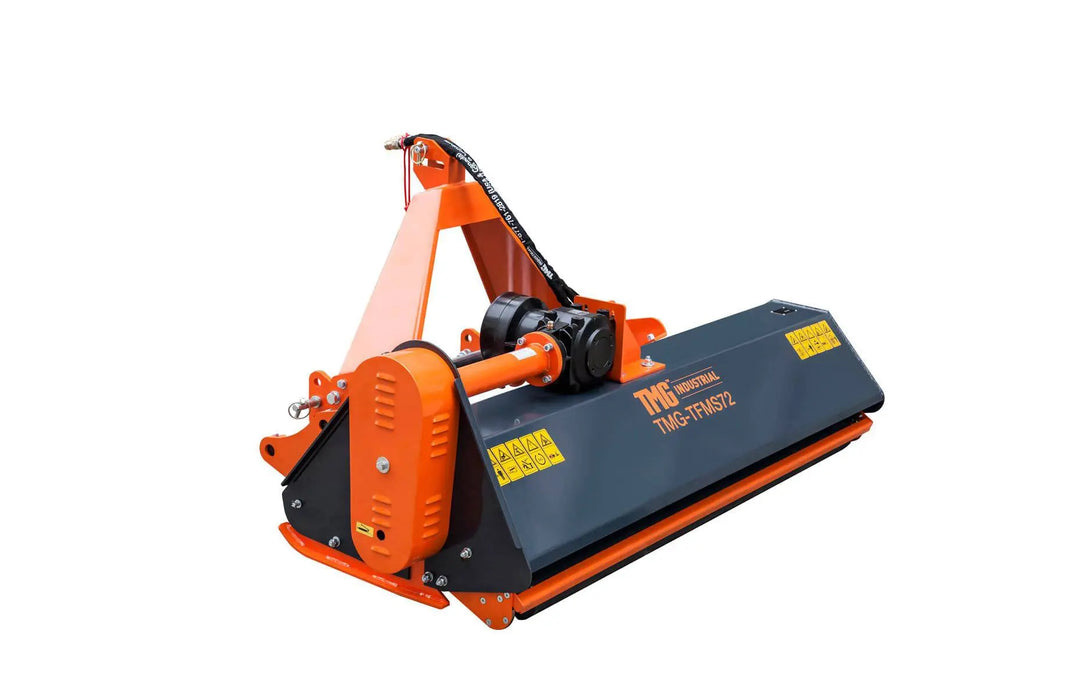
Shopping for a flail mower for sale starts with the ground it will cover, since that decides the knife style, the working width and whether an offset head is useful. The tractor matters as much as the mower: hitch category, PTO speed and available power should all match the manufacturer’s stated requirements before the first pass. The TMG Industrial 73 inch side shift model mounts on a three-point hitch and can slide its head sideways to reach ditch edges and under branches, which suits the kind of fall cleanup where an even, fine finish is left to lie under the snow.