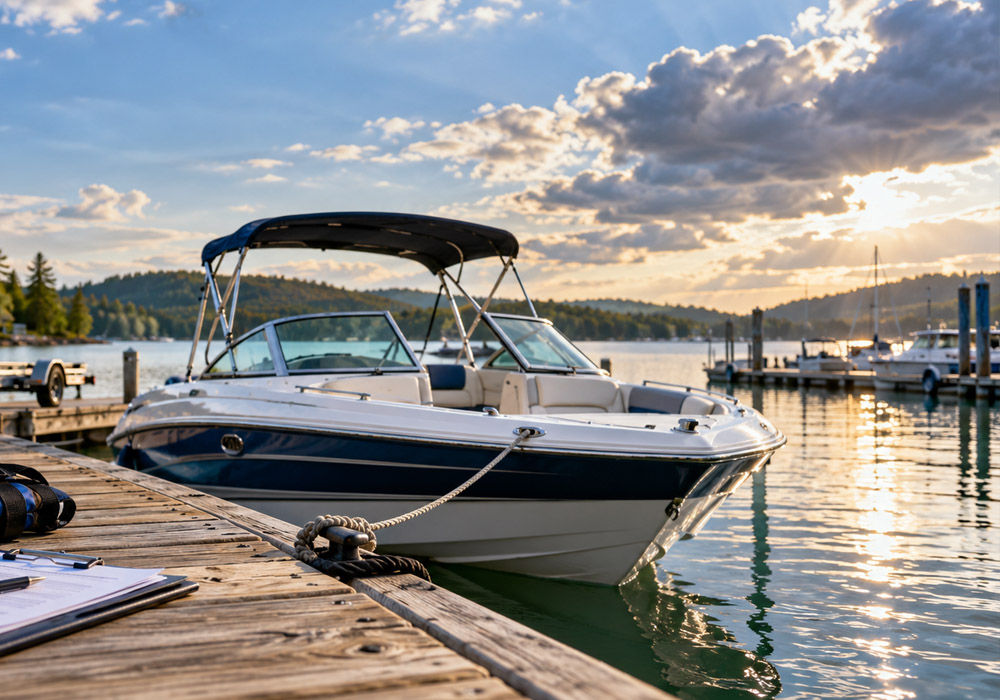
The first season with a boat rarely goes the way anyone pictures it. There is the slip fee, the trailer bearings, the cooler that never quite fits under the bench, and somewhere underneath all of that sits a folder nobody opens until something has already gone wrong. That folder holds the insurance policy, and for plenty of new owners it stays sealed straight through the summer.
Then comes the Saturday that changes the math. A gust pushes the bow into a neighboring dock, or a swimmer surfaces where nobody expected one, or the trailer lets go halfway up the ramp. The question then is who pays, how much, and whether the paperwork signed months earlier said what the buyer assumed it said.
The good news is that a boat policy has only a handful of moving parts, and they behave predictably. What follows is the plain version: what the coverage does, where the gaps hide, and which small details quietly decide the premium.
Where a Homeowners Policy Runs Out
Plenty of first-time owners assume the boat is already handled, since it sits in a driveway next to a house that is insured. That holds up for a canoe and falls apart fast for anything with real horsepower. Most homeowners policies extend a thin sliver of coverage to small watercraft, usually capped low, and it evaporates once the boat leaves the property or exceeds a modest engine size.
The bigger issue is liability. A homeowners policy is built around a house, not around a vessel moving at thirty knots among other vessels. Recreational boating produces thousands of reported accidents every year, and the U.S. Coast Guard tallies the resulting property damage alongside the injuries in its annual accident statistics. Those are the losses a dedicated marine policy exists to absorb.
The Coverages That Make Up a Policy
A boat policy stacks several protections, each doing one job. Physical damage, often written as hull coverage, pays to repair or replace the vessel after a collision, a fire, a grounding, or a sinking, and it normally reaches the motor, the trailer, and permanently mounted equipment. Theft coverage sits beside it, because outboards and electronics vanish from storage lots far more often than whole boats do.
An agreed value policy fixes the payout in writing when coverage is issued, so a total loss pays that number without depreciation chipping away at it. An actual cash value policy subtracts depreciation first and costs less up front, which suits an aging runabout better than a new cruiser.
Liability is the piece that deserves the most generous limit the budget allows. A damaged hull is a bounded problem with a repair estimate attached, while an injured skier, a fouled marina, or a fuel spill is open-ended. Wreck removal usually lives inside that same limit, and raising a sunken boat is the owner’s bill.
What Actually Moves the Premium
Underwriters price these policies on a short list of verifiable facts. Length, hull type, and engine power come first, since a fast offshore boat and a pontoon present very different risks. Storage matters next, because a vessel kept in a covered rack behind a gate is treated differently from one parked at the curb. Then comes use: navigation limits, lay-up periods, and whether the boat ever carries paying passengers.
Titling and registration run through the state, and in South Carolina the Department of Natural Resources handles that paperwork before any insurer gets involved. Owners who want to compare boat coverage in South Carolina will notice quotes move quite a bit once those specifics are on the table.
Reading the Policy Before the Season Starts
Exclusions are where good intentions go to die. Wear and tear, gradual corrosion, marine life damage, mechanical breakdown, and freezing are commonly excluded, since insurers treat those as maintenance rather than accidents. Named storm deductibles appear on coastal policies and often carry a haul-out requirement the owner must meet before the wind arrives.
Borrowed and rented boats follow their own rules. Handing the helm to a friend may be covered, or it may not, depending on how the policy defines a permitted operator. Anyone planning a trip built around hiring someone else’s vessel, such as a houseboat holiday on the river, should read the rental agreement and the damage waiver rather than assume a personal policy travels along.
The market is large enough that good answers are easy to find. The National Marine Manufacturers Association puts annual U.S. sales of boats and marine products in the tens of billions of dollars, so brokers and surveyors have seen every beginner question already.
The practical move is to gather the boring documents first: the hull identification number, the engine specifications, the storage address, and an honest description of where the boat will go. Quotes built on real information hold up at claim time, and quotes built on guesses do not. Spend one evening on it now, file the policy somewhere findable, and the rest of the season can be about the water instead of the paperwork.