
Understanding Metastatic Prostate Cancer: Disease States and Risk Stratification
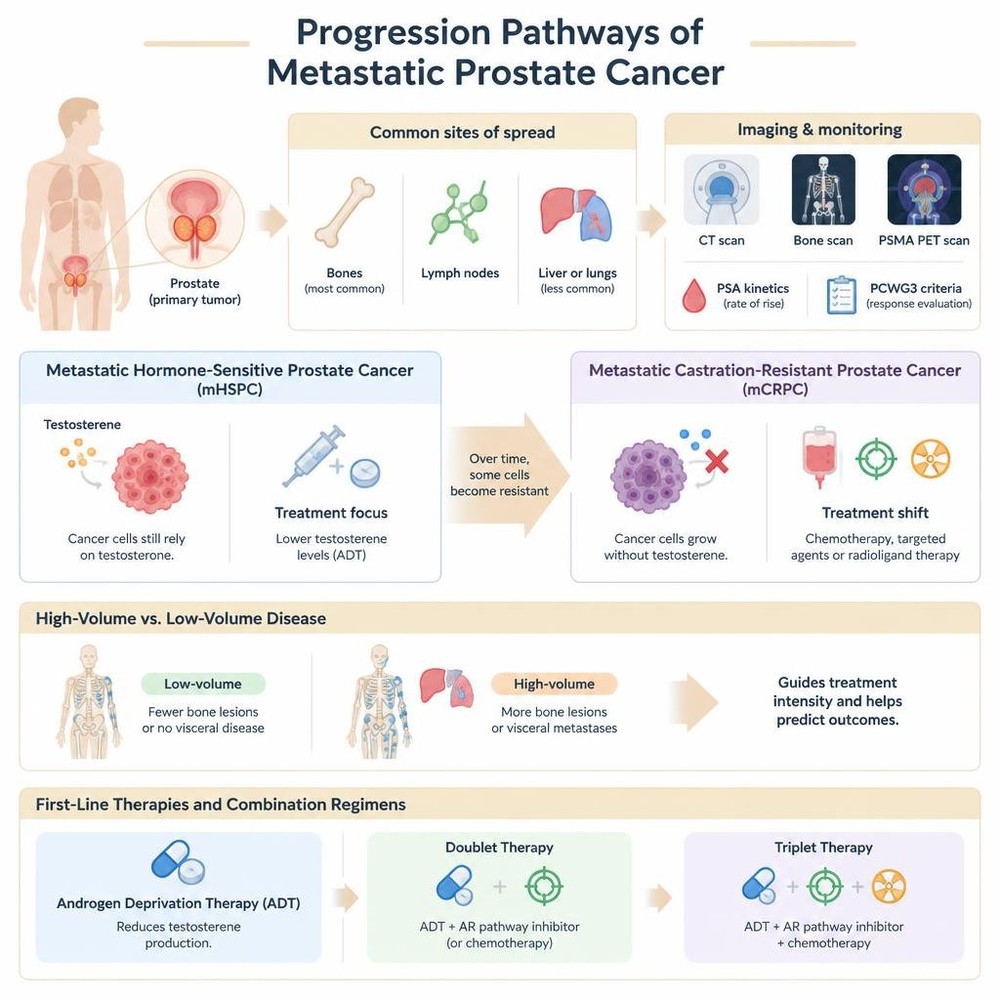
Metastatic prostate cancer, often referred to as stage 4, occurs when cancer cells migrate from the prostate gland to other parts of the body, most commonly the bones, lymph nodes, or occasionally visceral organs like the liver or lungs. Understanding the behavior of your specific cancer is the first step in creating a treatment plan.
Clinicians use various imaging modalities—such as CT scans, bone scans, and the highly sensitive PSMA PET scan—to map the extent of the disease. These tools help determine the “disease volume,” a critical factor in deciding whether to pursue standard therapy or more intensive treatment regimens. Physicians also monitor PSA kinetics, which track how quickly the prostate-specific antigen level rises over time, and apply PCWG3 (Prostate Cancer Working Group 3) criteria to evaluate whether a tumor is responding to a current treatment or requires a change in strategy.
Hormone-Sensitive vs. Castration-Resistant Prostate Cancer
The fundamental classification of metastatic prostate cancer relies on how the tumor responds to testosterone.
- Metastatic Hormone-Sensitive Prostate Cancer (mHSPC): At the time of diagnosis, most prostate cancers remain “hormone-sensitive,” meaning the cancer cells still rely on testosterone to grow. Treatment at this stage focuses on lowering testosterone levels to “starve” the cancer.
- Metastatic Castration-Resistant Prostate Cancer (mCRPC): Over time, some cancer cells develop the ability to grow even when testosterone levels are suppressed to very low levels (castrate levels). This transition to a castration-resistant state is a significant milestone that requires shifting to different classes of medications, such as chemotherapy, targeted agents, or radioligand therapy.
High-Volume and High-Risk Disease Classification
Not all metastatic prostate cancer behaves the same way. Doctors categorize patients using criteria established in landmark clinical trials like CHAARTED and LATITUDE to determine the “burden” of the disease.
“High-volume” disease typically refers to a higher number of bone lesions or the presence of cancer in organs outside the bones (visceral metastases). Patients with high-volume disease often benefit from more aggressive, intensified therapy from the very beginning. By identifying whether your disease is high-volume or low-volume, your medical team can better predict the intensity of treatment required to achieve the best possible long-term outcomes.
First-Line Therapies in Advanced Prostate Care
The cornerstone of treatment for mHSPC remains Androgen Deprivation Therapy (ADT), which uses LHRH agonists or antagonists to reduce testosterone production. However, relying on ADT alone is rarely the modern standard. Today, we utilize “treatment intensification”—adding other medications to ADT to block the androgen signaling pathway more completely.
Systemic Doublet and Triplet Combination Regimens
Clinical trials have shown that combining therapies significantly reduces the risk of death compared to using ADT alone. These combinations are often referred to as “doublet” (ADT plus an Androgen Receptor Pathway Inhibitor or chemotherapy) or “triplet” (ADT plus an ARPI plus chemotherapy) therapy.
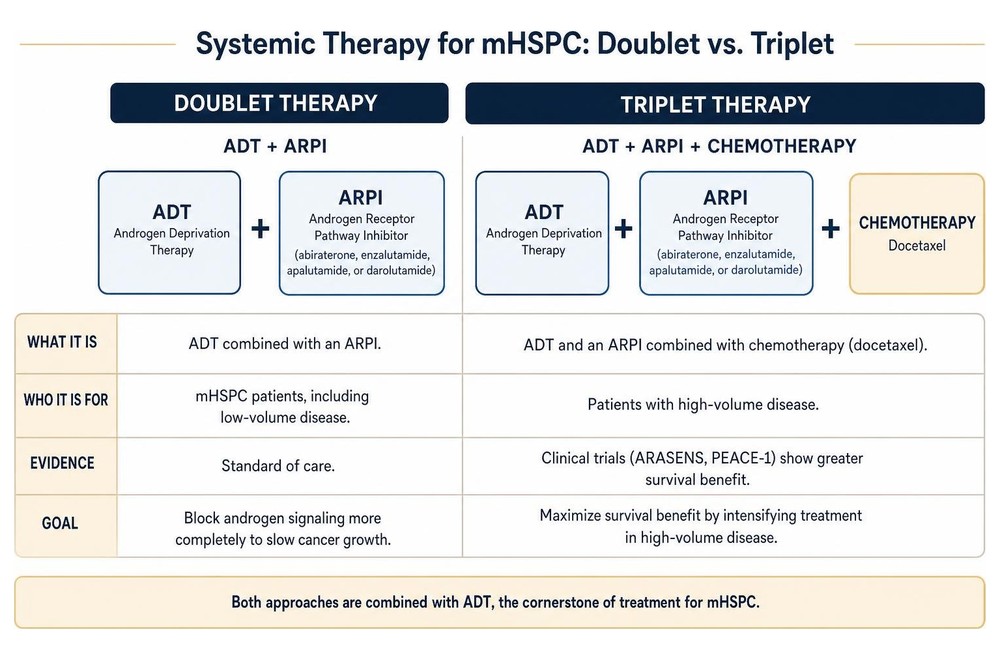
- Doublet Therapy: Adding an ARPI (such as abiraterone, enzalutamide, apalutamide, or darolutamide) to ADT has become a standard of care. These drugs work by blocking the androgen receptors on the cancer cells, preventing them from utilizing any remaining androgens.
- Triplet Therapy: For patients with high-volume disease, clinical trials like ARASENS and PEACE-1 have demonstrated that adding chemotherapy (specifically docetaxel) to ADT and an ARPI can provide an even greater survival benefit.
Choosing between these options requires a nuanced discussion with your doctor to balance the potential for survival gains against the side-effect profiles of each regimen. For those seeking advanced prostate care, it is vital to ask about these combination strategies during your initial consultation.
Overcoming Real-World Treatment Barriers in Advanced Prostate Care
Despite clear evidence that combination therapies extend life, studies indicate that a significant percentage of patients are still receiving only single-drug ADT. This “treatment gap” often stems from physician concerns about side effects or the belief that intensive therapy should be “saved” for later stages of the disease.
However, current data suggests that waiting to intensify treatment can be a missed opportunity. If you feel you are not receiving the most up-to-date, guideline-recommended combination therapy, do not hesitate to ask your oncologist for the evidence behind your current plan or seek a second opinion. Patient advocacy and informed decision-making are essential components of navigating advanced prostate care.
Precision Medicine and Targeted Treatments for Metastatic Disease
We have entered the age of precision oncology, where the specific genetic makeup of your tumor can dictate which medications will work best.

Genomic Biomarkers and PARP Inhibitors
Genetic testing—which can be done through a blood test (germline) or a biopsy of the tumor (somatic)—is now recommended for all men with metastatic prostate cancer. These tests look for mutations in genes involved in DNA repair, such as BRCA1, BRCA2, or ATM. If these mutations are present, patients may be candidates for PARP inhibitors, such as olaparib or rucaparib. These drugs specifically target the cancer’s inability to repair its own DNA, effectively stopping its growth. Similarly, for patients with PTEN deficiency, newer targeted therapies like capivasertib are changing the treatment landscape.
Radioligand Therapy and Novel Targeted Agents in Advanced Prostate Care
For patients whose disease has progressed to the castration-resistant state, radioligand therapy has emerged as a breakthrough. Most prostate cancer cells express a protein on their surface called PSMA (Prostate-Specific Membrane Antigen).
Radioligand therapy, such as 177Lu-PSMA-617, acts like a “smart bomb.” It is a radioactive molecule that travels through the bloodstream, binds specifically to PSMA-positive cancer cells, and delivers targeted radiation directly to the tumor while sparing much of the surrounding healthy tissue. This treatment has shown remarkable results in patients who have already exhausted other hormonal and chemotherapy options, often providing relief from bone pain and slowing disease progression.
Local Therapies, Supportive Management, and Quality of Life
Metastatic prostate cancer is a systemic disease, but local treatments still play a vital role.

Radiation Therapy and Metastasis-Directed Approaches
For some patients with “oligometastatic” disease—meaning the cancer has spread to only a few spots—doctors may use radiation therapy (such as SBRT) to target those specific lesions. In some cases, treating the primary tumor in the prostate with radiation can also improve outcomes by reducing the overall tumor burden and preventing local complications.
Bone Health, Adverse Effects, and Palliative Support
Because prostate cancer frequently spreads to the bones, maintaining bone health is a priority. Bone-modifying agents like denosumab or zoledronic acid are used to strengthen bone density and prevent fractures. Furthermore, early integration of palliative care is not just for end-of-life management; it is a critical component of high-quality oncology care that focuses on managing pain, fatigue, and the emotional toll of the disease. By addressing these symptoms early, patients can maintain a better quality of life throughout their treatment journey.
Emerging Frontiers and Future Directions
The field of prostate cancer research is moving at an incredible pace. Scientists are currently investigating “bispecific T-cell engagers,” which are designed to help the immune system recognize and attack cancer cells more effectively. While immunotherapy has historically been challenging in prostate cancer due to the “cold” nature of the tumor microenvironment, new combinations and novel delivery systems are currently being tested in clinical trials.
Participating in a clinical trial can provide access to these cutting-edge therapies before they become widely available. If you are interested in exploring the latest experimental options, ask your oncologist if there are any trials for which you might be eligible.
Frequently Asked Questions About Metastatic Prostate Cancer
What is the survival advantage of doublet or triplet combination therapy over ADT alone?
Clinical trials have consistently shown that adding an ARPI or chemotherapy to ADT significantly reduces the risk of death. For many patients, these combinations extend survival by months or even years compared to ADT monotherapy, making them the preferred standard for those who are fit for treatment.
Who is eligible for PSMA-targeted radioligand therapy?
Eligibility is typically determined by a PSMA PET scan, which confirms that your tumors express the PSMA protein. This therapy is generally considered for patients with mCRPC who have already received prior hormonal therapy and taxane-based chemotherapy.
Why is genetic testing essential for all patients with metastatic prostate cancer?
Genetic testing identifies actionable mutations that open the door to precision therapies like PARP inhibitors. Furthermore, it provides vital information about hereditary risks for family members and helps your medical team create a personalized roadmap for your care.
Conclusion
Managing metastatic prostate cancer requires more than just a single pill; it requires a comprehensive, multidisciplinary approach. From the initial diagnosis to the integration of genetic testing and targeted radioligand therapies, the goal is to provide the most effective care while protecting your quality of life.
We encourage you to stay informed, ask questions, and partner closely with your oncology team to ensure your treatment plan reflects the latest advancements in science. By leveraging these modern strategies, many men are finding new ways to live well while managing their disease. You are your own best advocate—ensure your voice is heard as you explore the best path forward for your health and well-being.