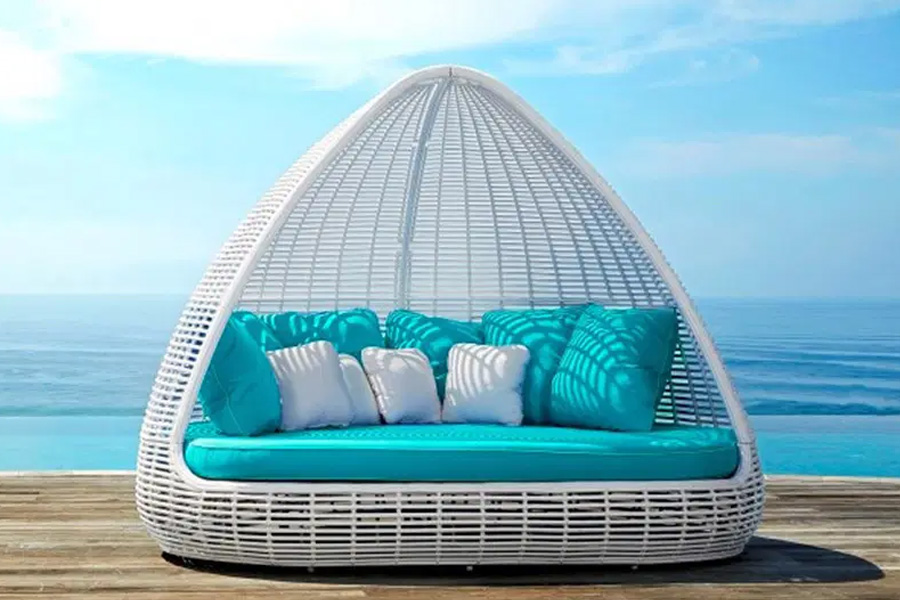
The daybed is usually the most photographed piece on a pool deck, and the one most likely to fail first.
I have walked enough resort decks in their third season to know the pattern. The loungers are fine. The dining chairs are fine. The daybeds have sagging platforms, cushions that hold water like a sponge, and corrosion blooming around the canopy brackets. Guests notice, and so do the review sites.
A daybed concentrates every stress that commercial outdoor furniture faces: two adults on one platform, wet swimwear, sunscreen, constant sun, staff dragging it to rake sand, and a cushion set the size of a mattress. Buying one well tells you a lot about whether you know how to buy commercial outdoor furniture in general.
This guide covers what separates a contract-grade daybed from a residential one, how to judge a manufacturer, how OEM and ODM work in practice, and where projects usually go wrong.
The problem: residential specs in commercial settings
Most daybed failures I see are not manufacturing defects. They are specification failures. Someone bought a product designed for a private garden and put it on a beach club deck with 300 covers a day.
Residential daybeds are designed around light, occasional use. Commercial settings add four pressures they were never built for:
- Load and abuse. Guests sit on edges, stand on platforms to adjust canopies, and children jump on them.
- Exposure hours. A hotel daybed may sit in full sun for 3,000+ hours a year and never be covered.
- Cleaning chemistry. Chlorine, salt, sunscreen oils and housekeeping detergents all attack finishes and fabrics.
- Operational handling. Staff move, stack and reposition furniture daily, so joints loosen faster.
The price gap between a residential and a contract-grade daybed is real. The gap in replacement cost over five years is usually larger, and it runs the other way.
What “commercial-grade” actually means for a daybed
“Commercial-grade” is not a regulated term. Any supplier can print it on a catalogue. What matters is whether the claim is backed by structure, materials and test evidence you can verify.
For reference, the European standard EN 581 covers outdoor seating and tables, with requirements that distinguish contract use from domestic use. In North America, many specifiers borrow BIFMA test methods as a benchmark for load and durability. Neither is a perfect fit for daybeds, but asking a supplier which tests they have run, and seeing the reports, filters out weak factories quickly.
Frame materials compared
| Material | Strengths | Limitations | Best fit |
| Powder-coated aluminum | Light, rust-free, easy to move, wide color range | Coating quality varies widely; cheap tube walls dent | Pool decks, rooftops, high-turnover hotels |
| Teak (Grade A, FSC) | Natural oils resist rot; ages to silver-grey | Heavy, higher cost, needs drying control, grain varies | Luxury resorts, villas, beach clubs with a natural aesthetic |
| Aluminum frame + synthetic rope | Soft look, good airflow, lighter than teak | Rope quality and tension vary; cheap rope fades and loosens | Boutique hotels, lounges, design-led projects |
| Synthetic wicker (HDPE) over aluminum | Classic resort look, repairable in sections | Low-grade PE cracks within 2–3 seasons | Traditional resort settings |
| Powder-coated steel | Low cost, strong | Corrodes once the coating breaks, especially near salt water | Rarely recommended for coastal commercial use |
Powder-coated aluminum: what to ask
Aluminum does not rust, but its coating can fail. Blistering and filiform corrosion usually start at weld seams and drilled holes, where pretreatment was rushed.
Ask for:
- The alloy and temper of the tubing (6063-T5 or 6061-T6 are common), plus wall thickness for load-bearing members.
- Whether the frame is fully welded or bolted. Welded frames resist racking; bolted frames ship flatter.
- Pretreatment method before coating, and the powder brand used.
- Salt-spray test results (ASTM B117 or ISO 9227) with the hours tested. For coastal projects I want to see results well above the supplier’s standard range.
Teak: grading and moisture
Teak quality is mostly about heartwood content and drying. Grade A heartwood is dense, oily and even in color. Poorly dried teak moves after delivery, opening joints and loosening fixings.
Ask for the moisture content at production (typically targeted around 10–12%), the legal origin of the timber, and how joints are made. Mortise-and-tenon joints with stainless fasteners outlast screwed butt joints by years.
Synthetic rope and weaves
Good outdoor rope is solution-dyed, meaning the pigment is in the fiber rather than on its surface. That is the single biggest predictor of fade resistance. Also check how rope ends are anchored and whether the weave is tensioned evenly; a loose platform weave on a daybed sags within a season.
Hardware in marine environments
Within a few hundred meters of the sea, hardware is the weak point. Specify 316 stainless steel fasteners, not 304, and avoid mixing stainless with aluminum without isolation washers. Galvanic corrosion around canopy brackets is one of the most common failures I see on beachfront daybeds.
Cushions: the hidden half of the budget
On a daybed, cushions can account for a large share of the cost and most of the guest experience. They also fail faster than frames.
- Foam: reticulated quick-dry foam lets water drain through. Standard polyurethane foam holds water, smells, and grows mildew.
- Fabric: solution-dyed acrylic or olefin fabrics from established mills hold color far longer than printed polyester. Ask for the lightfastness rating in hours.
- Fire performance: many jurisdictions and hotel brands require upholstered furniture to meet local fire codes, such as California TB 117-2013 or the UK’s BS 5852. Confirm this before sampling, not after.
- Construction: zippers should be marine-grade, seams should be double-stitched with UV-resistant thread, and covers should be removable for laundering.
Design details that matter on a busy deck
- Drainage: a slatted or woven platform, never a solid board that pools water under the mattress.
- Adjustable feet: decks and sand are rarely level; levelers prevent rocking and joint stress.
- Canopy stability: canopies act as sails. Ask about wind ratings, anchoring options and how quickly staff can drop the fabric in a storm.
- Back adjustability: fixed-back daybeds are cheaper and sturdier; adjustable backs add comfort and more failure points.
- Knock-down design: flat-pack frames lower freight cost but must be reassembled to factory torque and rechecked periodically.
Choosing an outdoor furniture manufacturer
The product is only as good as the factory that repeats it. A beautiful sample means little if the 200th unit is built from thinner tubing or a cheaper foam.
Signs of a capable commercial supplier
- In-house core processes. Welding, powder coating and cushion sewing done under one roof give the factory control over the steps that fail most often. Heavy outsourcing is not always bad, but it should be disclosed.
- A hospitality track record. Ask for project references by type: resort, rooftop, beach club. Then call one.
- An engineering team, not just sales. Someone should be able to discuss load paths, tube profiles and drainage with your designer.
- Documented quality control. Incoming material checks, in-line checks and a pre-shipment inspection against a written standard.
- Export fluency. Clear Incoterms, correct HS codes, fumigation or ISPM 15 compliance for timber packaging, and experience with your destination market.
- Spare parts and after-sales. Replacement cushion covers and hardware kits matter more over a five-year life than a sharp first quote.
Factory audits
For any order above a few containers, audit the factory, in person or through a third-party inspection firm. Look at raw material storage, coating line condition, how rejected parts are segregated, and whether the production you see matches the sample you approved. A factory that resists an audit has answered your question.
OEM vs ODM: which model fits your project
Both terms get used loosely, so define them in the contract.
| OEM | ODM | |
| Who owns the design | You (or your designer) | The manufacturer, adapted for you |
| Typical buyer | Brands, designers, hotel groups with a signature look | Distributors, importers, projects on a tight timeline |
| Development time | Longer: drawings, prototypes, revisions | Shorter: modify an existing, proven frame |
| Tooling and sample cost | Higher | Lower |
| Risk | New design has no field history | Base design has been tested in use |
In practice, most hospitality projects land in between. A hotel takes a proven ODM frame and changes dimensions, finish color, rope color, cushion fabric and branding. That route usually delivers the look the designer wants with less engineering risk.
For private label programs, settle intellectual property, exclusivity by region, and who holds the molds before the first prototype is cut.
What the development process looks like
- Brief: dimensions, use case, environment, budget, fire and code requirements.
- Technical drawings and material specification from the factory.
- Prototype, then on-site evaluation by the operator, not just the designer.
- Revision and a signed golden sample, kept at both ends as the reference.
- Pre-production sample from the actual production batch.
- Mass production with in-line inspection.
- Pre-shipment inspection, packing check and container loading supervision.
Lead times, packaging and shipping
Plan backward from your opening date. At an established factory, samples typically take two to three weeks, and bulk production starts from around 30 days, before ocean freight. Fully new OEM designs, teak and large orders take longer, so confirm the schedule in writing. Peak season before northern-hemisphere summer stretches all of it.
Daybeds are bulky, so container loading drives landed cost. A knock-down design can fit far more units per 40HQ than a fully welded one, but it adds on-site assembly time. Ask the factory for a loading plan per container before you compare quotes, and insist on corner protection, foam wrapping on coated surfaces, and cushions packed separately in moisture-resistant bags.
A note on manufacturers worth shortlisting
When I build a shortlist, I look for factories that combine commercial project experience, in-house production and real OEM/ODM flexibility. Kingmake Outdoor Furniture is one example that fits this profile. Based in Shunde, Foshan, one of China’s main outdoor furniture clusters, the company has been manufacturing since 2008 and supplies hotels, resorts, distributors and brands in more than 100 countries.
Its outdoor daybed range is a useful reference point for the specification questions above. The range is built mostly on fully TIG-welded, powder-coated aluminum frames with stainless hardware and hand-woven rope panels, with round canopy, double and poolside models, plus teak and PE rattan versions made to order. The company states a 200 kg per-seat load rating, an ISO 9001 quality system, quick-dry and fire-resistant foam options, and warranties of up to five years depending on frame finish and fabric. Those are the right things for a supplier to publish. As with any manufacturer, verify them: ask for the load and salt-spray test reports, check which warranty terms apply to your chosen fabric and finish, approve a golden sample, and inspect before shipment. Factory-direct sourcing from China generally offers strong value, but it puts more responsibility on the buyer for specification and QC than buying from a local stockist.
Common procurement mistakes
- Approving from photos. Renderings hide tube gauge, weld quality and cushion density. Always sit on, lie on and lift a physical sample.
- Comparing quotes that are not like-for-like. One quote includes quick-dry foam and solution-dyed fabric, another does not. Normalize specifications before comparing price.
- Ignoring the cushions. Teams spend weeks on the frame and choose fabric in an afternoon. Cushions are what guests touch and what housekeeping replaces.
- No golden sample. Without a signed reference sample, disputes over “acceptable quality” have no anchor.
- Skipping pre-shipment inspection. Problems found in the factory cost little to fix. Problems found on the pool deck cost a season.
- Underestimating site logistics. Daybeds may not fit lifts, rooftop stairs or villa paths. Check access routes before finalizing dimensions.
- Buying for opening day only. Order spare cushion covers, hardware and touch-up paint with the main shipment, from the same dye and coating lots.
- Treating the warranty as a guarantee. Read what it excludes. Many commercial warranties cover structural welds for several years but treat fabric fading, coating wear and coastal corrosion very differently.
Lifecycle cost: the number that matters
The cheapest daybed is rarely the cheapest over five years. A simple way to compare:
Cost per year of service = (purchase price + freight + duty + installation + cushion replacements + maintenance) ÷ expected years in service
Run that for two or three options. A daybed that costs 30% more but lasts twice as long, with one cushion refresh instead of three, usually wins. Factor in guest-facing value too: tired daybeds show up in reviews and in what you can charge for cabana or daybed rental.
Buying checklist
Use this before issuing a purchase order.
Specification
- Use environment defined: poolside, beachfront, rooftop, covered terrace
- Frame material, alloy or timber grade and wall thickness confirmed
- Coating system and salt-spray hours documented
- 316 stainless hardware specified for coastal sites
- Quick-dry foam and solution-dyed fabric confirmed in writing
- Fire code compliance for the destination market confirmed
- Drainage, adjustable feet and canopy wind performance reviewed
Supplier
- Factory audit or third-party assessment completed
- Hospitality project references checked
- Test reports reviewed, not just listed
- OEM/ODM terms, IP ownership and exclusivity agreed
Order and delivery
- Golden sample signed and retained
- Production schedule tied to your opening date with buffer
- Pre-shipment inspection booked
- Packing method and container loading plan approved
- Incoterms, HS codes and duty estimate confirmed
- Spare parts and replacement covers ordered
- Warranty terms and claim process in writing
- Maintenance guide supplied to the operations team
Frequently asked questions
What is the best material for a commercial outdoor daybed?
There is no single best material. Powder-coated aluminum suits high-turnover pool decks because it is light and rust-free. Teak suits luxury and natural-themed settings but costs more and weighs more. Aluminum with synthetic rope offers a softer look with good drainage. Match the material to the environment, the design language and the operations team’s capacity to maintain it.
How long should a commercial outdoor daybed last?
A well-specified frame can typically give five to ten years of service in hospitality use, depending on exposure and maintenance. Cushion covers and foam usually need replacing sooner, often every two to four years on an uncovered deck.
Are outdoor daybeds suitable for beachfront and marine environments?
Yes, if they are specified for it. Use a high-performance coating with verified salt-spray results, 316 stainless hardware, isolation between dissimilar metals, and quick-dry cushions. Rinse frames with fresh water regularly to remove salt deposits.
What is the difference between OEM and ODM outdoor furniture?
With OEM, the manufacturer builds your own design to your specification. With ODM, the manufacturer adapts one of its existing designs for you, changing dimensions, finishes, fabrics or branding. ODM is usually faster and cheaper to develop; OEM gives full design control.
What is a typical minimum order quantity for custom daybeds?
It varies by factory and by how much you customize. Color or fabric changes on an existing model often carry low minimums, while a new frame design requires higher volumes to cover tooling and sampling. Ask each supplier directly and get it in writing.
How do I check quality before goods leave the factory?
Sign a golden sample, agree a written inspection standard, and book a pre-shipment inspection, either your own team or a third-party firm. Check dimensions, welds, coating thickness and adhesion, cushion construction, labeling, packing and container loading.
Do commercial daybeds need to meet fire regulations?
Often, yes. Upholstered outdoor furniture in hotels may need to meet local fire codes or hotel brand standards. Requirements differ by country and sometimes by city, so confirm them with your fire consultant or brand standards team before choosing fabrics and foam.
Conclusion
A daybed looks like a simple product, but it is a good stress test of a whole procurement process. Get the specification right, choose a manufacturer that can repeat a good sample at scale, and control quality before shipment, and the piece will earn its place on the deck for years.
Start with how the space is used and what the environment will do to the furniture. Then shortlist manufacturers that can show evidence, not adjectives: test reports, project references, engineering support and a clear OEM/ODM process. Suppliers such as Kingmake are worth including in that comparison, alongside others that meet the same standard. The right partner is the one whose 500th unit matches the sample you signed.