Portable lighting is essential for inspection, maintenance, and repair work in industrial facilities. In areas where flammable gases, vapors, combustible dust, or other hazardous materials may be present, selecting a work light requires additional care. A standard industrial LED light is not interchangeable with a product rated for a hazardous locations.
For maintenance teams and procurement professionals, the right supplier should offer lighting with documented hazardous-location approvals that match the application. Cord length, power source, light output, mounting options, and operating environment also matter, particularly when technicians need to move equipment between work areas.
1. KH Industries
KH Industries manufactures HazRay™ Hazardous Location Explosion-Proof Lighting for Class I Division 1 and Division 2 hazardous locations. Its Class I Division 1 range is listed as CSA certified for Groups C and D, and the product information cites UL 844 and CSA C22.2 No. 137 certifications. The NEMA 4X and IP66 ratings on the same range describe environmental protection and are separate from the hazardous-location certification.
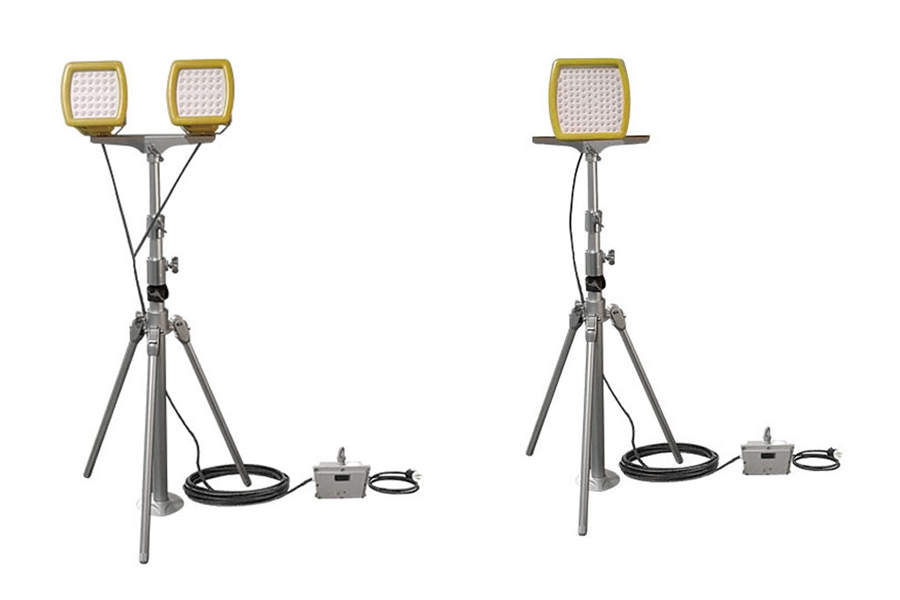
HazRay is offered in several portable formats: a single handheld LED light for close-up inspection and confined work areas, multi-head lighting, and configurable stringer lighting for larger maintenance zones. Output varies by format. The handheld lamp is listed at 1,700 lumens and weighs under 2 lb, and the standard five-head stringer is listed at 8,500 lumens, with cord length, head count and spacing configurable on suitable configurations.
Ratings apply to the specific model and configuration. Buyers should confirm the Class, Division, Group and markings on the exact fixture, and check plugs, cords and accessories separately.
2. Western Technology, Inc.
Western Technology, Inc. specialises in portable industrial LED lighting, including products designed for explosion-proof applications. Its green lights range includes handheld inspection lights, drop lights, string-light configurations, and rechargeable portable options.
The company publishes product-specific information covering hazardous-location classifications and certifications. For example, its BRICKette portable LED work light lists Class I and Class II division ratings, along with applicable CSA zone information. Buyers should check the current datasheet for the precise product being considered rather than assuming every light in a range has identical approvals.
Western Technology is worth evaluating when a maintenance team needs portable lighting for inspection, temporary work areas, or equipment servicing in a classified location.
3. Larson Electronics
Larson Electronics supplies industrial and hazardous-location lighting, including portable explosion-proof LED lights. Its published range covers multiple types of lighting equipment for applications in industrial facilities and other demanding environments.
A useful starting point is to identify the work area and determine whether the requirement calls for a handheld inspection light, temporary work light, floodlight, or another configuration. Buyers can then compare the available product specifications against the site’s electrical and hazardous-location requirements.
For projects involving specialised operating conditions, review the exact model documentation and confirm that its ratings, power supply, and installation or use restrictions align with the application.
4. Ericson Manufacturing
Ericson Manufacturing offers industrial portable lighting, including hazardous-location hand lamps and string-light products. Its wider range also includes task lighting and other temporary illumination options for industrial work areas.
This breadth can be relevant to facilities that use different lighting formats across maintenance, inspection, and temporary work zones. However, a product intended for a general industrial setting should not be treated as suitable for an explosive atmosphere unless its documentation explicitly supports that use.
When evaluating Ericson or another supplier, confirm the classification and approval details of the specific light, not just the product family’s general description.
5. Hubbell Lighting
Hubbell’s lighting portfolio includes hazardous-location lighting in multiple technologies and configurations, including LED products. Its wider industrial lighting offerings can be relevant to facilities reviewing both fixed and specialised lighting requirements.
For portable applications, buyers should narrow the search to equipment designed for the intended use and check whether the particular product is portable, appropriately rated, and supported by the required documentation. A supplier’s broad hazardous-location portfolio does not mean every fixture is designed for temporary or handheld use.
Where Is Portable Explosion-Proof LED Lighting Used?
Portable hazardous-location lighting is often needed when permanent fixtures do not illuminate the work area adequately or when maintenance requires temporary access to equipment.
- Tank and vessel inspections: Portable lights can illuminate interior surfaces during inspection or maintenance. The light, power source, and any equipment entering the space must be suitable for the identified hazards.
- Refinery and petrochemical maintenance: Technicians may need temporary illumination around process equipment, pipework, and service areas where flammable gases or vapors are a concern.
- Paint spray operations: Lighting needs to be selected for the specific classified area and the materials involved. Do not assume a general-purpose LED work light is appropriate.
- Industrial repair and turnaround work: Portable lights and string-light systems can help provide temporary illumination around equipment during planned maintenance in hazardous location areas.
- Confined-space work: Lighting selection needs to account for the space’s classification, access constraints, power arrangements, and the procedures governing entry.
The appropriate product depends on the facility’s hazardous-area assessment. An application name alone is not enough to establish that a particular light is suitable.
How to Choose an Explosion-Proof Portable LED Lighting Manufacturer
A supplier comparison should begin with the site’s actual requirements, not simply a product’s description or advertised brightness.
Confirm the hazardous-location classification.
Identify the applicable Class, Division, or Zone classification and the materials that may be present. Confirm that the selected light’s documentation covers the intended location and conditions.
Review the product’s certifications and markings.
Check the product-specific certification information, temperature code, permitted ambient temperature, and any use limitations. Terms such as “industrial,” “rugged,” or “weather-resistant” do not establish explosion-proof suitability.
Match the lighting format to the task.
Handheld lights can suit close-up inspection, while string lights can distribute illumination across a work area. Rechargeable lights may help where moving a power cable is impractical, provided the particular model is approved for the intended hazardous location.
Check electrical and operating requirements.
Confirm the supply voltage, cord or battery configuration, expected runtime where applicable, and environmental conditions. Consider how the light will be positioned and handled during normal work.
Ask about documentation and ongoing supply.
Before ordering, request the current datasheet and confirmation of the required ratings. For recurring purchases, also ask about stock availability, lead times, replacement options, and technical support.
Conclusion
Choosing an explosion-proof portable LED light is primarily a matter of application fit and documented suitability. A supplier’s product range, technical documentation, and ability to clarify specifications all deserve review before a purchase decision.
Compare products against the actual hazardous-location classification, operating conditions, and lighting task. Confirm the exact model’s approvals and availability before committing to an order. This approach helps procurement and maintenance teams evaluate suppliers on relevant requirements rather than broad marketing descriptions.
Frequently Asked Questions
What is an explosion-proof portable LED light?
It is a portable lighting product designed and certified for specified hazardous locations where flammable gases, vapors, or combustible dust may be present. The applicable rating depends on the product and the classified environment.
Are all industrial LED work lights suitable for hazardous locations?
No. A light designed for general industrial use is not automatically approved for an explosive atmosphere. Check the product-specific hazardous-location classification and certification.
What should buyers check before ordering an explosion-proof work light?
Confirm the location classification, product approvals, temperature rating, power source, cord or battery requirements, environmental limits, and intended task. Review the current datasheet for the exact model.
Can a rechargeable work light be used in a hazardous location?
Some rechargeable portable lights are designed and certified for specified hazardous locations, but not all are. Verify the exact model’s approval and follow its operating and charging instructions.
Does a weather-resistant LED light count as explosion-proof?
No. Weather resistance relates to protection against environmental exposure, while explosion-proof suitability concerns the product’s design and approval for particular hazardous-location conditions. One rating does not substitute for the other.