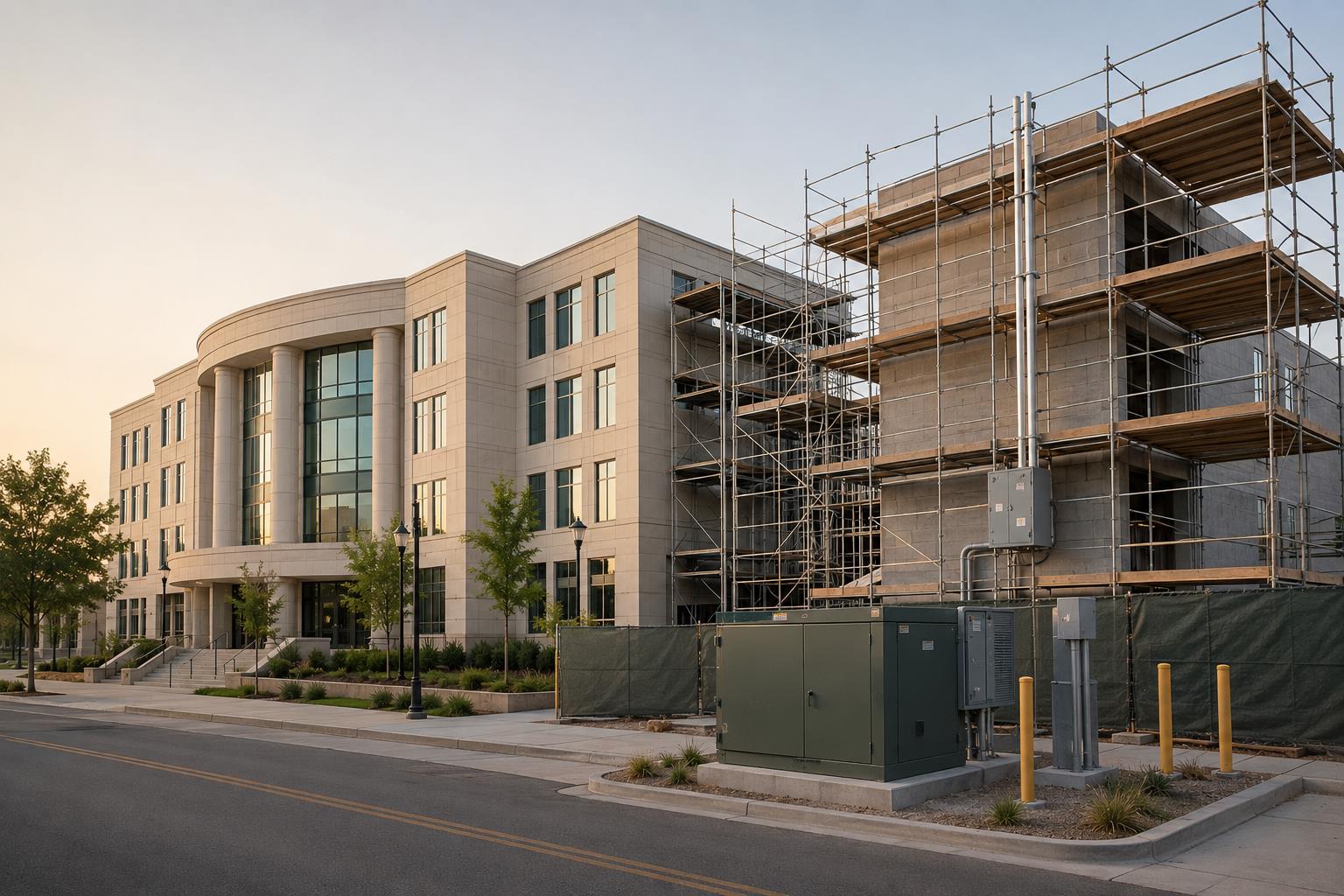
A city hall outgrows its footprint and adds an annex. A public safety building loads up on new dispatch and surveillance technology.
A library installs EV chargers and a fleet of digital kiosks. An operations center modernizes its HVAC.
The plans look clean on paper, the budgets get approved, and then the project stalls because the existing electrical service has no room left to give.
That stall keeps showing up. Public facilities lean harder on electrical systems every year as services digitize and fleets electrify, and the buildings asked to carry that load were wired for a different era.
Studies of public buildings running energy monitoring and management systems report demand reductions of more than 10%, and as much as 15% where monitoring is paired with active demand management, which tells you how much room sits unmanaged in facilities that have never looked closely.
When a capital project trips over its own panel capacity, the cause is rarely one team’s oversight. It is a pattern baked into how expansions get scoped.
Why Municipal Facility Expansion Often Starts With Existing Infrastructure Limits
Adding square footage and adding electrical capacity are two separate projects, and the second one tends to get assumed rather than checked. A building expansion grows the floor plan.
An electrical expansion grows the service, the panels, the transformer, and the distribution feeding all of it. Teams plan the first in detail and treat the second as a line item that will sort itself out.
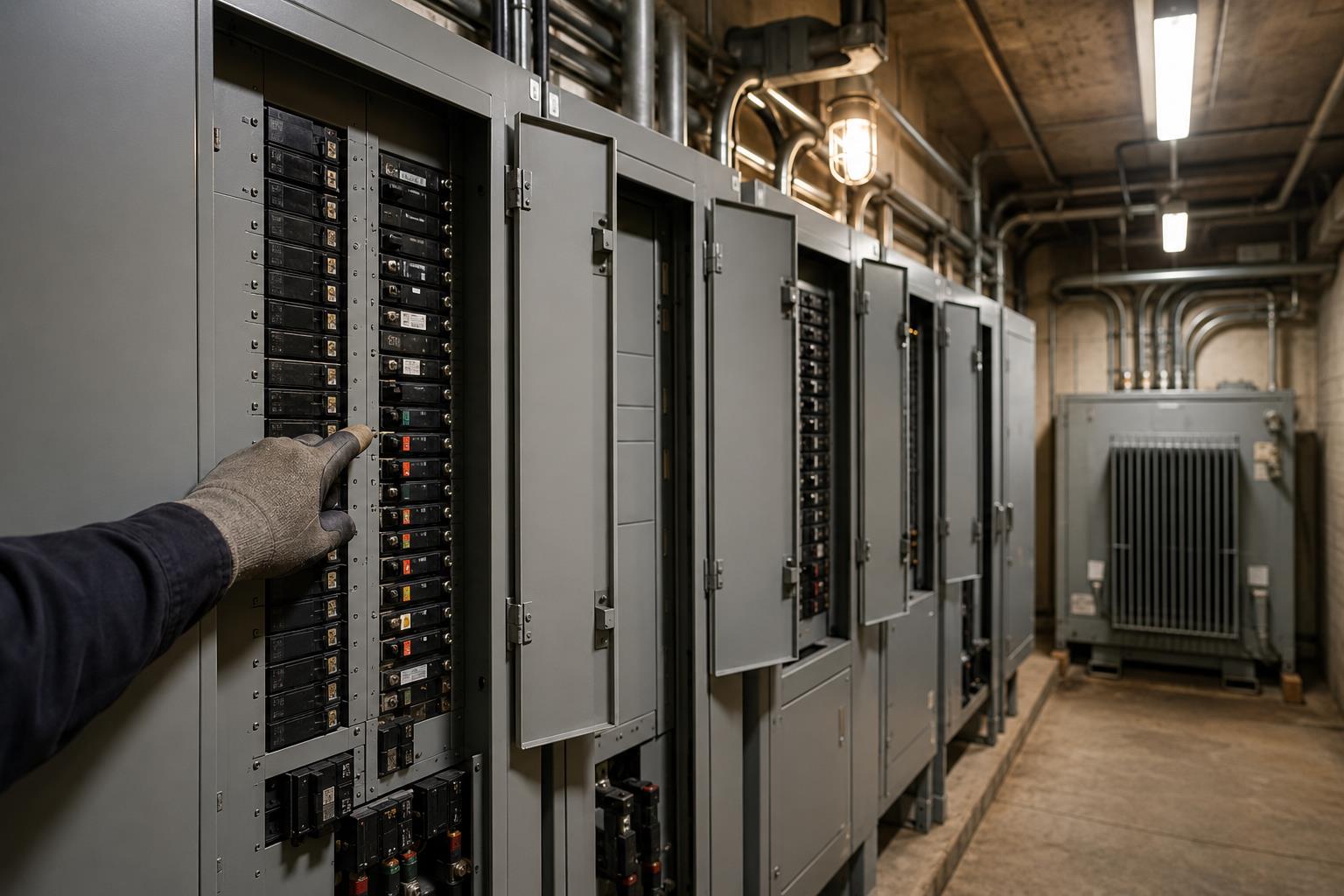
It usually does not. Older facilities run on panels with little spare breaker space, transformers sized for the load the building had two decades ago, and distribution paths that bottleneck once new circuits get added. Legacy utility connections cap how much power the site can even draw. In situations where overloaded systems or unexpected electrical failures occur, having access to a reliable emergency electrician can help address urgent issues before they lead to costly downtime or safety hazards.
These constraints sit quietly across a city hall annex, a police and emergency operations upgrade, a transit maintenance facility, or a public works campus, and they surface the moment someone tries to expand.
The national picture frames the local one. The American Society of Civil Engineers downgraded the energy sector to a D+ in its 2025 Report Card, citing a shortage of distribution transformers, a lack of transmission capacity, and aging grid assets struggling to keep pace.
The infrastructure feeding public buildings carries the same strain the buildings themselves do.
The One Electrical Capacity Issue Appearing Across Capital Projects
Strip the variation away and projects keep colliding with the same wall: the electrical system was sized for the demand of its day, and that day is gone.
Systems installed years ago never accounted for EV fleet charging, networked security, smart building controls, dense data infrastructure, HVAC electrification, or on-site battery storage, let alone whatever public service arrives next.
Existing power distribution was sized for yesterday’s demand
The load profile of a modern municipal building barely resembles the one its service was engineered for.
National forecasts capture the gap: the U.S. is projected to need roughly 35 gigawatts of additional electricity by 2030, double the 17 gigawatts required in 2022, driven largely by electrification and data demand. Individual facilities feel that curve as a panel that fills up faster than anyone planned.
Expansion increased load faster than infrastructure planning
New technology lands in waves, and each wave draws more power. Planning cycles move slower than procurement does, so the load climbs while the infrastructure assessment waits its turn.
Capacity reviews happened too late in design
The electrical study often arrives after the architecture is set and construction sequencing is underway, which is the most expensive moment to discover a limit.
Picture a public works department expanding its campus by 25 percent. The new bays go up, the offices fill, and a year later the fleet team requests charging for incoming electric vehicles, only to learn the service was maxed out by the expansion itself. The building grew. The capacity to power its future did not.
How Expansion Delays Become Budget Problems
A capacity limit found mid-project sets off a chain reaction. The electrical scheme gets redesigned, which forces permit revisions, which pulls the utility into new coordination on a service upgrade that can take months to schedule.
The construction calendar slips. Contractors sit idle or get demobilized and remobilized, and equipment already ordered against the original design needs to be changed or returned.
What happens when a project discovers its infrastructure ceiling after the slab is poured? The cheapest fixes are already off the table.
ASCE’s reviewers note that agencies are increasingly sequencing work to favor phased construction and avoid triggering more costly rehabilitation later, a direct response to how brutal late-stage redesigns have become.
The Shift Toward Future Ready Electrical Planning
The fix is to treat capacity as a forecast rather than a snapshot. That means modeling long-term load growth instead of sizing for the equipment list in front of you, specifying scalable switchgear that can grow with the building, and designing distribution with redundancy and reserve capacity built in from the start.
A few moves do most of the work: run the electrical assessment early, model future load against real growth assumptions, fold in technology and electrification plans, and open the utility coordination conversation before the design locks.
How Municipal Teams Plan Around Future Demand Instead of Current Demand

Forward-looking teams plan against horizons, not the present invoice. A five-year facility growth view, a ten-year infrastructure forecast, electrification targets, vehicle transition timelines, and emergency power needs all feed the load model before a single circuit gets drawn.
A city preparing to electrify its vehicle fleet, for instance, sizes the service today for the full charging build-out it expects in eight years, so the second phase plugs in rather than triggering another service upgrade.
Public infrastructure assessments keep flagging capacity and maintenance gaps in aging systems, and planning to the horizon is how a project stays off that list.
Why Municipal Expansion Projects Need Infrastructure Partners Early

Engineering, utility coordination, phased upgrades, and integrated electrical master planning work best when they start together, early, before architecture commits the project to a fixed envelope.
Planning Expansion Timelines With Trusted Commercial Electrical Services Chicago Partners
Municipalities frequently bring in experienced commercial electrical services Chicago teams during the planning phase precisely to surface hidden constraints before construction begins.
A seasoned electrical partner reads the existing service, the panel headroom, and the utility’s available capacity, then maps those against the technology and load the expansion will demand.
The value sits in catching the ceiling on paper, when moving it costs a drawing revision instead of a change order.
Questions Municipal Teams Should Ask Before Expansion Begins
- What spare electrical capacity does the facility actually have today, measured rather than assumed?
- How much additional demand will planned technologies add over the next decade?
- Can the current infrastructure absorb EV charging growth?
- Are utility-side upgrades required, and what is their lead time?
- Will emergency and backup power scale alongside the expansion?
- What happens to the load profile if the building’s use changes in five years?
Conclusion
Expansion problems that read like construction failures often began as electrical capacity questions nobody asked early enough.
A facility that models its future load, sizes its service for the decade ahead, and brings electrical expertise into the room during planning protects its budget, holds its schedule, and keeps the project moving when the new technology finally arrives.
Before the next capital project breaks ground, find out what the building can actually power.