You found a crack in your foundation wall. Maybe you spotted it during a routine check, maybe a contractor pointed it out, maybe you’ve been watching it for months and quietly hoping it would stop progressing. Whatever brought you here, you’re asking the right question: what does this actually mean?
The honest answer is that it depends — on the type of crack, the direction it runs, whether it’s growing, and whether water is involved. Not all foundation cracks are emergencies. But none of them are nothing. Here’s how to read what you’re looking at.
Direction Tells You More Than Size
The shape and orientation of a crack is the first thing any experienced contractor looks at — and it should be the first thing you look at too.
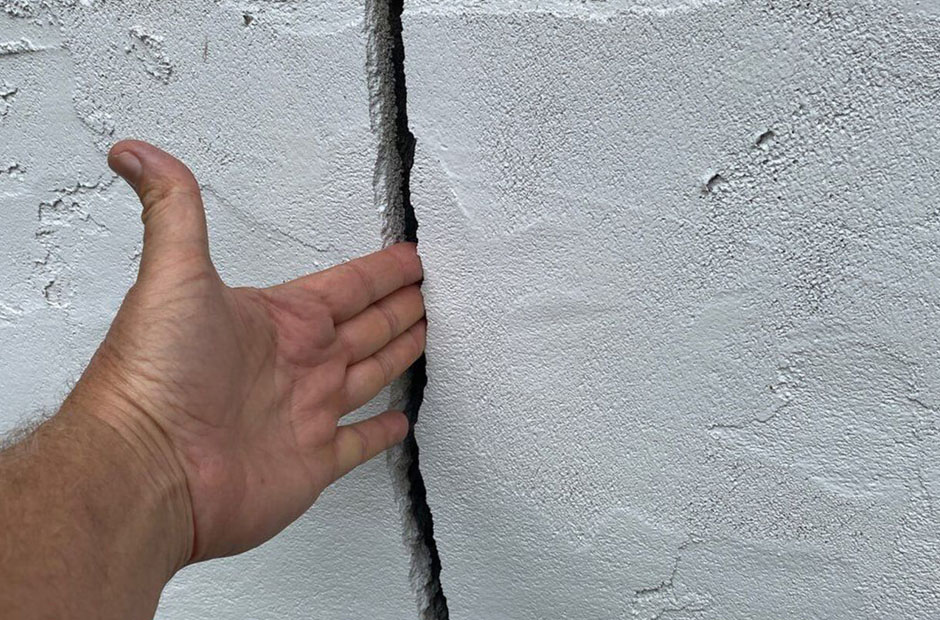
Vertical cracks run straight up and down the wall and are the most common type in poured concrete foundations. They’re usually caused by concrete shrinkage during the curing process — a normal, predictable part of how concrete behaves as it sets. Structurally, they’re typically low concern. As water entry points, they’re not. A hairline vertical crack will widen with every freeze-thaw cycle, and once water finds it, the damage compounds season by season.
Diagonal cracks — running at an angle, often from the corners of windows or doors — usually indicate differential settlement. One section of the foundation has moved relative to another, typically because the soil beneath it has shifted, eroded, or compacted unevenly. Minor diagonal cracking can be stable and manageable. Widening diagonal cracks, or cracks where one side has shifted higher than the other, are a signal that movement is ongoing and needs professional assessment.
Horizontal cracks are the ones that demand the most immediate attention. They typically appear near the midpoint of a foundation wall and indicate that the wall is under lateral pressure from saturated soil pushing inward. A horizontal crack means the wall is bending — and a wall that’s bending has a structural problem, not just a water problem. This is not a crack to monitor and revisit next season.
When Water Is Involved, the Timeline Compresses
A dry crack and a wet crack are fundamentally different problems — not in cause, but in urgency. The professionals at Aquatech Waterproofing in Vaughan assess foundation cracks as part of their inspection process specifically because water turns a manageable structural issue into a compound one. Moisture that enters through a crack saturates the surrounding concrete, accelerates freeze-thaw damage, promotes mold growth in adjacent framing and insulation, and progressively weakens the wall’s integrity.
If you’re seeing water staining, white mineral deposits around the crack, or active seepage after rain, the problem is further along than the crack alone suggests. The visible crack is the entry point. The damage it’s done to the material around it is the part you can’t see until someone opens up a wall.
Active vs. Dormant — and How to Tell the Difference
Not every crack is growing. Some stabilize after the initial movement that caused them and stay static for years. Others continue to widen or extend as soil conditions change, drainage fails, or seasonal pressure cycles accumulate.
A simple way to check: mark the ends of the crack with a pencil and write the date beside each mark. Check it again in four to six weeks. If the crack has extended beyond your marks, it’s active. If the width has changed — you can measure across it with a feeler gauge or even a credit card — it’s active. An active crack needs attention sooner. A dormant crack still needs to be sealed against water infiltration, but the timeline is less compressed.
What Fixing It Actually Involves
The repair approach depends on what the crack is doing and why it formed.
Epoxy injection is the standard repair for structural cracks — vertical or diagonal cracks where the goal is to restore the wall’s integrity. Epoxy bonds the two faces of the crack back together with strength that often exceeds the original concrete. It requires a dry surface to cure properly, so active water needs to be managed before injection.
Polyurethane foam injection is better suited to cracks with active water movement. It expands as it cures, filling the void and conforming to irregular crack geometry. It’s flexible rather than rigid, which makes it more tolerant of minor ongoing movement. It stops the leak effectively but doesn’t restore structural strength the way epoxy does.
Horizontal cracks — the structural ones — often require more than injection. Carbon fiber straps, wall anchors, or in severe cases, full wall reconstruction may be necessary depending on how far the movement has progressed.
The One Thing Worth Repeating
Foundation cracks don’t resolve on their own. A crack that seeps a little today seeps more next spring. A crack that’s stable now may start moving after a wet season shifts the soil loading around it. The cost of addressing a foundation crack early — injection, sealing, drainage improvement — is a small fraction of the cost of addressing what it becomes if it’s left alone long enough.