In a New York apartment, some of the hardest elements to design around are the ones you cannot simply remove. A steam radiator under a window, a PTAC unit along an exterior wall, or an HVAC component near built-in cabinetry may be essential to the room, but none of them was chosen for its looks.
The answer is not simply to hide the equipment behind the first cabinet that fits. A well-planned enclosure has to work with the room and the mechanical unit at the same time. Dimensions, airflow, valves, service access, trim, and nearby furniture all influence the result.
When those details are handled from the beginning, the radiator cover can feel like part of the architecture rather than something added after the room was finished.
What Radiator Covers New York Apartments Actually Need
Off-the-shelf radiator cabinets are built around standard dimensions. New York interiors are rarely that cooperative.
An older apartment may have uneven floors, deep window sills, exposed pipes, substantial baseboards, or a radiator that sits slightly off-center. In a renovated condo, the challenge may be different: new cabinetry, window treatments, or wall paneling create lines that the radiator enclosure now needs to follow.
That is why accurate field measurements should come before decisions about style. The height and depth of the radiator are only the beginning. Valve and pipe locations, outlets, window casings, floor conditions, and adjacent millwork can all affect the proportions of the finished enclosure.
When homeowners compare radiator covers new york options, appearance naturally gets much of the attention. Fit, however, is what makes the finished piece look intentional. Even an attractive cabinet can feel wrong if it leaves an unexplained gap against the wall or ends at a height that conflicts with the window above it.
A Radiator Cover Still Has a Mechanical Job to Respect
The enclosure cannot be designed as if the radiator were simply a piece of furniture. Heat still needs to circulate, and important components may need to remain accessible.
Openings and grille patterns should be planned around the particular unit. Internal clearances matter as well. If the enclosure surrounds HVAC, AC, or PTAC equipment instead of a steam radiator, vents, controls, filters, and removable service panels introduce another set of considerations.
Access is easy to overlook when the focus is on appearance. A panel may look clean on installation day but become inconvenient if a technician later has to dismantle surrounding millwork to reach a valve or filter.
A properly planned custom radiator cover works around those practical requirements from the start. The purpose is to make the mechanical equipment less visually dominant without making it harder to operate or maintain.
Use the Enclosure to Improve the Proportions of the Room
Radiators tend to occupy prominent places. They sit below windows, interrupt long walls, and sometimes create awkward transitions between furniture and architecture.
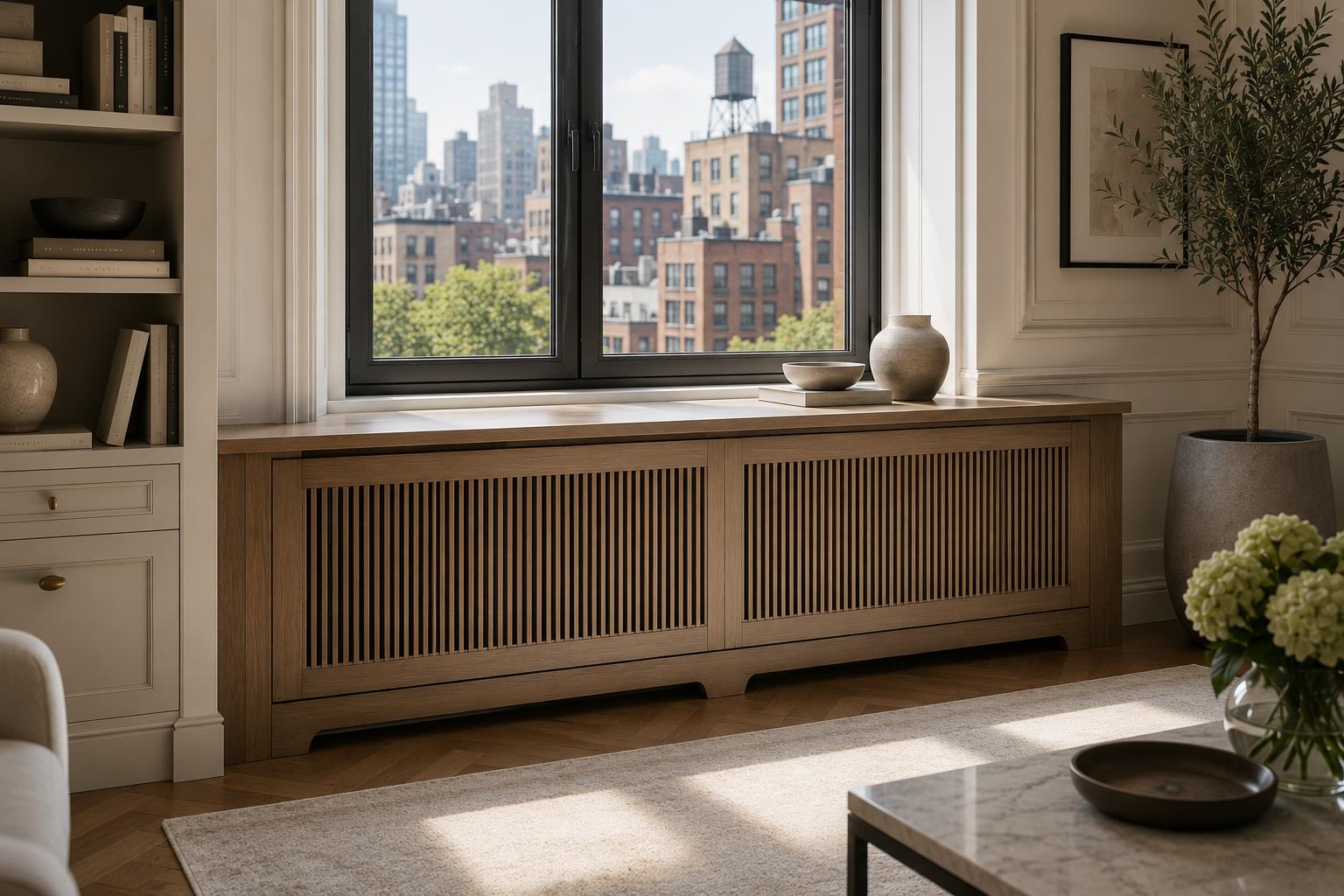
A made-to-measure enclosure gives more control over those lines. Beneath a window, its top can relate to the sill rather than stopping at an arbitrary height. Beside cabinetry, its depth and detailing can follow the surrounding millwork. Where the equipment and required clearances allow, the top may also become a useful surface.
A search for radiator cover ny can bring up everything from flat-pack products to site-specific millwork. The important distinction is whether the cover is expected merely to surround the radiator or to become part of a larger room design.
During a renovation, the latter approach can make a noticeable difference. The enclosure can be coordinated with a window wall, shelving, cabinetry, or other built-ins instead of being treated as a separate object.
Let Existing Materials Set the Direction
The radiator does not need its own design language. In many interiors, the better approach is to look at what is already in the room.
A painted enclosure can relate to window casings, walls, or nearby cabinetry. Natural wood can pick up materials used in shelving, paneling, doors, or built-ins. The choice depends less on making the cover stand out and more on establishing a visual connection with its surroundings.
Details matter here. Grille geometry, edge profiles, panel proportions, and the way the top meets the wall can shift the character of an enclosure from contemporary to more traditional.
Consistency is usually more convincing than novelty. If a room already has well-defined architectural millwork, the radiator cover should speak the same language.
When a Radiator Cover Becomes Part of a Built-In
Not every enclosure needs another function. Sometimes the right solution is simply a well-fitted cabinet around the radiator.
Other rooms offer more possibilities. A cover below a window may connect visually with storage on either side. In a living room, it could become part of a wall with shelving. In a bedroom or home office, several elements may be designed as one continuous millwork composition.
Ivenko Studio uses this site-specific approach for custom radiator covers nyc, designing and fabricating radiator covers as well as HVAC, AC, and PTAC enclosures for New York homes. The work is planned around the actual equipment and room conditions, including airflow, service access, surrounding trim, and nearby cabinetry.
That level of coordination becomes especially important once an enclosure connects with other built-ins. A dimensional problem no longer affects just one cabinet; it can disrupt the alignment of an entire wall.
The Best Result Does Not Need Much Attention
A radiator enclosure is a relatively small part of an interior, yet it can resolve a surprisingly visible problem. Instead of allowing mechanical equipment to dictate the appearance of a wall, the cover can follow the room’s proportions and materials while keeping the equipment functional.
The order of decisions matters. Start with the existing conditions and exact measurements. Identify ventilation and access requirements. Look at the surrounding windows, trim, cabinetry, and furniture. Then decide on proportions, materials, grille details, and whether the enclosure should stand alone or join a larger built-in.
That approach produces a more convincing result than selecting a standard cabinet based on appearance alone. In a New York home, where a few inches can change how a room works, a good radiator cover should not look like an attempt to hide something. It should simply look as though it belongs there.