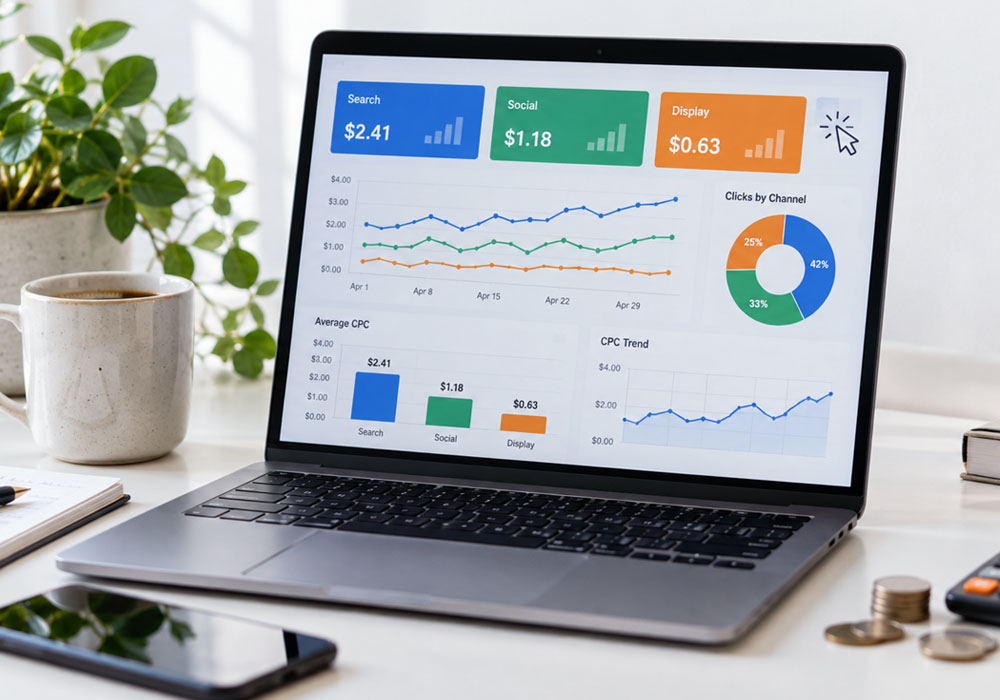
Ten cents on one platform. Nine dollars on another. Same offer, same landing page, same week.
If you’ve ever exported a campaign report and stared at two cost-per-click columns that looked like they came from different planets, you already know the uncomfortable truth: click cost isn’t a property of your business. It’s a property of the room you’re bidding in. Google Search, Meta, LinkedIn, and programmatic display each run their own auction, their own audience, and their own version of what a click is worth.
So here’s what this piece does. You’ll get the mechanics behind why the same click costs $0.40 on one network and $14 on another, the general bands you should expect across major channels, and a short diagnostic you can run this week when your CPC drifts outside the range you’d budgeted. I’ve watched enough accounts blow past their projected click costs to know the number itself is rarely the problem. The comparison is.
Why the same click costs wildly different amounts
Every ad platform is a marketplace, and marketplaces price on scarcity. Google Search auctions a finite set of queries with explicit commercial intent, which means you’re bidding against people who already know what they want. That competition pushes cost per click up. Meta and other social networks auction attention instead of intent, so the floor sits lower, but you pay for volume you have to qualify yourself.
Three levers drive nearly all of the spread:
- Auction density. How many advertisers want the same placement at the same moment.
- Commercial intent. How close the user is to pulling out a card.
- Value of the outcome. What a converted lead is worth to the buyer, which sets their ceiling bid.
A personal injury firm can justify a triple digit cost per click because a single signed case covers a year of media spend. A local kids’ activity studio cannot, and shouldn’t try. The platform doesn’t know either of those facts. Your competitors’ bids communicate them on your behalf.
And the macro picture keeps shifting. Advertising and marketing services employment has grown steadily for years, according to the Bureau of Labor Statistics, which tells you how crowded the bidding side of these auctions has become. More people managing spend means more competition for the same impressions.
What click costs generally look like by channel
Nobody can hand you a single accurate number, and anyone who does is selling something. What you can work with is relative positioning, because channel to channel the ordering is remarkably stable.
| Channel | Typical intent level | Relative CPC | What you’re really buying
|
| Google Search | High | Highest | Someone actively looking |
| Google Shopping | High | High | Product comparison behavior |
| Medium | High | Job title and company filters | |
| Meta (Facebook, Instagram) | Low to medium | Low to moderate | Interest and behavior targeting |
| Programmatic display | Low | Lowest | Reach and retargeting volume |
I’d rather spend $6 on a search click from someone typing a purchase phrase than $0.30 on a display impression that might get seen. That’s not a universal rule, and brand campaigns flip it. But if you’re buying direct response, the cheap click usually isn’t the cheap conversion. You pay for it later in your cost per acquisition.
That is exactly where a proper Media Platform CPC Benchmarks reference earns its keep. A raw CPC tells you what you paid. A benchmark tells you whether that payment was normal for your vertical or a signal that something in your targeting, creative, or offer needs a second look.
Your vertical moves the number more than your platform does
Here’s the part most budget spreadsheets miss. Two advertisers can run identical Meta campaigns with identical creative and still see click costs that differ by four or five times, because they’re in different verticals.
Sales cycle length and average order value explain almost all of it. An ecommerce brand closing a $45 order the same day has a ceiling bid of maybe a few dollars. A B2B software company closing a five figure annual contract can pay far more per click and still book a healthy return. Neither is being wasteful. They’re pricing the same unit of attention against wildly different downstream value.
The sector mix keeps shifting too. The U.S. Census Bureau tracks business formation and industry composition, and the categories filling up your auction this year aren’t the ones that filled it five years ago. New DTC brands, new local service operators, new agencies managing other people’s money. Each one adds a bidder.
Think about a Medicare brokerage and a home services contractor running ads in the same metro. The Medicare advertiser might accept a click cost several times higher because a single enrollment can pay for itself across multiple years. The contractor needs the job to pencil out in weeks. Watching one of them panic about the other’s “cheaper clicks” is a waste of everybody’s afternoon.
A five step diagnostic for when your CPC looks wrong
Run this before you touch a bid. It takes about twenty minutes and saves you from the most common overreaction, which is cutting spend on a campaign that was working fine.
- Check the match, not the number. Pull benchmarks for your vertical, not for advertising in general. A cross industry average is noise.
- Measure the click against the conversion. A rising CPC with a stable cost per acquisition is a budget conversation. A rising CPC with a rising CPA is a campaign conversation.
- Look at auction insights. New entrants, rising impression share for competitors, and sudden overlap spikes tell you if the market moved or you did.
- Segment by device, geography, and audience. Blended averages hide the fact that one segment is carrying the whole account and another is burning cash.
- Only then adjust. Change creative, offer, or targeting before you change the bid. Bids are the last lever, not the first.
One honest caveat: claims about what your ads can and can’t say are governed by rules that aren’t optional. The Federal Trade Commission enforces advertising standards that apply across every platform you buy, and a tempting headline can cost more than any click ever will.
The two things I’d actually protect are lead quality tracking and incrementality. If you don’t know which clicks turned into revenue, every benchmark on the internet is just a number someone else typed into a spreadsheet.
Frequently asked
Is a low CPC always a good sign?
No. Cheap clicks often mean low intent, weak placements, or accidental clicks you’ll never convert. Compare your cost per qualified lead, not your cost per click.
How often should I recheck benchmarks?
Quarterly is plenty for planning. Weekly if you’re in a seasonal vertical or you’ve just seen a sharp move in auction density.
Do benchmarks apply to small local advertisers?
Directionally, yes. The ranges widen at small spend levels, so treat any benchmark as a flag to investigate rather than a verdict on your account.
The number only matters next to the right comparison
Click cost alone will never tell you whether your advertising is healthy. It tells you what the auction charged. Your margin, your sales cycle, and your close rate decide whether that charge was worth paying. Get the comparison right first, and most of the panic about expensive clicks disappears on its own.
So before your next budget review, grab your last ninety days of spend, sort it by channel, and ask one question of each line: was this click priced like my industry, or like somebody else’s? If you can’t answer that yet, that’s your next hour of work.