Moving into a new house is the moment when every purchase feels like a decision about how you want to live. You are choosing a sofa, a dining table, a bed frame, a nightstand—and somewhere in that list, the thing that sits on the nightstand and decides how your mornings begin. A sunrise alarm is not a gadget for people who struggle to wake up. It is a device for people who are furnishing a new home and want the bedroom to work as well as it looks. The difference matters: a traditional alarm interrupts sleep with sound, while a sunrise alarm attempts to ease you out of sleep with light that gradually brightens over a set window before any sound plays. If you have ever hit snooze four times and still felt groggy, the problem may not be your discipline. It may be the method—and in a new house, the method is worth getting right from the start.
This guide covers what a sunrise alarm actually does, the factors worth comparing before you buy, and two devices that represent different answers to the same question: Glocusent as the practical, feature-dense choice for a new bedroom, and Hatch as the most polished app-driven sleep-routine device on the market.
What a Sunrise Alarm Actually Does
A sunrise alarm contains a light source programmed to brighten gradually, mimicking the natural progression of dawn. Most models let you set a window for the brightening phase—somewhere between 5 and 60 minutes depending on the device—with better ones allowing you to choose the exact duration. The light typically reaches a modest intensity, far less than a clinical light box, but the gradual change is the point, not raw brightness.
Sound usually follows. On many models, audio begins after the light has already been brightening for some time. Some sunrise alarms also offer a sunset routine: the light slowly dims over a set period at night, giving your brain a visual cue that the day is ending.
The mechanism is circadian, not magical. Light signals the brain’s master clock to suppress melatonin and promote wakefulness. A gradual increase is thought to produce a more orderly transition from sleep than a sudden auditory jolt, potentially reducing sleep inertia—that heavy, disoriented feeling that can linger after a harsh alarm.
Key Factors to Consider
Light Behavior and Brightness
Not all sunrise simulations are equal. Look for a device that lets you control the brightening window. The Glocusent N17 uses a 5-minute sunrise simulation with gradually increasing light and alarm volume. That is shorter than many competitors—some offer 15 to 60 minutes—so consider whether a quick transition suits you or feels rushed. The Hatch Restore 3 offers a more customizable sunrise with selectable hues and a gradual brightening sequence that reviewers consistently describe as gentle and effective.
Check whether the final brightness is sufficient for your new bedroom. Smaller models may not illuminate a larger room. If you want the clock to double as a reading light, confirm that it has a dedicated lamp mode. The Hatch Restore 3 includes a bedside light button, though reviewers note it is more of a personal reading light than a full room lamp.
Sound Options and Sequencing
Do you want sound at all? Some people prefer light-only waking; others need audio as a backup. The Glocusent N17 offers 10 alarm sounds and 30 sleep sounds, plus Bluetooth streaming for your own audio. That is an unusually generous sound library for its price point. The Hatch Restore 3 includes 40 sleep sounds and 20 alarm sounds at no extra cost, with a larger library available through the optional Hatch+ subscription.
Pay attention to sequencing. On the Glocusent, the alarm volume increases gradually alongside the light. The Hatch Restore 3 sequences light first, then sound, which is the more traditional sunrise-alarm approach. If you are sensitive to morning noise, a delayed-audio option matters more than the size of the sound library.
App Control vs. On-Device Controls
This is where the two devices diverge most sharply. The Glocusent N17 offers both physical buttons and app control—and critically, the app requires no subscription. Reviewers consistently praise the app for making setup and adjustment easy without fumbling with buttons in the dark. You can control it either way; neither path is locked behind a paywall.
The Hatch Restore 3 requires the Hatch Sleep app and Wi-Fi for initial setup and scheduling. Once configured, the physical controls are genuinely good: a central rotating Big Button for volume, routines, and snooze, plus dedicated buttons for bedside light and alarm toggle. Reviewers highlight this phone-free daily operation as one of the device’s strongest features—you set it up with your phone, then leave your phone out of the bedroom. But if you want to change a routine or access the full content library, you will need the app. And the full library requires Hatch+, a paid subscription (currently $4.99/month after a 30-day trial).
If keeping your phone out of the bedroom is a priority, both devices can support that goal—but only Hatch makes it a core design philosophy, and only Glocusent lets you avoid a subscription entirely.
Size, Design, and Placement
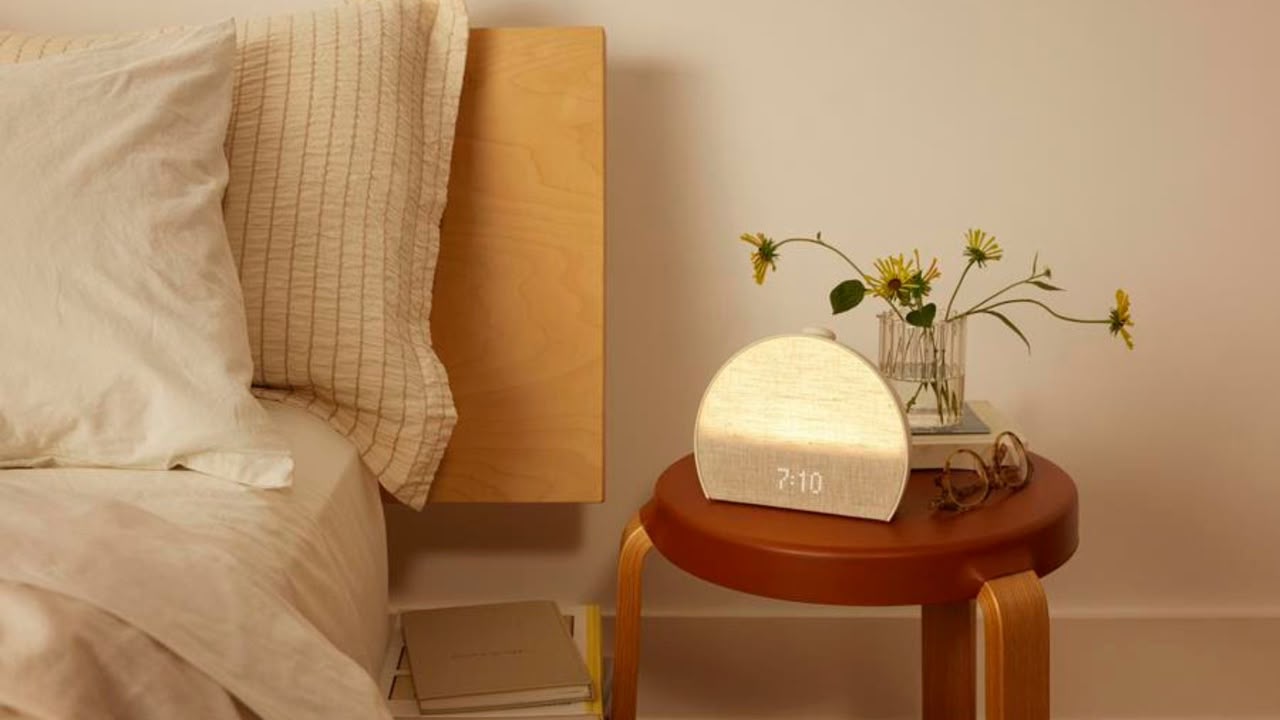
Sunrise alarms live on nightstands, so footprint matters—and when you are choosing furniture for a new bedroom, the nightstand is part of the decision. The Glocusent N17 measures roughly 8.5 × 16.8 × 18 cm, a compact circular design with a fabric-wrapped body that reviewers describe as fitting neatly on small nightstands and looking more like decor than a gadget. The Hatch Restore 3 is noticeably larger at 7.5 × 2.75 × 5.75 inches, with a fabric-fronted, softly rounded design that reviewers say looks like a small bedside speaker. It takes up more space but feels substantial and well-built.
Consider the clock display. The Hatch Restore 3 uses a deliberately dim display to avoid light pollution at night—helpful if you are sensitive to light. The Glocusent has a small display that shows the time; reviewers do not flag it as intrusive, but check if you need total darkness.
Subscription and Ongoing Costs
The Glocusent N17 is a one-time purchase with no subscription required for any of its features—app control, sounds, and light modes are all included. It is a new launch, and the current promotional price runs from $39.99 to $59.99 depending on the offer, against a manufacturer’s suggested retail price of $99. That means the device is selling well below its official list price during the launch window—a meaningful consideration if you are equipping a new bedroom on a budget.
The Hatch Restore 3 costs $169.99 upfront, and while the base device includes a solid library of sounds and light options, the full experience—expanded audio content, meditations, sleep stories—requires the Hatch+ membership. Reviewers consistently flag this as the device’s main drawback: you are paying a premium price and still encountering a paywall for the complete content library.
Two Devices, Two Approaches
Glocusent N17: The Practical New-Home Choice
If you are furnishing a new house and watching your budget across a dozen categories, the Glocusent makes a compelling case. It covers the essentials—sunrise simulation, dual alarms, a generous sound library, app control without a subscription, Bluetooth streaming, and a battery backup for power interruptions—at a fraction of the Hatch’s price. Reviewers describe it as “versatile” and “more complete than expected,” with particular praise for the app’s convenience and the quality of the sunrise simulation for the price.
The pricing story is part of the appeal. With an MSRP of $99 and a new-launch promotional range of $39.99 to $59.99, the N17 is currently positioned well below its official list price. For a new homeowner, that gap between suggested retail and actual selling price is worth noting: it is a full-featured device being introduced at an entry-level price, not a stripped-down model that happens to be cheap.
The trade-offs: the sunrise window is fixed at 5 minutes, which is shorter than ideal for deep sleepers who benefit from a longer, more gradual transition. The 5W speaker is adequate for white noise and alarms but not a replacement for a dedicated Bluetooth speaker. And while the fabric-wrapped design is pleasant, it does not have the premium feel of the Hatch. But for a new homeowner equipping a bedroom from scratch, it is a sensible, low-risk addition that does not demand a monthly fee.
Hatch Restore 3: The Most Famous App-Driven Sleep-Routine Device
The Hatch name has become nearly synonymous with the app-connected sunrise alarm category, and the Restore 3 is its most refined iteration. Reviewers across CNET, WIRED, and Wareable consistently rank it as the best overall sunrise alarm for one reason: it excels at both the morning wake-up and the evening wind-down. The physical controls are genuinely usable without a phone, the build quality is high, and the sound library is deep. CNET’s reviewer said the device made their bedroom “phone-free at night, significantly improving my sleep quality.” WIRED called it the best option for “interesting, varied soundscapes and audio content to fall asleep to.”
But the Hatch is not a sleep tracker in the clinical sense—it does not measure sleep stages or report data. What it tracks, in practice, is your routine: it learns the bedtime and wake-up patterns you set and reinforces them with light and sound cues. If “sleep tracker” means data and metrics, neither device qualifies. If it means a system that actively shapes your sleep schedule, the Hatch is the more sophisticated tool.
The trade-offs are real: $169.99 upfront, a subscription for full content, and a larger footprint on the nightstand. It is also not designed as a Bluetooth speaker, so you cannot stream your own audio through it the way you can with the Glocusent. For a new house where the budget is stretched, the Hatch is a deliberate splurge—worth it if you will use the routine-building features and the audio library, wasteful if you just want a light that turns on before your alarm.
What to Ask Yourself Before Buying
Do you need sound, or is light enough? Both devices offer sound, but the Glocusent lets you choose light-only alarms easily. If you share a bed with someone on a different schedule, light-only may be less disruptive.
Will you actually use an app? The Glocusent works fully without the app if you prefer buttons. The Hatch requires the app for setup and any routine changes—but once configured, daily use is phone-free. Be honest about whether you will customize routines or set it once and forget it.
Does it fit the furniture you have chosen? Measure your nightstand. The Glocusent is compact and fabric-wrapped; the Hatch is larger and more speaker-like. In a new bedroom, the device should look like it belongs.
Is your sleep schedule consistent? Sunset and sunrise routines work best when paired with a regular bedtime and wake time. If your schedule shifts daily, manual activation features matter more than automated scheduling.
Common Questions
Does a sunrise alarm actually work?
For many people, yes—as a gentler wake-up method. Research supports gradual light exposure as a way to facilitate a more orderly transition from sleep, though it is not a treatment for clinical sleep disorders. If you have persistent insomnia, speak with a clinician.
Is the Hatch a real sleep tracker?
No. It does not measure sleep stages, heart rate, or movement. It is a routine device—it uses light and sound to cue bedtime and wake-up. The “tracking” is behavioral, not biometric. If you want actual sleep data, you need a wearable or a bedside radar device.
Can I use the Glocusent without the app?
Yes. All core functions—alarms, light modes, sound selection—are accessible via physical buttons. The app adds convenience, not necessity.
Can I use the Hatch without a subscription?
Yes, but with limits. The Restore 3 includes 40 sleep sounds, 20 alarm sounds, and 20 lighting options without Hatch+. The subscription unlocks the expanded library of meditations, stories, and rotating content. Check what is included before you buy.
Conclusion
In a new house, a sunrise alarm belongs to the same set of decisions as the bed, the nightstand, and the curtains—the things that shape how a room feels and how you live in it. The Glocusent N17 is the pragmatic choice: it covers sunrise simulation, a large sound library, app control without a subscription, and a compact fabric-wrapped design that fits a new nightstand—and with a $99 MSRP against a new-launch promotional price of $39.99 to $59.99, it is being introduced at a fraction of its official list price. The Hatch Restore 3 is the premium choice: it is the most polished, most thoughtfully controlled, and most routine-oriented device in its class, but it costs nearly three times as much and asks for a monthly fee to reach its full potential.
Choose the one whose controls you will actually use and whose light and sound match your sleep patterns. Choose it because it fits the room you are building, not because it has the longest feature list. A sunrise alarm that earns its place on the nightstand is one you will still be using long after the moving boxes are gone.