Every facility that relies on overhead lifting equipment eventually confronts the same operational truth: unplanned downtime is expensive, and it rarely announces itself in advance. A single failed component on a production floor can halt an entire line, delay shipments, and put strain on labor scheduled around that equipment. For plant managers and operations directors, the difference between a minor service interruption and a multi-day shutdown often comes down to how proactively the equipment was maintained before the problem appeared.
The Real Cost of Reactive Repairs
Reactive maintenance, fixing equipment only after it fails, tends to look cheaper on paper because it avoids scheduled service costs. In practice, it usually costs more. Emergency repairs require rush parts, overtime labor, and often force idle time across dependent stations while technicians diagnose the issue. Insurance and safety audits also weigh heavily on facilities with a history of unplanned failures, since repeated breakdowns can signal deferred inspections or inconsistent service records. A facility that waits for failure is, in effect, budgeting for the worst-case scenario every time equipment runs.
Building a Maintenance Calendar Around Usage, Not Just Time
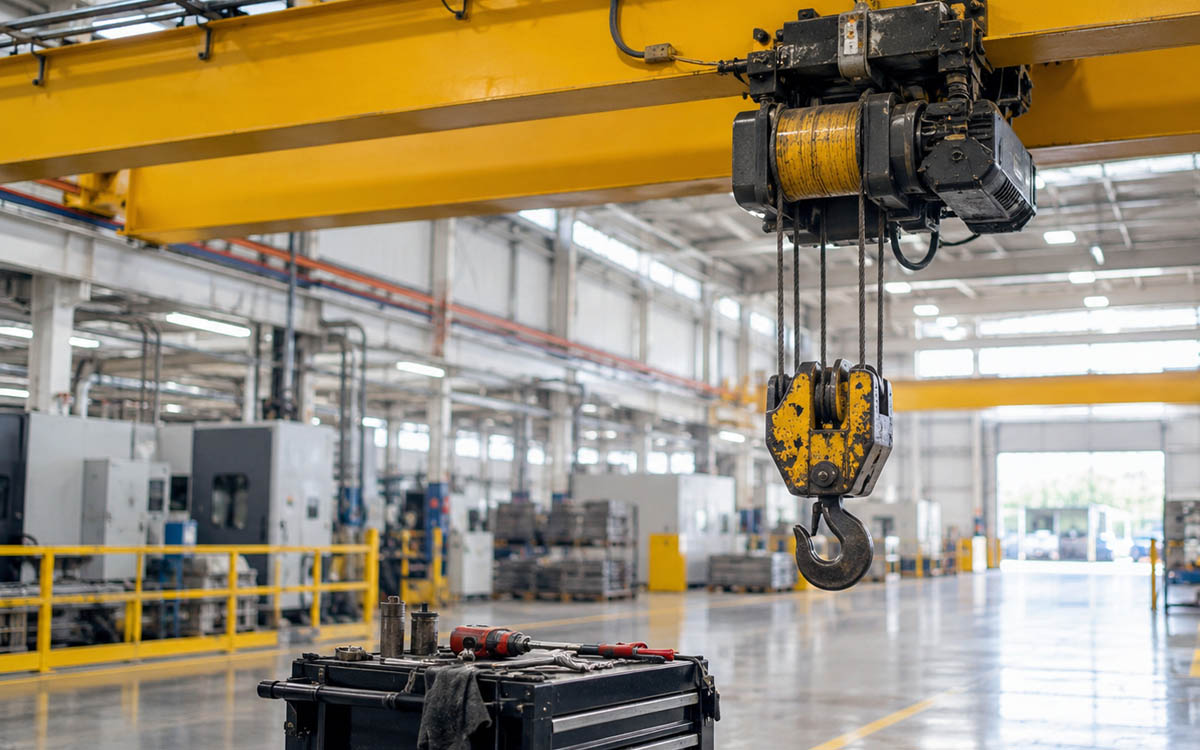
Many maintenance schedules are built around fixed calendar intervals, quarterly or annual checks, regardless of how heavily equipment has been used. This approach can leave gaps for machinery running near-continuous shifts while over-servicing equipment is used only occasionally. A more accurate approach ties inspection frequency to load cycles, duty class, and operating hours. Facilities running multiple shifts with heavy daily lifting demands, particularly those operating industrial hoists at or near rated capacity, generally need more frequent bearing, brake, and cable inspections than facilities using similar equipment intermittently. Aligning service intervals with actual usage data, rather than the calendar alone, closes the gap between scheduled maintenance and real wear patterns.
Training Staff to Recognize Early Warning Signs
Even the best maintenance schedule benefits operators who notice small changes before they become failures. Unusual noise during lifting, inconsistent speed control, or slight drift in load positioning are often early indicators of wear in gearboxes, motors, or braking systems. Training floor staff to log and report these observations, rather than dismissing them as normal variation, gives maintenance teams a head start on diagnosis. This kind of frontline awareness does not replace formal inspection but supplements it, catching issues in the window between scheduled service visits.
Documentation as a Risk Management Tool
Consistent, detailed maintenance records serve a purpose beyond compliance. When equipment does eventually need replacement or a warranty claim, thorough documentation shortens the process considerably. It also gives facility managers a clearer picture of which assets are approaching the end of their reliable service life, allowing capital planning decisions to be made before a failure forces the issue. Facilities that treat documentation as an afterthought often find themselves making reactive purchasing decisions under time pressure, typically at less favorable terms than a planned replacement would allow.
Ultimately, the facilities that avoid costly lifting downtime are rarely the ones with the newest equipment. They are the ones that pair reasonable service intervals with attentive daily observation and disciplined recordkeeping, treating maintenance as an ongoing operational function rather than a periodic task to check off.