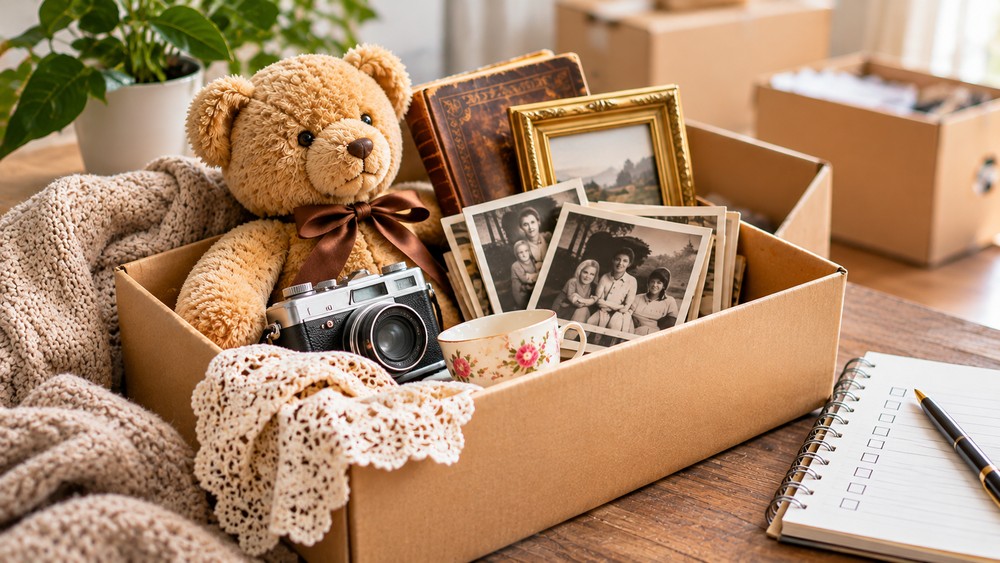
Picture a daughter standing in her mother’s hallway closet, holding a shoebox of birthday cards, a roasting pan from 1974, and a move-in date that is three weeks away. None of it is worth much money. All of it feels impossible to throw out.
That tension sits at the center of every downsizing project. The gentlest way to sort sentimental items when downsizing is to start with low-stakes rooms, place every object into one of four simple groups, keep a small memory box for what matters most, and photograph or scan whatever cannot make the trip. This guide walks through that method step by step, and it explains which items should ride with the person instead of on the moving truck.
Start With the Person, Not the Pile
The person who owns the belongings should lead the sorting whenever they are able, because the meaning of an object lives in their memory, not in the object itself.
A relative cannot tell by looking whether a chipped teapot is clutter or the last gift from a grandmother. Only the owner knows. So instead of asking “Do you need this?”, try “Tell me about this one.” The story often settles the decision faster than any debate, and it gives the family something to write down before it is lost.
If memory loss or poor health limits what the person can do, keep them involved in small ways. Let them pick between two photographs or choose which sweater goes in the suitcase. Having a say, even a small one, protects dignity during a move that can otherwise feel like things are being done to them.
Before the first session, agree on a few ground rules. Decide who has the final word on disagreements, and keep each session short, an hour or two at most. Sentimental sorting is emotionally tiring, and tired people either keep everything or discard too fast.
How to Sort Sentimental Items When Downsizing: Start Small
Begin with the rooms that carry the least emotion, so decisions get easier before the hard ones arrive.
Kitchen cabinets, the linen closet, the bathroom, and the garage are good first stops. Most of what lives there is practical, and each cleared shelf gives the family a visible win. Move on to bedrooms and living areas next. Save photographs, letters, and hobby collections for last, when everyone has built up some momentum.
A common mistake is starting with the photo albums because they feel like the “real” work. By the second box, everyone is worn out, and the whole pile slides into the keep category.
Measure the new space before sorting anything. A simple floor plan with the actual closet and wall dimensions turns “keep what you love” into a concrete budget.

Sort Everything Into Four Simple Categories
Four groups cover nearly every object and take away the all-or-nothing pressure that makes sorting so painful.
- Travels with me: items the person uses daily or loves most, and that fit the new space.
- Goes to family: items a specific relative wants and will care for.
- Gets recorded: items that matter to the family story but not to the floor plan. These get photographed, and the story behind each one gets written down.
- Lets go: items to donate, sell, recycle, or discard.
The third group does the most work emotionally. Many people can release an object once they know its story will survive. A quilt can be photographed, its maker named, and the date noted. The quilt may leave, but the memory stays in the family record.
Here is a realistic example. A man downsizing from a three-bedroom home owns forty years of bowling trophies. He keeps the two that mean the most (travels with me), photographs the full shelf with a note about the league and the years (gets recorded), and donates the rest of the cups to a local league (lets go). Nothing was thrown away carelessly, and the shelf is gone.
Build a Memory Box With a Size Limit
A memory box is one container, chosen in advance, that holds the small objects that mean the most.
The size limit does the hard work. When the box is full, the family has to choose without anyone having to say “no.” Good candidates include handwritten recipe cards, a wedding invitation, a child’s drawing, a watch, or a bundle of letters.
Add a short note to each item: who it belonged to, what it is, and roughly when. Without that note, the next generation will see a pile of old objects and have no idea why they matter.
Think about storage, too. The Library of Congress explains that the most effective and economical ways to preserve family collections are preventive ones, meaning proper storage, a stable environment, and careful handling. In practice, that means a sturdy box kept inside the living space, not in an attic or basement where heat and damp swing widely. The National Archives adds that cool, dry conditions slow the aging of papers and photographs, while hot storage speeds up staining and brittleness.
Digitize Photos and Papers Before the Move
Scanning gives every relative a copy and keeps the originals safe, so an album never has to be split or abandoned.
A phone with a scanning app works well for most family collections. A flatbed scanner gives better quality for prints that are special. Start with the oldest and most irreplaceable pieces, then work toward newer ones. If there are hundreds of slides or old film reels, a professional scanning service may save weeks of effort.
Record names and dates while the owner can still identify the people in the pictures. Putting them in the file name or in a simple list is safer than writing on the back of a print. After scanning, save the files in at least two places, such as a computer and a cloud account, and share a folder with the whole family.
Once a photograph is scanned, the family can decide about the original more calmly. Some prints go in the memory box. Others go to the relative who appears in them. Some can be released, because the image now exists in several places.
Pass Heirlooms to Family While the Stories Are Still Fresh
Giving an heirloom to a specific person now, along with its story, is usually kinder than leaving it in a pile for someone to sort later.
Try a “choosing afternoon.” Relatives take turns picking one item at a time, and each person says why it matters to them. This rotation keeps things fair and surfaces meaning that would otherwise go unspoken. If relatives live far away, plan for shipping early, and photograph fragile pieces before they travel.
Write a short story card for each item and tape it to the back or tuck it into the box. Take a photo of who received what so the family has a record. If nobody wants an item, that is a normal outcome, not a failure. Record it and let it go.
If an item might be valuable, such as jewelry, art, or an antique, have it appraised before deciding.
What Should Travel With the Person, Not the Truck
A short list of essential and comforting items should go with the person in the car, not in the moving truck.
Trucks arrive later, boxes get stacked in the wrong room, and some things simply cannot wait. Pack a personal bag with medications, identification, glasses, hearing aids, a phone and charger, key papers, a few framed photographs, and the memory box. These items are irreplaceable, needed on day one, or both.
Comfort items matter too. Guidance from the Alzheimer’s Association on moving someone to dementia care recommends furnishing the new home with familiar furniture, mementos, photos, and books, and packing belongings out of the person’s sight so the process does not cause anxiety. Even when memory loss is not a factor, a favorite chair, a quilt, and framed family photos in place before arrival can make a new apartment feel like home faster. Taking pictures of the old room’s layout makes it easy to recreate.
Timing is easier when the movers know the plan. Families in southwest Colorado can ask about senior moving services in Durango that coordinate move-in windows with care communities and family schedules, so the items that matter arrive at the right time and in the right room.
What to Do When Sorting Stalls
When someone cannot decide, put the object in a “maybe” box with a review date, and return to it after the rest of the sorting is done.
Set the date a few weeks out. Many maybes get easier with distance. If an item is still hard to release on the review date, keep it or photograph it and move on. Forcing a decision in the moment often leads to regret.
Watch for signs of fatigue and grief. Tears, anger, or sudden silence are normal during this work and do not mean the plan is failing.
If the move date is close, work in priority order: essentials first, the memory box second, then everything else. Whatever is left can go to a short-term storage unit or a relative’s garage and be sorted later at a calmer pace.
Frequently Asked Questions
How do you decide which sentimental items to keep?
Keep what the person uses, loves, or can tie to a specific story, and what fits the new space. Ask “Tell me about this” instead of “Do you need this?” If an item matters for the story but not the space, photograph it and write down its history before letting it go.
What can you do with sentimental items you cannot keep?
You can photograph them, give them to a relative who wants them, or donate them to a group that will use them. Items with a family story work well as a photo plus a short note. Recording the story helps many people release the object itself without feeling they are erasing the memory.
How many sentimental items should someone keep when downsizing?
There is no fixed number. A practical approach is to pick a container, such as one memory box or one shelf, and let its size set the limit. This keeps the decision fair and concrete, because the family is working with real space rather than guessing about how much is “too much.”
How do you handle disagreements over who gets which heirloom?
Use a rotation, where each person picks one item at a time and shares why it matters. Photograph duplicates or make copies of photos when possible. If two people want the same piece, ask the owner who should have it, and write down the reasoning so it is clear later.
When should families start sorting?
As early as possible, ideally several weeks or months before the move. Sentimental sorting takes longer than packing because each object can trigger a story or a strong emotion. Starting early allows short sessions, rest between them, and time to scan photographs and gather relatives for a choosing afternoon.
Keep the Stories, Lighten the Load
Downsizing does not require anyone to stop caring about their belongings. It asks them to decide where each memory will live: in the new home, with a relative, in a photograph, or in a story told aloud.
Start with one drawer this week. Choose a category for each item, write one short note, and see how it feels. Small steps taken at the owner’s pace build the confidence needed for the harder rooms later.