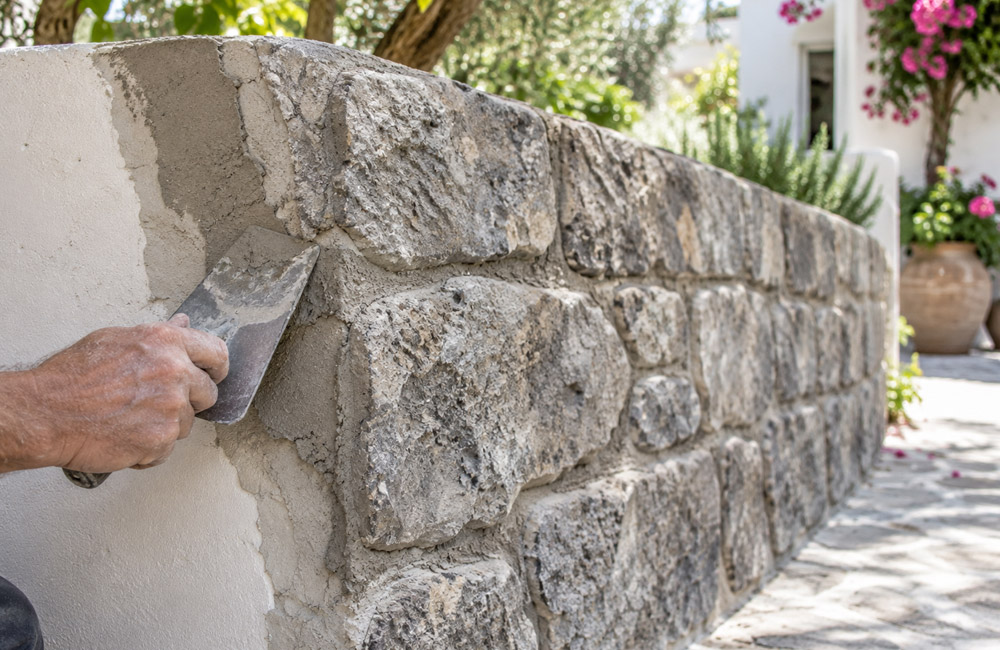
Picture a garden wall that looks like it was hauled out of a quarry by a team of very patient oxen. It’s chunky, weathered, and full of character. You run a hand across it, expecting cold, heavy rock, and the truth turns out to be more interesting.
Heavy materials carry a certain authority. Stone, poured concrete, and old masonry all say “this isn’t going anywhere,” and people have admired that look for centuries. But the weight your eyes report isn’t always the weight your back would feel while moving the thing.
Plenty of those solid-looking walls are actually decorative finishes, built up by hand until they read as dense, ancient, or industrial. The magic lives entirely in the surface rather than the substance, and it’s far more convincing up close than most people would ever guess.
Texture Can Fool the Eye
A convincing finish rarely happens in one pass. Layers go on in stages, each one adding a little grit, tone, or ridge, until the surface stops looking like a coating and starts looking like a material. It’s slow, careful work, and the patience shows.
That’s the appeal of textured concrete Westminster CO finishes that homeowners choose for exterior walls, entryways, and feature areas, where a surface can look poured, cast, or carved even though it started as something far lighter. The eye accepts the story.
Part of why it works is that human brains are lazy detectives. They spot a rough surface, a muted color, and a few hard edges, then declare “stone” and move on. Nobody checks the wall’s paperwork.
Depth Changes How Light Hits the Surface
Flat paint is a smooth, uniform sheet, so light bounces off it in a fairly predictable way. Textured finishes have peaks and valleys, and every tiny ridge catches light on one side while casting a small shadow on the other. That’s where the drama comes from.
Those shadows shift as the day moves along. A wall that looks soft and creamy at breakfast can turn moody and sculpted by late afternoon, with deep lines appearing like someone quietly turned up the contrast.
Movement matters, too. Walk past a textured surface and the highlights slide around, which gives it a living quality that a single coat of color can’t fake. Flat paint is a photograph, while a deep finish behaves more like a tiny landscape.
Imperfection Can Be the Whole Point
Machines love consistency, but real materials rarely cooperate. Stone has veins, chips, and odd patches of color, and old plaster has soft spots where a trowel once swept through. A hand-applied finish borrows that natural unevenness, and it’s what makes the result believable.
A perfectly uniform surface can actually look suspicious. When every inch matches every other inch, the eye starts hunting for the sticker that says “fake.” A slightly wandering line or a patch that’s a shade lighter reads as honest, the way a handwritten note feels warmer than a printed one.
That’s why skilled applicators don’t chase flawlessness. They aim for the kind of variation that looks earned, like decades of weather or a mason’s steady rhythm. It’s controlled randomness, which sounds like a contradiction until you see it done well.
A Finish Can Suggest a Material Without Copying It Exactly
A good finish usually isn’t a perfect forgery of one specific rock. It borrows a mood instead, hinting at limestone, weathered concrete, sun-baked adobe, or aged plaster, and lets the viewer’s imagination fill in the details. Suggestion is often more charming than imitation.
That freedom is a gift. A surface can carry the calm of an old Tuscan wall, the crisp edge of cast concrete, and a soft, chalky tone all at once, creating something no quarry could ever supply. It’s inspired by materials rather than shackled to them.
The result feels familiar without feeling copied. Visitors sense stone-like weight or old-world age, yet they can’t quite name the source, and that little mystery keeps people looking. A wall that sparks a guess is doing its job better than one that just answers the question.
Conclusion
Architectural surfaces have a sneaky talent for borrowing visual weight. Through layering, depth, and carefully managed irregularity, a finish can deliver the gravity of stone or the quiet toughness of concrete without actually being either one.
That’s the fun of a well-made surface. Light plays across it, small flaws give it personality, and its inspirations stay just vague enough to feel fresh. The material isn’t lying, exactly. It’s more like a costume that fits perfectly and keeps its secrets.
So the next time a wall seems to radiate permanence, give it a closer look and a gentle knock. What you find might be thinner than it appears, yet every bit as impressive, and a lot more clever than a plain slab.