If I had to describe the turning market in September 2026 with one word, I would choose integration.
Not speed. Not horsepower. Not even precision.
Those things still matter enormously, but as I look at the technologies being presented at IMTS 2026 in Chicago, running September 14–19, the bigger story is becoming difficult to miss. Turning equipment is increasingly being designed around an entire production process rather than around one machining operation.
A machine is no longer expected simply to spin a workpiece while a tool removes metal.
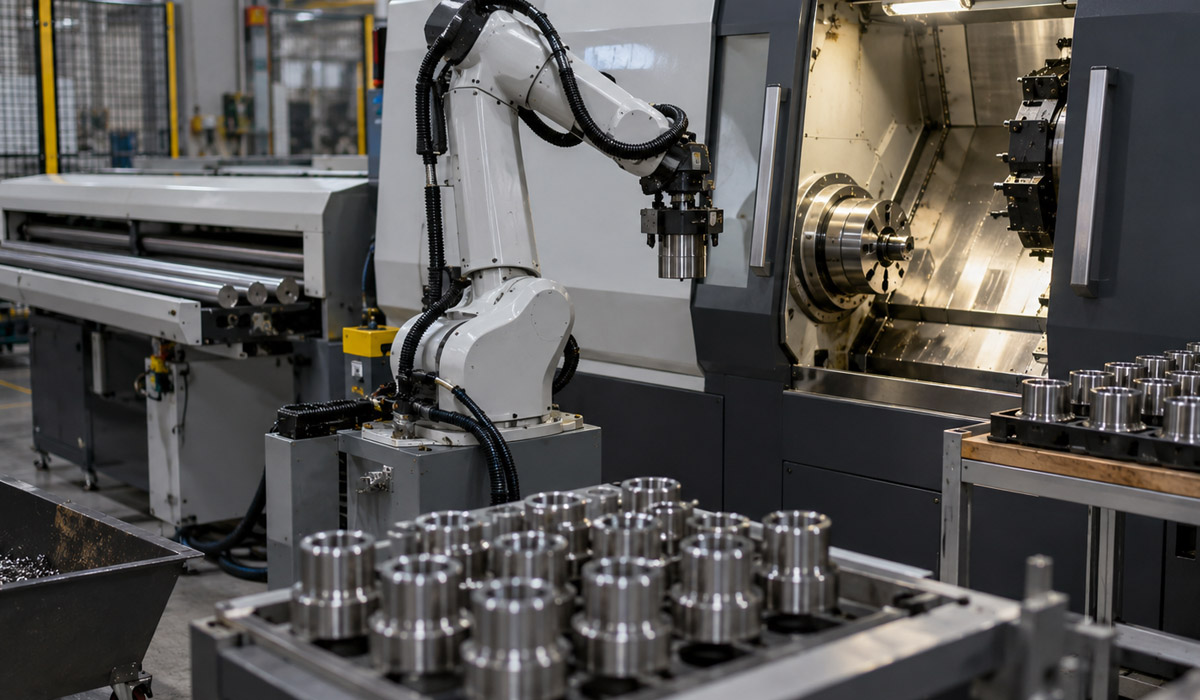
Increasingly, it is expected to turn, mill, drill, transfer, measure, unload, communicate with automation and keep producing with limited operator intervention.
In other words, the modern turning center is beginning to look less like an isolated machine and more like a miniature factory.
And this change is happening at an interesting moment for the machine-tool industry.
U.S. orders for metalworking machinery reached $605.8 million in July 2026, according to AMT’s latest U.S. Manufacturing Technology Orders data. That was 55.2% higher than July 2025. Orders for the first seven months of 2026 reached approximately $4.03 billion, up 37.1% year over year, while July marked the fifth consecutive month in which orders exceeded $500 million.
Those figures cover metalworking machinery broadly rather than turning machines alone, but they show that manufacturers are continuing to make substantial capital-equipment investments.
What interests me most is not simply how much manufacturers are spending.
It is what they appear to be spending it on.
The Machine Is Becoming Part of the Automation System
One of the clearest themes at IMTS 2026 is that automation is moving closer to the machine itself.
Okuma, for example, is demonstrating multiple turning platforms with integrated automation. Its LT2000 EX horizontal lathe is being paired with a bar feeder and built-in unloading technology. The LU3000 EX is being shown with a gantry-loading system, while the LB2000 EX III MYW is being demonstrated with robotic loading.
To me, this says something important about where turning is heading.
We used to talk about automation almost as if it were an accessory—a robot added beside the machine after the purchasing decision had already been made.
Now the relationship is becoming much tighter.
The machine, feeder, robot, workholding, unloading system and CNC control increasingly need to behave like pieces of the same organism.
That changes the basic question manufacturers ask when evaluating equipment.
Instead of asking:
“How quickly can this machine produce one part?”
The more useful question is becoming:
“How many finished, acceptable parts can this system produce during an entire shift with minimal intervention?”
Those questions sound similar, but economically they are very different.
Dual Spindles and Y-Axes Are Changing the Productivity Equation
Haas is also giving us a good snapshot of the current direction of turning technology.
Its IMTS lineup includes the ST-20Y, with Y-axis capability and live tooling, as well as the DS-30Y, a dual-spindle Y-axis turning center demonstrated with a 12-foot bar feeder. Larger dual-spindle configurations are also part of the company’s current turning portfolio.
Why does this matter?
Because many components refuse to remain simple “turning parts.”
They arrive with cross holes.
Flats.
Slots.
Off-center features.
Threads.
Milled surfaces.
Features on both ends.
Every additional feature forces the manufacturer to make a decision: move the component to another machine or give the turning center enough capability to finish more of the work itself.
Y-axis machining, live tooling and secondary spindles push the answer toward the second option.
That is one reason modern CNC lathes are increasingly being evaluated not just by how well they turn a diameter, but by how many secondary operations they can absorb into the same setup.
The traditional boundary between the lathe and the machining center is becoming harder to see.
The Goal Is Becoming One Setup
Perhaps the strongest example of this shift is the growth of turn-mill equipment.
Okuma is featuring the MULTUS U1000, a multitasking machine built around complete machining. Its configuration includes a wide-range B-axis, a high-speed milling spindle and a large automatic tool changer, with options for a sub-spindle and lower turret.
The specifications are impressive.
But for me, the more important story is what those capabilities represent.
A traditional lathe performs turning exceptionally well. A modern turn-mill platform is trying to absorb operations that once belonged to several different machines.
That can mean turning the outside diameter, boring the inside diameter, drilling a cross hole, milling a feature, machining the back side and producing something much closer to a finished component before the machine door ever opens.
Every eliminated setup is like removing a toll booth from a highway.
The workpiece keeps moving toward completion without stopping to be unclamped, transported, queued, reclamped and referenced again.
That is not simply a cycle-time improvement.
It can influence accuracy, work-in-process inventory, labor requirements, floor-space usage and total lead time.
Multi-Spindle Machines Push Productivity in Another Direction
INDEX is also using IMTS 2026 to introduce technology aimed specifically at high-productivity turning.
Its TRAUB MS12-4 CNC multi-spindle is making its North American debut. The concept is designed to increase throughput for small precision components by bringing multiple machining positions together within one production system.
INDEX is also highlighting the G160 CNC turn-mill, combining multiple spindles, five-axis milling capability and lower turrets capable of working across different machining positions.
I find this particularly interesting because it shows that turning technology is evolving in two directions at the same time.
One direction is flexibility: allowing one machine to process more part families and complete more operations.
The other is parallel productivity: allowing several operations to happen simultaneously.
The old manufacturing equation often said that if you needed significantly more output, you added another machine.
Modern multi-spindle and multi-turret systems challenge that assumption.
Instead of multiplying machines, manufacturers can multiply the amount of machining taking place inside one enclosure.
Swiss-Type Machines Are Following the Same Pattern
The same trend is visible in precision small-part manufacturing.
Tsugami America is showing several Swiss-type automatic turning machines at IMTS 2026, including small-diameter multi-axis systems as well as larger B-axis sliding-headstock platforms. Its lineup also includes turn-mill equipment with automated loading and unloading.
Again, I see the same pattern.
More axes.
More operations.
More automated handling.
Less unnecessary movement between machines.
This is particularly important in industries producing large numbers of precision components—medical devices, electronics, automotive parts, aerospace components, connectors and other demanding applications.
In these environments, a few seconds saved in handling may seem insignificant.
Multiply those seconds across hundreds of thousands of parts and suddenly they become hours, days and considerable cost.
Bar Feeders and Robots Are Becoming Part of the Buying Decision
This is why I think manufacturers need to broaden the way they evaluate turning equipment.
Maximum turning diameter still matters.
Spindle speed matters.
Spindle power matters.
Tool capacity matters.
But increasingly, I would also ask:
Can the machine run effectively from a bar feeder?
Can it unload finished components automatically?
Can a robot load castings, forgings or pre-cut blanks?
Can it machine both ends without manual transfer?
How easily can it communicate with automation?
Can one operator realistically supervise multiple machines?
Can tooling conditions be monitored during unattended production?
These are no longer futuristic questions.
They are purchasing questions.
For manufacturers operating CNC lathes, this is particularly significant because turning is naturally well suited to automation. Bar stock can be continuously fed, chucking work can be robotically loaded, and finished parts can be transferred or unloaded without requiring an operator to open the door after every cycle.
The machine becomes part of a flow rather than a standalone workstation.
Programming Is Also Moving Away From the Physical Machine
Another current development adds a digital layer to this transformation.
On September 15, 2026, Siemens introduced its “Meet at the Machine” initiative with TRAK Machine Tools.
The idea is to connect engineering, programming, simulation and machine automation more closely so manufacturers can begin preparing production before a new machine has even reached the factory floor.
Siemens says the approach can reduce machine ramp-up time by as much as 50%. That figure comes from Siemens itself rather than an independent industry benchmark, but the broader direction is worth paying attention to.
More programming and process preparation can now happen away from the actual machine.
Digital twins and offline simulation allow manufacturers to test toolpaths, examine collisions and prepare production virtually.
To me, this adds another chapter to the automation story.
First, we automated cutting.
Then we automated loading and unloading.
Now we are beginning to automate and virtualize more of the preparation surrounding the machining process.
The physical machine is still where metal becomes a finished component.
But an increasing amount of the thinking can happen before the first chip ever falls.
Manufacturers Are Paying for Capability
There is also an interesting detail inside the current U.S. machine-tool order numbers.
For the first half of 2026, U.S. manufacturing technology orders reached roughly $3.44 billion, representing the highest first-half value reported by AMT since it began collecting the current series of data.
At the same time, the number of machines ordered did not increase at the same rate as total spending.
There are many possible reasons for this—including machine mix, pricing, tariffs and larger individual projects—so I would not reduce the trend to one simple explanation.
Still, it fits what we are seeing on the technology side.
Manufacturers appear willing to invest in machines that provide more capability inside one platform.
A turning center that replaces two setups, automatically transfers the workpiece, performs milling, runs from bar stock and continues producing while an operator manages another machine may carry a higher initial price.
But its real value is not simply in what happens at the cutting edge.
Its value comes from everything it removes from the surrounding production process.
Fewer transfers.
Fewer queues.
Fewer fixtures.
Less manual handling.
Less idle spindle time.
The cheapest machine is not always the machine that produces the cheapest part.
Automation Does Not Mean Every Factory Needs the Most Complex Machine
It would be easy to look at IMTS and conclude that every manufacturer needs an enormous multitasking system packed with axes, turrets and automation.
I do not think that is the right lesson.
Simple two-axis turning machines will continue to make enormous economic sense for the right applications.
Sometimes simplicity is exactly what production needs.
What is changing is that automation is becoming increasingly scalable.
One manufacturer may begin with a conventional turning center and a bar feeder.
Another may require Y-axis capability and live tooling.
A higher-volume operation may move toward twin spindles and automatic unloading.
A precision small-part producer may choose a Swiss-type platform.
A supplier making high-value complex components may justify a B-axis turn-mill machine capable of completing almost everything in one setup.
Different machines.
Different investment levels.
But the direction is remarkably consistent.
Reduce handling.
Reduce setups.
Keep the spindle producing.
Increase the amount of finished work created before a person needs to touch the component again.
The Spindle Is Still the Heart
There is something almost poetic about this evolution.
The fundamental principle of turning is mechanically simple: rotate the workpiece and bring a cutting tool against it.
That principle remains intact.
But nearly everything surrounding that rotating spindle is changing.
At IMTS 2026, we see turning centers connected to robots, gantry loaders, bar feeders and automatic unloaders. We see twin spindles handing components from one side of the machine to the other. We see B-axis milling heads bringing complex machining into the turning environment. We see Swiss machines compressing remarkable numbers of operations into compact production cells.
And increasingly, we can simulate and prepare that production digitally before the machine is ready to cut.
The spindle is still the heart.
But automation is becoming the nervous system.
For me, that is the real turning story of 2026.
The competition is no longer simply about building a faster machine.
It is about helping manufacturers transform raw material into a finished component with fewer setups, fewer interruptions and less unnecessary movement in between.