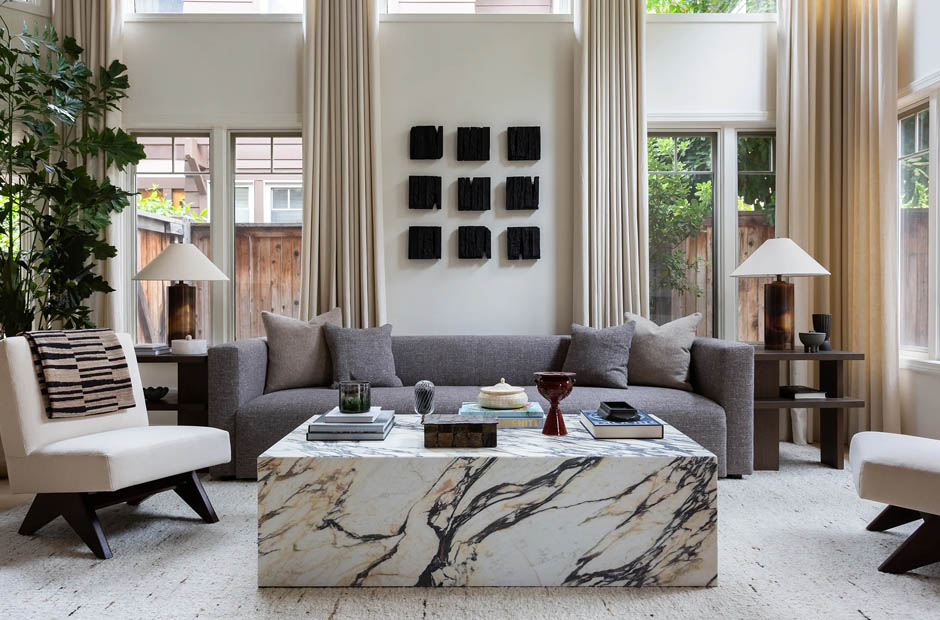
Luxury interiors have changed their tone. Of course, it is not entirely true. This is because people still love drama, shine, scale, and the little theatrical things that make a room feel expensive.
However, the louder version of luxury now feels slightly tired. It is too obvious and too showroom-ish.
Instead, the sharper direction sits somewhere between restraint and intensity. For instance, a room might feel calm and still carry force. Also, it can use fewer objects and still say more. In fact, that is where serious interior design now seems to be heading. Now, it is about less clutter and more consequence.
The New Luxury Is About Weight, Not Noise
For a long time, luxury meant abundance. It was about more marble, more polish, more decorative layers, and more imported everything. Yet, modern taste has become more suspicious of excess. Although people still want beauty, they want beauty that feels edited, grounded, and lived with.
This is why metal, stone, dark timber, sculptural lighting, and architectural panels keep finding their way into refined homes. These materials do not beg for attention. Still, they hold the room. Moreover, they create edges and shadows. Also, they create a quiet rhythm that matters more than another glossy object on a console.
Why Statement Pieces Need Discipline
A statement piece works only when the room gives it enough air. Otherwise, it becomes just another expensive thing fighting for space. Therefore, the better approach is not to fill every corner. Rather, it is about choosing one or two strong visual anchors. Also, let the rest of the design support them.
For example, a steel wall panel, a sculptural mirror, or a carved room divider might change the whole mood of a space. Likewise, a dark accent piece will bring depth without making the room feel heavy. The trick, though, is proportion. For instance, too small looks nervous, while too large takes over.
Also, lifestyle now shapes design more directly. In fact, a homeowner who values art, travel, and privacy may want interiors that feel composed rather than flashy. In that sense, even premium services such as private jet charter Dubai sit within the same luxury mindset. It is about-
- Controlled movement
- Personal comfort
- A smoother relationship with time.
Materials Now Carry the Story
Materials are not neutral anymore. Essentially, they carry memory. They suggest taste, permanence, and sometimes even attitude.
Steel, in particular, has moved beyond its industrial reputation. When treated carefully, it feels refined and graphic.
However, no material saves a poorly planned space. For instance, a beautiful metal screen will still look awkward if the lighting is wrong. Similarly, a dramatic feature wall can feel flat when surrounded by mismatched furniture.
So, the real question is not, “What looks expensive?”
The better question is, “What gives the room a point of view?”
| Design Choice | What It Communicates | Best Used When |
| Sculptural metalwork | Strength, precision, permanence | The room needs a visual anchor |
| Dark finishes | Depth, intimacy, control | Natural light is strong enough |
| Art-led décor | Personality, culture, taste | The space feels too generic |
| Minimal furniture | Calm, clarity, confidence | The architecture already has a presence |
The Problem With Over-Styled Homes
Many luxury homes now suffer from the same issue. Although they look complete, they are not alive. Basically, everything matches too neatly. Also, nothing interrupts the eye. Consequently, the space feels expensive but emotionally thin. It is like a hotel lobby pretending to be a home.
Better interiors usually contain some friction. It might be a bold line against a soft wall, or a vintage object next to something contemporary. Also, it might be a handmade texture beside a flawless surface. These small tensions make rooms feel human. Moreover, they stop luxury from becoming sterile.
A few principles help keep things balanced:
- Choose one dominant material story. Then, let other elements support it.
- Use contrast carefully, especially between matte and reflective surfaces.
- Leave negative space around strong pieces. This is because visual breathing room matters.
- Avoid buying décor only to fill silence. Sometimes silence is the design.
Quiet Rooms Can Still Have Power
The strongest luxury interiors today do not shout. Rather, they hold themselves well. Also, they use fewer gestures. However, those gestures land harder. As a result, the room feels intentional rather than decorated, personal rather than performed.
To be honest, that may be the more mature version of luxury. It is a little severe where it needs to be, and softer where life actually happens. Also, it must be confident enough to let materials, shadows, and space do their work.



