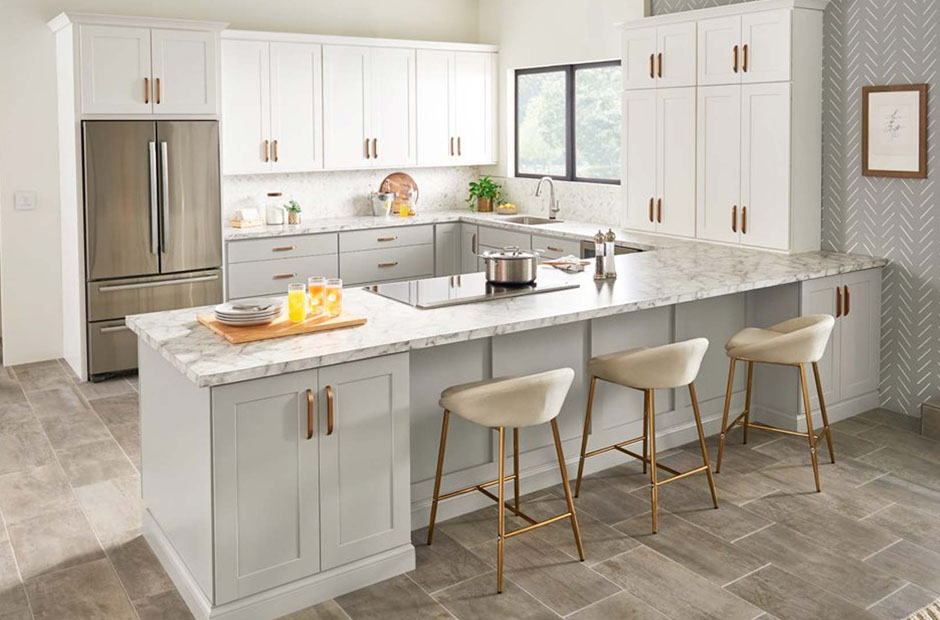
Three kitchens. Same general layout. Same overall budget envelope. One was built with stock cabinets, one with semi-custom, one fully custom. To the eye in a real estate photo, they can look nearly identical. To live in, they perform very differently, and the underlying construction is much further apart than the finished appearance suggests.
Kitchen cabinets are the single largest material decision in most kitchen renovations. The category of cabinet you choose shapes the project’s cost, its timeline, what dimensions are possible, and how the kitchen will hold up over years of daily use. Yet most homeowners enter the renovation conversation without a clear sense of how the three tiers actually differ.
For anyone considering custom kitchen renovations Toronto, understanding what “custom” actually means in cabinet construction is the difference between specifying the right product for the space and overpaying for marketing language. Here is what each tier really involves.
Stock Cabinets: Fixed Sizes, Fast Delivery
Stock cabinets are mass-produced in standard dimensions. Box widths typically come in three-inch increments from 9 to 48 inches. Heights are standardized. Depths are fixed at 12 inches for uppers and 24 inches for bases, with limited exceptions.
Construction is generally particleboard or thin plywood with melamine interiors. Doors come in a defined catalog of styles, colors, and finishes. The cabinet either fits your space or it does not. Fillers and adjacent strips of wood are used to span the gaps where dimensions do not line up exactly.
The advantages are real. Stock cabinets are the least expensive option by a wide margin. They are typically available in two to four weeks rather than months. Quality control is consistent because the manufacturing process is standardized.
The disadvantages show up in two places. First, the construction materials are not built to last decades. A well-cared-for stock kitchen typically performs well for ten to fifteen years before drawers start to fail, door alignment drifts, or moisture damage appears at the seams. Second, the fixed dimensions force compromises in space planning. Awkward gaps, oversized fillers, and limited storage configurations are common.
Semi-Custom: The Middle Ground
Semi-custom cabinets start with a stock catalog but allow modifications. Common variations include adjustable widths in one-inch increments, choice of interior configurations, several depth options, and a wider range of door styles, finishes, and accessories.
Construction is typically a step up. Cabinet boxes are often plywood rather than particleboard. Joinery is more robust. Interior fittings, such as soft-close hinges and full-extension drawer slides, are usually standard rather than upgrades.
Delivery times stretch to six to twelve weeks, sometimes more, because each order is built to specification. Pricing typically runs from forty to seventy percent above stock for comparable visual quality.
This tier suits most kitchen renovations in the middle of the market. The dimensional flexibility solves the worst space-planning compromises of stock cabinets. The construction quality is significantly better. The cost premium is meaningful but not prohibitive. For a typical Toronto kitchen, semi-custom often produces the best result per dollar spent.
Fully Custom: Built to the Space
Custom cabinets are built from scratch to fit a specific kitchen. There is no catalog. Each cabinet is designed, drawn, and constructed for the project at hand.
Construction is hardwood or marine-grade plywood. Joinery uses doweled or mortise-and-tenon connections rather than mechanical fasteners. Doors are typically solid wood, often with raised panels or other detailed construction. Interior fittings can be specified to any configuration the homeowner can imagine, including unusual depths, varied heights within a single run, integrated appliances, and bespoke storage solutions like custom spice drawers, knife blocks, or appliance garages.
The lead time is the longest. Twelve to twenty weeks is typical, and some custom cabinet shops run on schedules of six months or more. Pricing varies widely depending on the maker, but typically begins around two to three times the cost of comparable semi-custom and can run much higher for high-end woodwork.
Where custom earns its premium is in two specific areas. First, dimensional precision. A custom kitchen can be designed for the actual room, including walls that are not perfectly square, ceilings that are not perfectly level, and openings that are oddly sized. Stock and semi-custom cabinets have to be made to fit through fillers and adjustments. Custom cabinets are made to fit. Second, longevity. A well-built custom kitchen using solid wood construction routinely performs for thirty to fifty years. Many century homes still have their original built-in cabinetry, which would not be true of stock products.
How to Tell Which Tier a Quote Is Actually Offering
Cabinet quotes use the language of “custom” loosely. A semi-custom line being sold as custom is common. The way to tell what you are really being quoted is to look at the construction specifications:
- Box material. Particleboard or thin MDF is stock. Plywood is semi-custom or custom. Solid hardwood box construction is genuinely custom.
- Mechanical fasteners and stapled corners are stock. Doweled or pocket-screw construction is semi-custom. Mortise-and-tenon or dovetailed joinery is custom.
- If the quote can only be built in three-inch increments, it is stock. If it can be built in one-inch increments, it is semi-custom. If it is genuinely built to your drawing, with any dimension possible, it is custom.
- Door material. Veneered MDF or particleboard with thermofoil finish is stock. Solid wood doors with painted or stained finishes are custom-tier.
- Lead time. Two to four weeks is stock. Six to twelve weeks is semi-custom. Twelve weeks or more is typically custom.
When Each Tier Makes Sense
Stock cabinets are the right choice for rental properties, secondary homes used occasionally, or homes the owner plans to sell within a few years. The shorter lifespan matches the shorter expected use horizon.
Semi-custom is the right choice for most owner-occupied kitchens in the middle market. The construction is durable enough for long-term use, the dimensional flexibility solves the worst space planning issues, and the cost premium over stock is justified by the meaningfully better outcome.
Custom is the right choice for kitchens in homes the owner intends to live in for many years, for spaces with unusual dimensions or architectural features that semi-custom cannot accommodate, and for homeowners who specifically value handcrafted construction. The premium is real, but so is the result.
The Bottom Line
The word “custom” is doing a lot of work in kitchen marketing. Most kitchens described as custom are actually semi-custom, and most semi-custom kitchens are sold for more than their construction reflects. The way out of the confusion is to look at the construction specifications rather than the language on the brochure.
A kitchen lives with you for decades. Knowing what tier of cabinetry you are actually getting, and matching that tier to the way you actually plan to use the space, is one of the most consequential decisions in the entire renovation.



