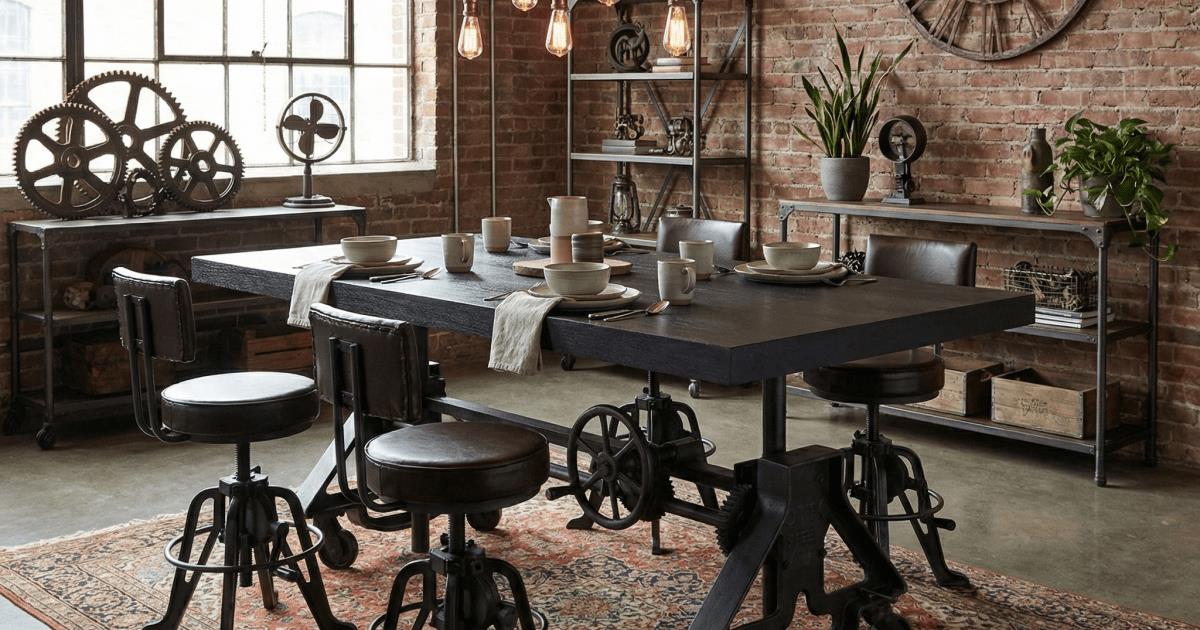
Themed rooms succeed when you build the space around one or two quality anchor pieces and keep the supporting cast highly restrained, rather than crowding the area with novelty items. While themed interiors have a bad reputation for looking like gift shops or stage sets, focusing on material authenticity creates personal, memorable spaces.
This guide outlines five unique room themes, from industrial lofts to castle-inspired designs, that consistently work when executed with this single-anchor principle.
1. The Industrial Loft
Authentic industrial room décor relies on exposed raw metal joints, Edison filament bulbs, and bare brick textures. The aesthetic demands furniture that reads as a working space rather than a curated showroom floor. Nothing sits in the room unless it serves a strict functional purpose alongside its visual weight.
The desk serves as the non-negotiable statement-piece room anchor in this layout. A showroom sofa can feel merely industrial-adjacent, since a dedicated workspace sets the mechanical tone for every other object.
An authentic piece like a sturdy industrial drafting table from Knox Deco brings early factory proportions into an industrial drafting desk home office. The reclaimed hardwood surface and heavy cast-iron base handle the design work while remaining genuinely usable day to day.
Pair this heavy metal anchor with a worn leather chair so the softer texture adds necessary visual depth. Run open steel or iron pipe shelving along an adjoining wall to provide practical storage.
Restrict the surrounding color palette to charcoals, matte blacks, and warm raw wood tones. Resisting bright color accents prevents the hard edges of the space from softening.
| Key Insight: Industrial design is built on functional honesty. If a piece doesn’t serve a demanding physical job, its visual weight will feel performative. Let a heavy, usable anchor like a drafting table set this non-negotiable tone. |
2. Medieval and Castle-Inspired
Authentic medieval room décor settles in with dark wood, heavy iron, and a profound sense of accumulated history. Restraint drives the success of castle-inspired interior design. A space full of cheap novelty items quickly degrades into a costume shop, but one or two display-quality pieces create a historically grounded atmosphere.
Decorative armor acts as the definitive focal point when placed in specific display scenarios. You can mount a fluted steel helm directly above a central fireplace or arrange a chainmail hauberk inside a recessed alcove.
Museum-quality reproductions like the decorative medieval armor from Medieval Collectibles carry a material weight that plastic pieces simply cannot replicate. The detailed metal construction anchors the room, so smaller supporting pieces do not have to.
Support this heavy focal point with substantial dark wood furniture like a heavy oak sideboard or a trestle-style console table. Place wrought-iron candle holders on these surfaces to introduce atmospheric lighting without allowing bright electronic fixtures to disrupt the historical aesthetic.
Layer deep jewel-toned textiles in burgundy or forest green across seating, and utilize exposed stone or deep charcoal paint as a heavy backdrop.
3. Botanical and Biophilic
Moving from iron to living materials shifts the visual energy toward botanical abundance. This framework relies on clustered plant groupings paired with natural fiber textiles like jute, rattan, and linen against an earthy moss-green palette.
Anchor the layout with a single large statement plant instead of scattering dozens of small starter pots across every available flat surface. According to indoor environment research, keeping the greenery dose around 20 percent provides the strongest restorative response, while filling 60 percent of a room with looming plants actually elevates stress.
Layering woven textures builds material warmth without generating visual clutter. Place a thick jute rug underfoot, hang a structural rattan pendant light, and drape a heavy linen throw over seating to ground the organic elements.
The physical plants do more than just look good. Adding just six potted plants to a room can decrease CO2 concentrations from 2004 to 1121 ppm while reducing total VOC averages from 933 to 249 µg/m³ and dropping PM10 concentrations by 30 percent.
Keep the surrounding wall color painted a neutral white so the physical greenery reads as the deliberate focal point. Getting the lighting right ensures these plants thrive and reduce air pollutants by up to 87 percent. This combination of clean air and balanced natural textures makes the space feel intentionally designed rather than overgrown.
4. Coastal and Nautical
Trading deep greens for sun-bleached blues introduces the airy lightness of a coastal aesthetic. The foundational materials require whitewashed furniture combined with soft navy fabrics and strictly minimized maritime objects.
Choose a large bleached-wood credenza as the physical foundation of the room. The lighter grain establishes a maritime feel without looking literal or cliché.
Integrate heavy nautical rope as a functional mechanical detail for curtain tiebacks or cabinet handles rather than hanging it as a standalone decoration. Select exactly one deliberate maritime object to dictate the room’s character.
A salvaged brass porthole mirror or a framed vintage nautical chart does significantly more structural design work than an entire shelf of painted wooden buoys.
5. Japanese Minimalist
Moving away from heavy iron introduces a quieter discipline where the primary design action is removal rather than addition. The Japanese minimalist aesthetic demands clean architectural lines and negative space treated as a deliberate structural element.
Apply a strict one-object-per-surface rule throughout the area. Placing a single ceramic bowl or a small pruned bonsai ensures the item carries full visual weight because nothing else competes with it.
Select solid wood furniture featuring visible joinery and clear natural grain so the raw material itself serves as the primary decoration. Construction quality dictates the visual success of the piece when ornamentation is absent.
Install wide paper pendant shades to keep the ambient light soft and even. Harsh overhead recessed fixtures actively fight the contemplative nature of the layout.
| Pro Tip: Apply a strict one-object-per-surface rule immediately. By forcing every single ceramic bowl or bonsai to carry the full visual weight, you transform ordinary items into powerful focal points without spending a dime. |
The Bottom Line
Adjacent themes often share a raw material vocabulary that allows them to combine without causing visual confusion. Industrial and medieval spaces both rely heavily on forged iron, dense dark wood, and rough stone textures.
Placing a cast-iron drafting table beside a mounted steel helm against a dark brick wall generates deliberate architectural tension rather than a messy clash of eras.
Understanding how to theme a room without overdoing it comes down to letting one major piece carry the structural load. A dedicated workspace anchor or a piece of display-quality armor dictates the room’s entire story while the supporting furniture stays out of the way.