Choosing the right car rental location during a European holiday means comparing travel convenience, vehicle choice, and the full price. Costs can differ a lot between airport counters, city branches, and suburban depots. The desk closest to your arrival gate is not always the best choice. You may need to compare airport facility fees with local public transport costs, check whether your pickup point is inside a low-emission zone, and confirm that the branch has the transmission type and cross-border documents you need.
When deciding where to rent a car, match the branch with your route and check how that location operates. This can help your trip start smoothly as soon as you collect the keys.
A good pickup point can save more than a few euros on the daily price. It can protect your holiday schedule and reduce stress. Driving through old cobbled streets in an unfamiliar car after an overnight flight is rarely enjoyable. Choosing a station that suits your driving experience and travel plans can turn a difficult task into an easy start to your European road trip.
Which Car Rental Location Best Fits Your Itinerary?
European car rental branches are mainly found in four types of places: international airports, city centers, railway stations, and smaller towns. Each type works better for a different travel plan. The right choice depends on where you will drive after collecting the car. Picking a branch that fits your route can help you avoid heavy traffic and extra public transport connections.
Branch operations can also vary a lot. An airport counter may offer service all day and night, with a large parking area holding hundreds of vehicles. A small city office may have only two employees and keep its cars in a commercial garage several streets away. Learning how each branch works can help you choose a location that fits your plans.
Airport Pickup: Convenience, Availability, and Extra Fees
International airports are easy pickup points for people arriving by plane. They often offer long opening hours, large fleets, and direct access to major motorways. Collecting the car after landing means you do not have to arrange a train journey or a costly taxi into the city while carrying heavy bags. Large airports also tend to have more vehicles available, including automatic cars and larger estate cars for several passengers.
This convenience usually comes with a higher price. Many European countries charge airport concession fees and location surcharges. These may raise the basic rental price by 14% to 20% in countries such as Germany and Switzerland. In France, Spain, and the UK, the added fee may be a fixed €35 to €80. You need to decide whether driving away directly from the arrivals area is worth the extra charge.
City-Centre Pickup: Access, Pricing, and Driving Restrictions
City-center branches suit travelers who want to spend their first days exploring a walkable capital before driving into the countryside. You can wait to collect the car until you are ready to leave the city. This avoids hotel parking costs and means you do not pay for a car that is sitting unused. City branches are often reachable by a short walk or a quick local transport ride from your accommodation.
City locations also bring some problems. Leaving an underground garage in the center can put you straight into busy traffic, confusing one-way streets, and strict local driving rules. Narrow roads, delivery vans, bicycles, and pedestrians can make the first few minutes difficult, especially if European road layouts and local signs are new to you.
Train Station Pickup for Multi-City European Trips
Railway station branches work well for trips that combine fast trains with rural driving. You can take a comfortable train from a large city to a regional gateway, such as Paris to Avignon or Munich to Salzburg, and collect a car at the station. From there, you can visit nearby valleys and villages. This plan avoids hours on the motorway and can reduce toll costs while still giving you the freedom to explore the region.
Many European rental companies treat large railway stations as premium locations, just as they treat airports. Rail station branches in France, Germany, and the Netherlands may charge the same 15% to 20% location surcharge or fixed station fee found at airport counters. Compare the time saved by taking the train with the extra price charged at the station.
Small Town and Resort Locations: Lower Rates but Fewer Vehicles
Renting a car in a small town or coastal resort can provide a lower basic rate and help you avoid premium location charges. These branches are often quieter and have lower running costs. They also let you join country roads without first driving through a ring road or busy city junction. A local branch can be a relaxed option for travelers staying in a nearby holiday rental.
The main weakness of a small branch is its limited fleet and staff. It may have only a few basic compact manual cars. Specialty vehicles, large SUVs, and automatics may be hard to find unless you book several months ahead. Smaller offices may also have shorter hours, close at midday, or have less experience handling international booking vouchers and special insurance waivers.
How to Compare Airport, City, and Off-Site Rental Prices
To compare European rental prices properly, look beyond the daily rate shown on a booking website. Rental companies change their prices based on fleet size, season, local demand, and competitor rates. This can create surprising results. An airport branch with high operating costs may sometimes show a lower base rate than a quiet city branch because it has many more cars available.
Compare the full cost at each location. Add the daily rental price, local facility charges, taxes, public transport or taxi costs, and the value of time spent reaching the branch. Only after adding every cost can you tell which pickup point is really cheaper.
Location Surcharges, Facility Fees, and Local Taxes
When you rent from a major transport hub, the company often passes its higher property costs to the customer. In Germany, collecting a mid-sized estate car at an airport or main railway station may add about 20% to the basic rental price. A rental that costs €275 away from the airport could rise to €330 at the terminal for the same car and dates.
In countries such as France, Italy, and Spain, the extra location cost is often a fixed fee of €35 to €80. Many European contracts apply this fee only to the pickup point. This means you may be able to collect a car from a quiet city branch without the airport charge and return it to an airport without paying the airport fee again.
Transfer Costs and Time When Choosing an Off-Airport Branch
Off-airport companies are often located several kilometers from the terminal in commercial areas. They may advertise low daily rates, but you also need to calculate the cost of reaching the depot. If you must buy expensive express train tickets or order a ride for a family of four, the cost of getting there can remove most of the saving.
Time also has value during a holiday. Some off-airport companies use shuttles that run only occasionally. Others ask you to make an international phone call after customs so a driver can collect you. Waiting 30 to 45 minutes outside for a shuttle is frustrating, especially if the van has little space for bags or does not have the child seats you requested.
Why the Cheapest Daily Rate May Not Be the Lowest Total Cost
Read the final quote carefully. A low daily rate may come with strict fuel rules, limited daily mileage, or a large security deposit that holds thousands of euros on your credit card. An advertised price of €15 per day can quickly become three times higher after extra fees, required insurance, and location charges are added.
The table below compares two common choices for a seven-day rental in Western Europe. It shows why an airport rental that looks expensive at first can be close in price after all costs are included:
| Cost Component | Airport Terminal Desk | Off-Airport Shuttle Depot |
| Base Rental Rate (7 Days) | €280.00 | €190.00 |
| Airport Surcharge / Concession Fee | €45.00 | €0.00 |
| Ground Transfer / Taxi to Branch | €0.00 | €35.00 |
| Out-of-Hours Fee (Late Arrival) | Included / Open Late | €40.00 |
| Transit Time from Baggage Claim | 15-20 minutes | 45-60 minutes |
| Total Financial Cost | €325.00 | €305.00 |
In this example, the off-airport depot saves €20, but it uses extra holiday time and adds more steps after a tiring flight. Many travelers may prefer to pay a small amount more for immediate access to the terminal desk.
How Do European Driving Rules Affect Your Rental Location?
European cities have introduced many environmental and traffic rules that affect drivers. Local authorities limit vehicle access to protect historic areas, reduce emissions, and create more space for pedestrians. Picking up a car in a city center means you need to know these rules, since a wrong turn can lead to an automatic fine.
Your pickup location affects how soon you meet these restrictions. A branch outside the center or at an airport lets you join a main road without driving through local restricted areas. A central branch means you should check that the car has the right stickers and permits before leaving the garage.
Congestion Zones, Low-Emission Areas, and Car-Free City Centres
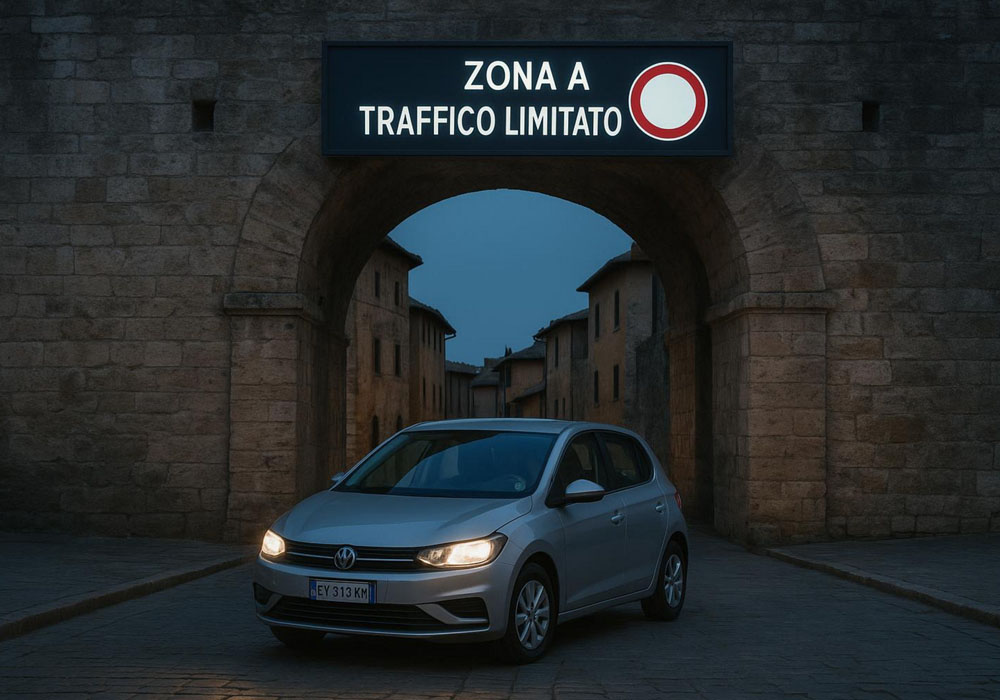
More than 320 European cities now have Low Emission Zones, Clean Air Zones, or other restricted areas monitored by cameras. In Italy, many historic centers are marked as Zona a Traffico Limitato (ZTL). Entering without permission can result in a fine of €100 to €330 each time. Spain has Zonas de Bajas Emisiones (ZBE) in all cities and towns with more than 50,000 residents. Vehicles may need an official DGT environmental sticker, such as C or ECO.
German city centers generally require a green Umweltplakette. French urban areas may require a Crit’Air windscreen sticker. If you collect a car inside one of these areas, check that the vehicle has the correct local sticker before driving away. An airport outside the city can help you avoid these rules during the first part of your trip.
Parking Availability Near City Pickup Branches
Parking in historic European centers is often difficult and expensive. Street spaces may be reserved for residents or controlled by strict payment times and digital meters. If your hotel does not have parking, collecting a car in the center can create an immediate problem. Commercial garages may charge €35 to €60 per night.
Many European parking garages are also small, with narrow ramps and tight spaces made for compact cars. Driving a mid-sized estate car or crossover through a medieval garage can lead to scratched wheels or damaged bodywork. Picking up the car outside the center means you can avoid city parking costs altogether.
What Should You Check Before Booking a Rental Location?
Before booking a branch, read its own terms instead of relying only on the general rules of the rental company. Conditions can differ between franchises in the same network. Small details about a branch can cause problems before your trip even reaches the counter.
Checking these details in advance can prevent surprises about opening hours, identification, and payment holds. Spend a few minutes reading the terms so you arrive at the right desk with the required documents and payment card.
Opening Hours, Late Pickup, and Key-Collection Rules
Check the branch hours against your arrival time. Airport counters at places such as Frankfurt, Madrid, and Paris Charles de Gaulle may stay open until midnight or operate all day. City branches often close by 6:00 PM on weekdays, work only part of the day on Saturdays, and close on Sundays. If your train is delayed before a late-afternoon city pickup, the office may close before you arrive.
Add your flight or train details to the booking. This lets staff follow delays and may help them hold the car after the usual closing time. Rental companies such as Carfree.pl ask for these details at the booking stage for exactly this reason. If you expect to arrive late, ask about an after-hours pickup fee. This commonly costs €30 to €60.
Vehicle Availability and Category Restrictions by Branch
European rental systems use four-letter ACRISS codes, such as CDMR for a compact, four-door manual car with unspecified drive. These codes describe the vehicle class rather than promise a particular make or model. A booking for “Volkswagen Golf or similar” means the branch will provide a car with a similar size and capacity. A small branch may have trouble meeting your luggage needs if its available replacement car has less space.
For five travelers with a lot of luggage, an airport branch gives you more options. If the assigned estate car is too small, an airport may have a compact passenger van or another suitable vehicle. At a small city office, the car already parked outside may be the only one available that day.
Driving Licence and International Driving Permit Requirements
Rental staff check driving documents carefully at collection. Licenses from English-speaking countries are accepted in much of northern and western Europe. However, countries such as Italy, Austria, Spain, and Greece formally require an International Driving Permit (IDP) in addition to your domestic license. If an IDP is required by law and you do not have one, the agent may cancel the booking and refuse the car.
An IDP costs about $20, translates your license into ten languages, and must be obtained before leaving your home country through an approved motoring organization such as AAA. Also check that the main driver’s physical credit card has enough available credit for the security deposit. This hold is often €500 to more than €2,000, depending on your insurance excess. Many European branches do not accept debit cards for vehicle pre-authorizations.
Which Rental Company and Branch Should You Choose?
Choosing a rental company means comparing price with service. Europe has large international companies, regional discount providers, and small independent businesses. Each group has different strengths. Pick the type of company that matches your budget and travel experience.
Service can also differ from one branch to another. An international company with excellent service in Munich may have a poorly managed franchise in Rome. Reviews of the exact branch can tell you more than the company name alone.
Global Brands Versus Local European Rental Companies
Large brands such as Avis, Hertz, Enterprise, Europcar, and Sixt generally offer consistent procedures, newer fleets, loyalty programs, and broad cross-border support. Their counters are often inside the main airport terminal rather than at a remote shuttle location. If the car develops a problem or you need new cross-border documents, these companies usually have 24-hour support and replacement networks in several countries.
Local companies and low-cost regional brands such as Goldcar, Centauro, and Green Motion often advertise very low starting prices. They may make up the difference through strong sales pressure at the counter, strict insurance checks, high fuel charges, and tough damage inspections at return. Experienced renters who know how to reject unwanted extras may save money with these companies. Larger brands usually offer a clearer and easier rental process.
Checking the Exact Branch Terms Rather Than Only the Brand
Many European rental branches are run by independent franchisees. Read recent reviews for the exact office you plan to use. Look for comments about waiting times, shuttle frequency, and arguments over small scratches or other minor damage. A well-known company name does not always mean the local desk will be easy to use.
Before confirming the rental, read the branch agreement. Check for mileage limits, make sure the collision damage excess works with your travel insurance or credit card cover, and ask about fees for extra drivers. Reviewing these local conditions can help you avoid problems at the counter.

Select the Rental Location That Fits Your Route and Budget
For good value, treat your European rental as a booking that can be reviewed before the departure date. Many reliable booking sites and rental company websites allow free cancellations months in advance without an upfront payment. Booking four to six weeks early can set a price limit and help you reserve a less common automatic car. Check prices every week or two for promotions or seasonal fleet moves. If you find a lower rate, you can often cancel and book again without a fee.
For trips that mix city travel with short countryside visits, combining car sharing with a normal rental can reduce costs. In Germany, the Netherlands, and France, services such as Free2move and Sixt Share let you use cars through a phone app for a short trip or half a day. This option avoids a rental counter and extra paperwork until you need a full-size car for longer travel on Europe’s open roads.