Most sunrise alarm lists read the same: Hatch is the best, here are four alternatives. That’s not wrong. It’s just not useful. The real problem with sunrise alarms isn’t that some are bad—it’s that they fail in predictable, boring ways. Some are too dim to actually wake you. Some lock basic features behind a subscription you’ll resent by February. Some are so fussy you stop using them by week two.
This list is organized around a different question: what kind of morning do you want? Five picks, five answers. And because these devices live on your nightstand—next to the lamp, the book, the glass of water—we’re also paying attention to something most reviews ignore: whether the thing is wrapped in fabric or not, and why that matters for how your bedroom feels.
1. Best Overall: Hatch Restore 3
$169.99 | Fabric: Yes
Subscription: Optional Hatch+ ($4.99/month)
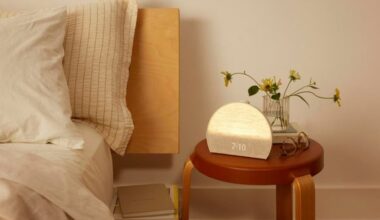
The Restore 3 is the sunrise alarm everyone recommends, and after two weeks of testing, Wareable’s reviewer understood why: it’s the rare device that handles both the morning wake-up and the evening wind-down without feeling like a compromise . WIRED’s tester put it more bluntly—previous Hatch models were too dim to actually wake them up, but the Restore 3 finally fixed that, and the new physical controls mean you can run your entire bedtime routine without touching your phone .
The fabric here is a front panel, not a full wrap. It’s a plastic body with a textile face, which means the Restore 3 looks like a small bedside speaker rather than a piece of sleep tech . That’s the right call for a device with this many buttons and a dimmable clock display. The fabric softens it just enough. It doesn’t try to be furniture.
The catch: The full content library requires Hatch+, and reviewers across the board flag this as the device’s real weakness. You get 40 sleep sounds, 20 alarm sounds, and 20 lighting options without paying . That’s plenty for most people. But the paywall is real, and at $170 upfront, it stings. It’s also not a Bluetooth speaker, and the sunset mode isn’t as gradual as some competitors .
Who it’s for: Someone who wants the most polished, routine-oriented device available and doesn’t mind the ecosystem tax. If you’ve tried cheap sunrise alarms and found them lacking, this is the upgrade that justifies the jump.
2. Best Budget Pick: Glocusent N17
$39.99–$59.99 launch pricing (MSRP $99) | Fabric: Yes
Subscription: None
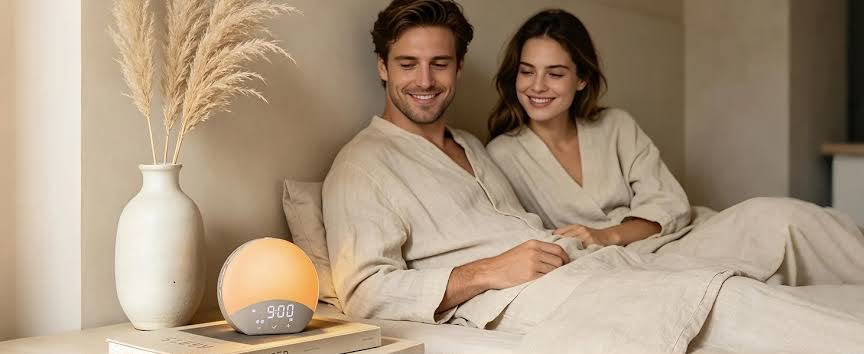
The N17 is the device that makes you question why anyone pays $170. At its current launch pricing, it costs roughly a third of the Hatch while covering the essentials. And here’s the thing: it’s the only alarm on this list that actually wraps the whole thing in fabric.
ELLE Decor’s Italian test team highlighted this immediately—the soft textile structure makes it “less aseptic” and more suited to a well-designed, modern bedroom . That’s not marketing fluff. Fabric on a bedside device does something specific: it hides the plastic, warms up the visual temperature of the object, and makes it look like it belongs next to a wooden nightstand and a linen duvet rather than a monitor and a keyboard. The N17 is compact, circular, and looks more like decor than a gadget.
The specs hold up, too. Testsieger.de measured it at 325 lux at 30 centimeters, which clears their 300-lux threshold for top marks, and confirmed all three test alarms fired punctually . The app is genuinely subscription-free. The display can be dimmed or turned off entirely. You get 30 sleep sounds, Bluetooth streaming, and a backup battery.
The catch: The sunrise simulation is fixed at five minutes . That’s short. Deep sleepers who benefit from a 30-minute gradual brighten should look elsewhere. The 5W speaker is fine for white noise but not music. Testsieger also noted the Bluetooth pairing took several attempts during setup, and the manual is English-only . And ELLE Decor’s tester observed that the sound can get a bit shrill at higher volumes .
Who it’s for: Anyone furnishing a bedroom on a budget who wants full features, no subscription, and a device that actually looks like it belongs in a room with furniture they chose on purpose.
3. Best No-Frills Simplicity: Lumie Bodyclock Rise 100
US$109.00 | Fabric: No—plastic
Subscription: None
Lumie has been making sunrise alarms since before they were a wellness trend. The Rise 100 is the stripped-down version of that expertise: a 30-minute sunrise, adjustable final brightness, a sunset program, and no app, no Wi-Fi, no subscription. Just buttons and a light that does what it says.
WIRED’s reviewer praised Lumie’s approach to routines specifically—the ability to press a button and start a 30-minute wind-down, rather than needing to be in bed at a preset time . For people whose schedules vary, that’s more practical than automated scheduling.
The catch: No nature sounds. The alarm is a beep, and user reviews consistently note this as the one thing missing . It’s also plastic, full stop. It won’t warm up your nightstand. Some users find the controls unintuitive at first, though most say you set it once and forget it .
Who it’s for: People who distrust apps in the bedroom entirely. If your ideal alarm clock has one job and does it reliably without asking for your email address, this is it.
4. Best for Sunset Seekers: Philips SmartSleep Wake-Up Light
US$139.00 | Fabric: No—plastic
Subscription: None
Philips has been in the wake-up light game longer than almost anyone, and the SmartSleep line remains a solid choice for people who prioritize sunset simulation as much as sunrise. The light transitions from soft dawn red through orange to bright yellow over 30 minutes, and the night guide function provides a dim orange glow for finding your way in the dark without disturbing your sleep .
The key differentiator is the sunset fade. If you struggle to wind down and want a device that actively dims your room, Philips executes this reliably. It’s also available in multiple models at different price points, so you can choose how many features you actually need.
The catch: No fabric, obviously. Limited sound options compared to Hatch—six natural sounds and FM radio on most models . No app connectivity. And user reviews note you have to remember to turn the alarm on each evening on some models, which is annoying .
Who it’s for: People who want a well-established brand, a strong sunset routine, and don’t need a vast audio library or an app ecosystem.
A Note on Fabric
Four of these five devices have no fabric at all. One has a front panel. Only the Glocusent N17 wraps the whole thing.
That’s not a coincidence. Fabric costs money, adds manufacturing complexity, and makes a device harder to clean. Most brands skip it. But if you’re furnishing a bedroom—choosing the nightstand, the lamp, the bedding—a sunrise alarm wrapped in textile does something the plastic ones can’t: it stops looking like a piece of tech and starts looking like part of the room. ELLE Decor’s reviewer put it plainly: the soft fabric makes the N17 feel less sterile and better suited to a designed space .
The Hatch’s partial fabric is a compromise that works. The Loftie, Lumie, and Philips are making different arguments entirely—sculpture, function, tradition. None of them are wrong. But if “warm furniture” is what you’re after, the N17 is the only one on this list that fully commits.
How to Choose Without Overthinking It
Ask three questions:
Do you need sound to wake up? If yes, eliminate the Loftie. If no, eliminate the Hatch unless you want the sound machine for bedtime.
Will you actually use an app? If the answer is “I want my phone out of the bedroom,” the Lumie and Philips are safer bets. If you enjoy fine-tuning routines, Hatch and Glocusent reward that.
Does the thing need to look like it belongs in your room? If yes, the N17 is the only one here that wraps itself in fabric and means it. If you don’t care, the field opens up.
The best sunrise alarm is the one you’ll still be using in March. A device with a hundred features you never touch is worse than one with five you use every night. Choose accordingly.