Concrete is often praised for its strength, durability, and long service life. Yet many surfaces fail long before their expected lifespan, not because the material was weak, but because water had nowhere to go. In drive lanes, loading areas, courtyards, utility zones, and hardscape edges, poor drainage causes slow, out-of-sight damage. The surface may appear solid for months or even years, while moisture continues to work below it.
Water is rarely harmless once it settles on or around concrete. It seeps into joints, presses against edges, softens the supporting soil, and carries grit that increases wear. Repeated exposure changes how the slab performs under traffic and temperature swings. What begins as minor pooling can turn into cracking, uneven settling, surface erosion, and costly patchwork repairs.
For property owners, builders, and maintenance teams, drainage should be treated as a structural issue rather than a finishing detail. The surface shape, the location of collection points, and the ability to move runoff away from traffic zones all affect how long concrete holds up under daily use.
Water Damage Starts Below the Surface
The most visible signs of drainage failure usually appear late. Standing water, discoloration, and joint breakdown are easy to spot, but the more serious problem often begins underneath the slab. When runoff collects at low points and cannot be captured efficiently, water moves into the base layer. Over time, that moisture reduces the stability of the compacted material that supports the slab.
Once the base begins to weaken, the concrete above it loses consistent support. One section may remain stable while another settles slightly. That difference creates stress, especially when vehicles pass repeatedly or when heavy loads pause at the same spot. Hairline cracks can widen, corners can chip, and slab edges can begin to break down.
This process becomes more severe when the surrounding grade directs water back toward the paved area. Instead of moving runoff away, the site keeps recycling moisture into the same vulnerable sections. The result is not one dramatic failure, but a pattern of small defects that grow more expensive each season.
Collection Points Matter More Than Many Realize
Drainage design often receives attention during major site planning, but collection points deserve closer review during both construction and renovation. Runoff needs a defined path, and that path must end in a location built to receive concentrated water flow.
Without that transition, even a well-sloped surface can send water toward edges, foundations, or soft spots that cannot tolerate repeated saturation.
A properly placed concrete catch basin helps interrupt that cycle by collecting runoff before it spreads across the slab or drains into unsupported areas. Its role is simple in concept, but significant in practice. Concentrating surface water into a controlled entry point reduces prolonged contact between runoff and the concrete surface, especially in areas exposed to frequent storms, washdowns, or snowmelt.
Placement, however, is just as important as the basin itself. If installed too high, water bypasses it. If located too far from natural low points, puddling remains. If the surrounding grade is uneven, water may collect in several shallow depressions instead of reaching the intended inlet. In many failed surfaces, the issue is not a lack of drainage components but a mismatch between the layout and actual water movement.
Cracks Often Reveal a Drainage Pattern
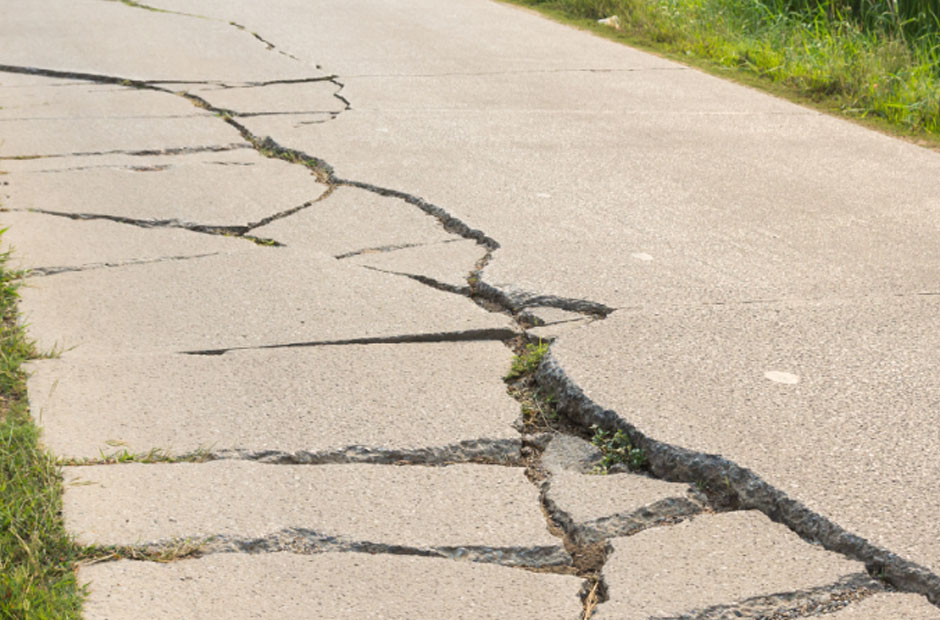
Concrete distress tends to follow water paths. Long cracks can form where moisture repeatedly undermines one side of a slab. Broken corners often appear near drain entries, curbs, or apron edges where runoff accelerates. Surface scaling may develop where water remains on top long enough to support repeated saturation and drying cycles.
These patterns are useful because they show that damage is rarely random. When cracks keep appearing in the same direction, or when repairs fail in the same section, drainage should be investigated before another patch is poured. Replacing concrete without correcting water flow only restarts the same problem.
This is especially common in areas where hardscape improvements were added in phases. A new walkway, widened drive, or equipment pad may change the way water crosses the site. If drainage was sized or placed for the earlier layout, runoff can begin collecting in places that were never meant to hold it.
Small Drainage Errors Become Large Repair Bills
Minor grading mistakes do not always look urgent. A shallow dip near a loading space or an apron that holds water for a few hours may seem like a maintenance issue rather than a structural risk. But concrete deterioration is often cumulative. Moisture intrusion, base movement, freeze-thaw stress, and sediment buildup work together over time.
The financial impact grows when repairs are delayed. Early correction may involve regrading, cleaning blocked inlets, or addressing isolated settlement. Late correction can mean removing slab sections, rebuilding the base, replacing drainage components, and restoring adjacent finishes. At that stage, the work affects both the budget and site use.
That is why inspection matters. Drainage should be reviewed after major storms, after nearby paving work, and whenever repeated cracking appears in a specific zone. Water stains, silt deposits, moss growth, and recurring puddles all point to the same question: Where is runoff actually going?
Durable Concrete Depends on Water Control
Concrete performs best when moisture is managed before it becomes pressure, saturation, or erosion. Strength alone does not protect a surface from poor runoff control. A well-finished slab can still fail early if the site directs water underneath it or leaves it exposed to constant pooling.
Long-term performance depends on more than mix design and thickness. It depends on grade, collection, outlet capacity, and regular maintenance of drainage paths. When those elements work together, the slab stays better supported, joints remain more stable, and repairs become less frequent.
In the end, concrete usually tells the truth about drainage. If it is cracking, settling, or breaking apart faster than expected, the surface is not only carrying weight; it is also being subjected to other forces. It is also carrying water that should have been removed long before the damage began.