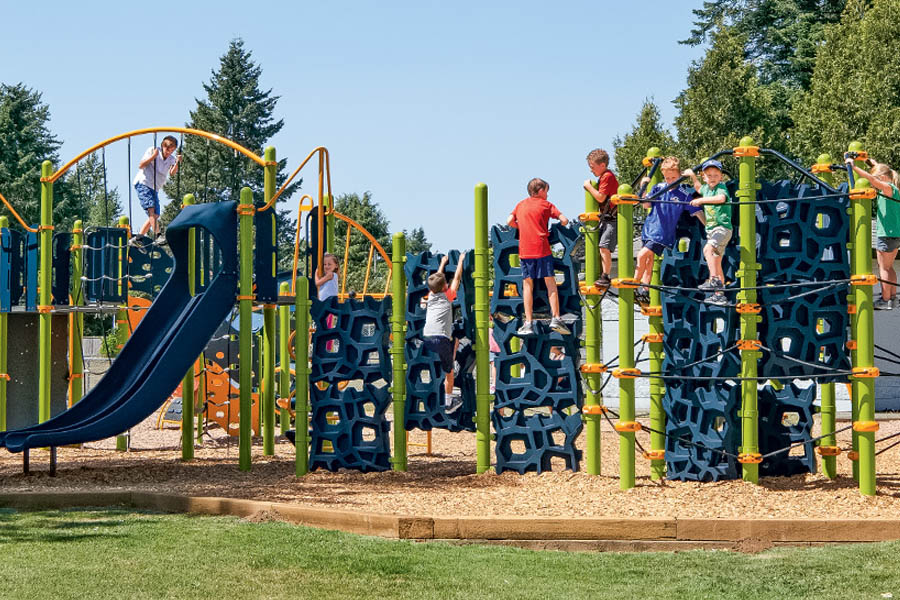
Recess used to be seen as a break from learning. Turns out, it might actually be part of the learning.
Kids who run, climb and swing before class often focus better once they sit back down at their desks.
Good school playground equipment is not just a fun add-on for the yard. Research keeps pointing to the same conclusion, that the right equipment shapes how much kids move, how well they build motor skills, and even how they get along with each other.
What Great Playground Equipment Actually Does for Kids
- Builds core strength and balance through climbing structures, ladders and rope elements.
- Raises heart rate and improves cardiovascular endurance during regular free play.
- Sharpens proprioception, the body’s sense of where it is in space, through swinging and hanging.
- Encourages cooperative games and negotiation skills when kids share equipment.
- Gives sensory-seeking or sensory-avoidant children a way to self-regulate through movement.
The Numbers Behind Active Play
Schoolyards are not a minor part of a child’s day. Research shows schoolyards contribute up to 40% of a child’s total daily physical activity, which makes the design of that one space unusually important.
One study tracking children aged 5 to 12 found that average activity levels, measured with accelerometers, increased by roughly 3.8% during school time for every additional play facility added, within a range of 14 to 35 facilities on the sites studied. That’s a small number per facility, but it adds up fast across a whole playground.
Why Equipment Variety Matters More Than Equipment Quantity
It’s tempting to think more equipment automatically means more activity. Research doesn’t fully back that up. What matters more is variety, having different types of challenge available so different kids find their entry point.
A child who avoids climbing might happily spend twenty minutes on a balance beam instead. Variety keeps the whole playground busy rather than concentrating everyone around one popular structure while the rest sits empty.
| Equipment Type | Primary Skill Developed | Best Suited For |
| Climbing frames and rope structures | Core strength, upper body control | Ages 5 to 12 |
| Balance beams and stepping elements | Coordination, spatial awareness | Ages 4 to 10 |
| Overhead ladders and monkey bars | Grip strength, shoulder stability | Ages 6 to 12 |
| Multi-user spinning and rocking equipment | Vestibular development, social play | Ages 3 to 10 |
Physical Activity Interventions That Actually Move the Needle
Systematic reviews looking at schoolyard interventions found that adding proper play equipment had a measurable positive effect on moderate to vigorous physical activity, tracked using accelerometers across multiple studies.
Simply increasing recess duration or reducing how crowded the playground feels showed weaker or inconsistent results on their own. Equipment itself, not just extra unstructured time, seems to be doing a lot of the heavy lifting.
Choosing Equipment for a School Setting, Not a Backyard
School playgrounds carry different demands than home ones. Durability under constant heavy use, safety compliance across large groups of unsupervised or lightly supervised children, and the ability to serve many age groups at once all matter far more here.
A well-planned school playground layers equipment by age and challenge level, so younger and older students aren’t competing for the same three metres of climbing frame. That layering is often the difference between a playground that gets loved and one that gets ignored within a term.