A landscape can feel surprisingly flat after sunset.
During the day, the eye naturally reads distance through colour, texture, sunlight, plant shape, and the changing scale of objects. At night, much of that information disappears.
If outdoor lighting reaches only the area closest to the house, everything beyond it can turn into one dark wall. If every visible feature receives the same brightness, the opposite problem appears: the property looks evenly illuminated but loses depth.
One way to avoid both results is to think in three layers.
The foreground sits closest to the viewer. The middle distance connects the scene. The background gives the eye somewhere farther away to land.
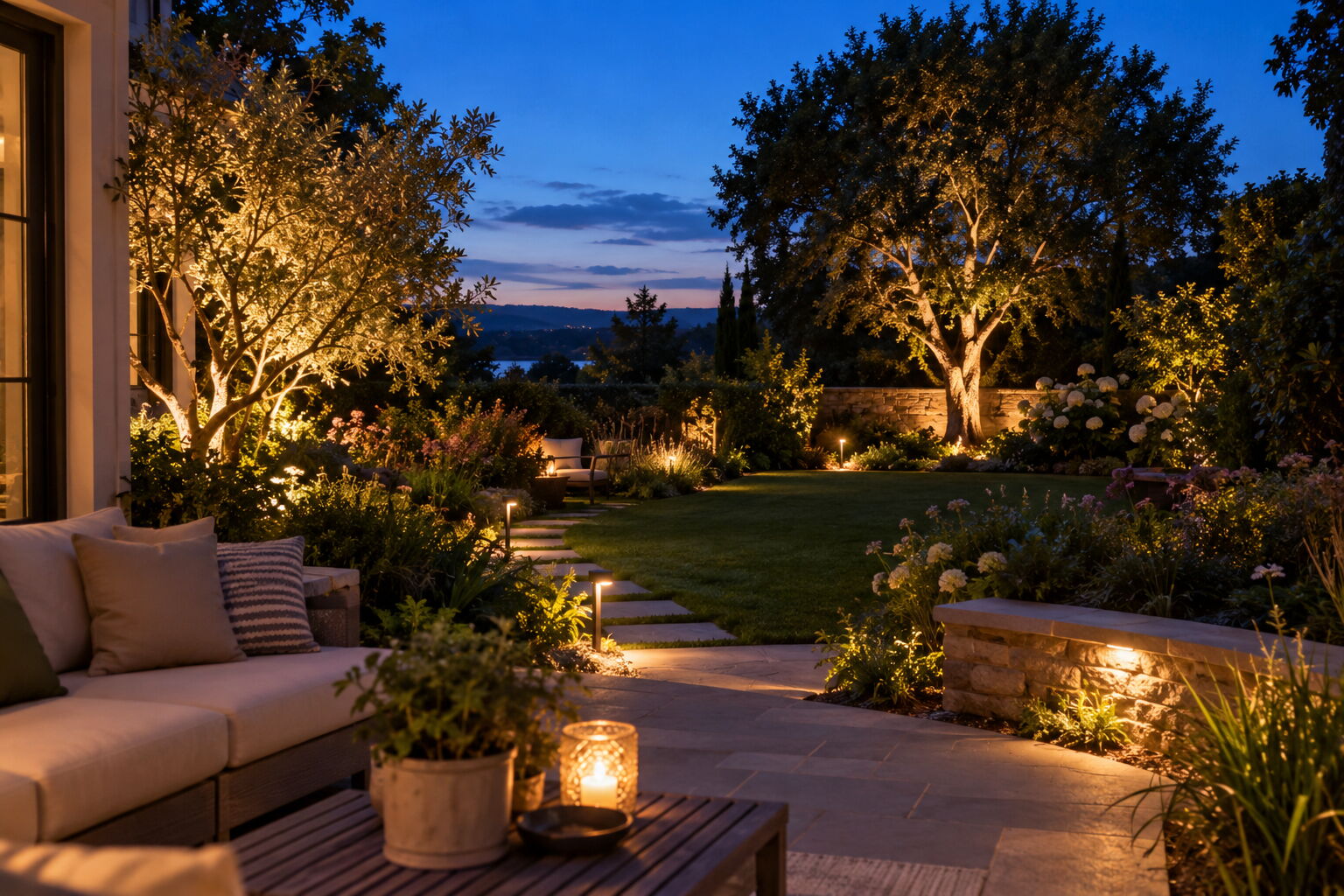
Lighting those layers differently can make the nighttime landscape feel deeper without requiring every area to be bright.
The Foreground Establishes Where the View Begins
Foreground lighting belongs to the nearest part of the scene.
From a patio, that might include low planting, a nearby wall, the edge of a seating area, or the first section of a path.
From inside the house, the foreground could be a terrace, planter, or architectural feature immediately outside the glass.
This layer should establish orientation.
It tells the viewer where the nighttime landscape begins.
That does not mean it must become the brightest area. Too much foreground light can make everything farther away harder to see by comparison.
Keep the Foreground From Becoming a Wall of Brightness
The closest surfaces are often tempting to illuminate heavily because they are easy to reach.
A patio wall, planting bed, or row of shrubs may sit directly beside convenient fixture locations.
If all of those nearby elements become bright, the eye can stop there.
The landscape beyond them loses visual importance.
Use enough light to describe the immediate space, but preserve openings toward the next layer.
A foreground should frame the view rather than block it.
The Middle Distance Connects Near and Far
The middle layer is often the hardest to define.
It may contain a lawn, secondary planting, path, small tree, garden structure, or open area between the house and rear property line.
Its role is connection.
Without some visual information in this zone, the foreground and background can feel disconnected.
That does not require lighting the whole middle area.
One or two quieter elements may be enough to guide the eye outward.
A softly defined planting group or path turn can create that bridge.
Use the Middle Layer to Control Pace
The middle distance affects how quickly the eye moves through the scene.
If nothing is visible there, attention may jump abruptly from a bright foreground to a distant tree.
If the middle becomes too bright, the background loses its impact.
A lower-intensity feature can slow that movement.
Think of it as a pause between two stronger visual moments.
This is particularly useful on larger properties where the space between the house and the far landscape would otherwise disappear after dark.
Let the Background Create the Sense of Distance
The background often contains the feature that makes the property feel larger at night.
It could be a mature tree, a textured boundary wall, tall planting, a structure, or another feature near the far edge of the view.
Lighting something in the distance gives the eye proof that the landscape continues.
That can make a dark yard feel deeper than one where illumination stops twenty feet from the house.
The background does not need to be large.
It simply needs enough visual presence to establish another plane.
Give Each Layer a Different Job
Depth becomes clearer when the three bands are not competing for the same role.
The foreground may support movement and immediate detail.
The middle distance can provide continuity.
The background can carry the strongest distant focal point.
A three-band composition discussed with Astoria Lighting Co can assign those jobs before fixture positions dominate the conversation: nearby elements establish orientation, quieter mid-distance features carry the eye outward, and a selected far element confirms depth at the edge of the scene.
The value comes from the relationship between the layers.
No single fixture creates the effect by itself.
Do Not Make All Three Layers Equally Bright
Equal brightness can erase the very depth the layers are meant to create.
If the foreground, middle, and background all demand the same attention, they begin to visually merge.
Variation matters.
One layer can be stronger.
Another may be intentionally subdued.
A third might appear only through a single illuminated feature.
The exact balance depends on the view, but the principle is consistent: distance should be suggested through hierarchy rather than uniform output.
Use Darkness Between Layers
The separation between foreground, middle distance, and background does not have to be filled with light.
Dark space can help define the layers.
A darker lawn between a softly lit planting bed and a distant tree creates a visible break.
That break tells the eye that one element is closer and another is farther away.
Trying to illuminate the entire space between them can remove that cue.
Darkness is often what allows the depth structure to remain readable.
Check the Layers From the Main Viewing Position
A three-layer design depends on perspective.
A tree that looks like background from the patio may sit directly behind a foreground shrub from the living-room window.
A path that forms a strong middle-distance line from one chair may disappear from another.
Choose the most important viewpoints and assess the layers from there.
The design does not need to create identical depth from every position.
It should work especially well from the places where people spend the most time after dark.
Let Plant Height Reinforce the Distance
Plant scale can strengthen the lighting composition.
Low planting in the foreground, medium shrubs farther out, and taller trees in the background naturally create depth.
Lighting can support that existing arrangement instead of fighting it.
Avoid over-lighting low foreground plants simply because they are easiest to reach.
Sometimes a restrained foreground makes the taller forms farther away feel more significant.
Use the landscape’s existing structure as part of the nighttime design.
Architectural Features Can Occupy Any Layer
The three-layer idea is not limited to plants.
A low garden wall might define the foreground.
A detached structure can sit in the middle distance.
A rear boundary wall or architectural feature could form the background.
What matters is where the element appears from the chosen viewpoint.
The same object may even shift roles depending on where someone stands.
That is why distance should be judged visually rather than by a fixed number of feet.
Avoid Creating Three Separate Lighting Projects
Foreground, middle, and background should not look like unrelated scenes.
The layers need some connection.
That connection may come from similar light colour, repeated material, related fixture direction, or a gradual change in intensity.
Too much variety can make the property feel fragmented.
The purpose of layers is depth within one composition, not three independent displays sharing the same yard.
Recheck the Background After Plants Mature
The far layer is especially vulnerable to landscape growth.
A young tree may initially reveal a clear trunk and canopy.
Several seasons later, new branches or surrounding shrubs can intercept the beam.
Before adding more fixtures, check whether the existing background light simply needs adjustment.
The same applies to the middle layer.
A planting bed that once acted as a subtle bridge can eventually become dense enough to block views beyond it.
Nighttime depth should be reviewed as the landscape changes.
Let One Layer Rest When Another Needs Attention
Not every scene requires all three layers to be equally active at all times.
A strong distant tree may allow the middle distance to remain very quiet.
A detailed foreground near a dining terrace may need only a faint background cue.
The three-layer model is a way to organize visual depth, not a requirement to fill every band with fixtures.
Sometimes the most convincing middle layer is mostly darkness.
Sometimes the background needs only one carefully chosen subject.
Build Depth Instead of Simply Adding Brightness
A deep nighttime landscape is not necessarily a bright one.
It is a landscape where the eye can distinguish what is near, what connects the view, and what lies farther away.
Use the foreground to establish the immediate setting. Let the middle distance guide the eye without demanding all the attention. Give the background enough presence to extend the scene beyond the nearest illuminated surfaces.
Then preserve darkness where it helps separate those layers.
Outdoor lighting becomes more convincing when the property still feels three-dimensional after sunset.
The aim is not to light everything that can be seen.
It is to make distance itself visible.