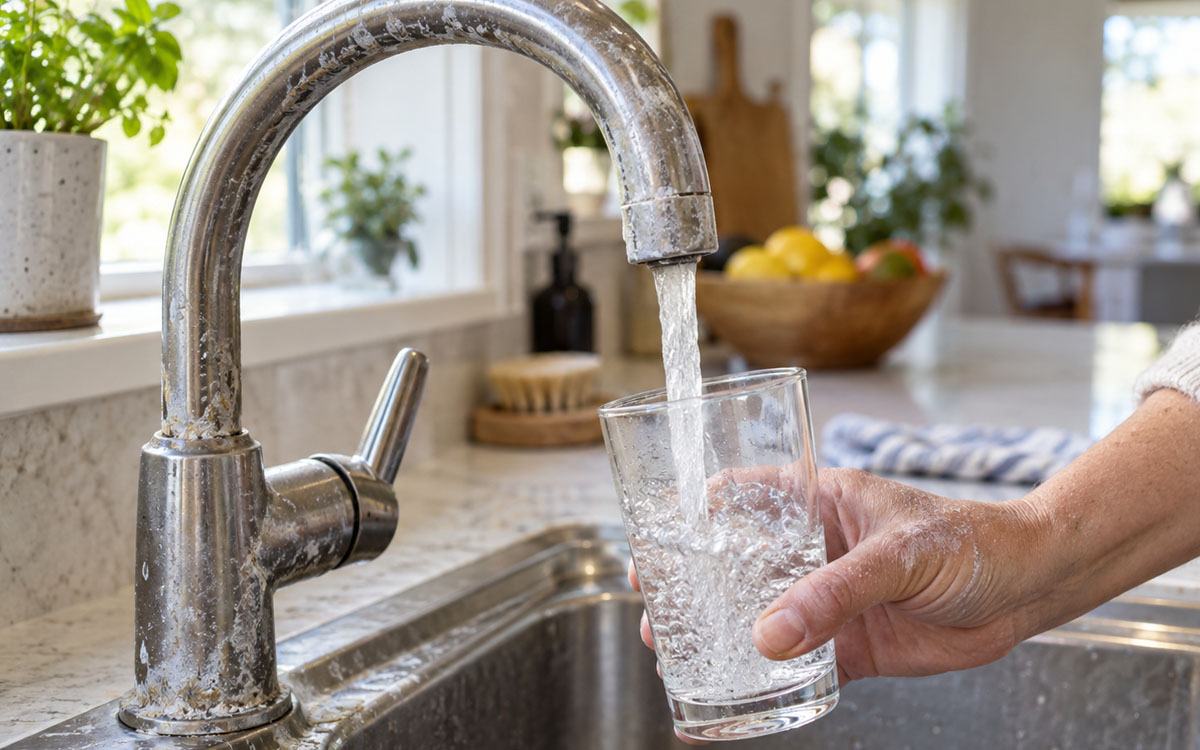
According to the U.S. Geological Survey, roughly 85 percent of households in the United States receive hard water. This means the water flowing through your pipes is rich in dissolved minerals, primarily calcium and magnesium. Water picks up these minerals as it percolates through deposits of limestone, chalk, and gypsum in the earth before reaching your local municipal supply or private well. While water with more than 60 parts per million of these minerals is classified as hard, many homes experience much higher concentrations. Most homeowners only notice the visible signs, like spots on glassware, but the true impact goes much deeper, affecting both your home infrastructure and your personal health. The World Health Organization notes that an ideal range for dissolved minerals is between 50 and 150 parts per million, which provides beneficial dietary minerals while avoiding the severe scaling associated with highly hard water.
What Hard Water Does to Your Household Plumbing
Over time, the dissolved minerals in hard water precipitate out to form a rock-like scale deposit known as calcium carbonate. This buildup acts as a flow restrictor inside your primary household pipes. In severe scaling scenarios, this mineral accumulation can reduce overall home water flow by 40 percent or more. Understanding how to manage this buildup is a key part of your routine plumbing maintenance, since neglecting the issue often leads to costly repairs and unseen water damage behind your walls.
Maintaining consistent indoor comfort across all seasons also relies on keeping home utility systems running efficiently alongside plumbing upgrades. Homeowners evaluating overall equipment efficiency often consult local HVAC specialists like Modern Air to ensure cooling units operate smoothly without excess strain, supporting overall home energy management and reducing unexpected repair expenses.
The financial toll on everyday appliances is particularly striking. Hard water forces water heaters and washing machines to work significantly harder, leading to decreased efficiency and premature failure. Inside a water heater, the scale acts as an insulating layer between the heating element and the water, driving up energy consumption and utility bills. The Water Quality Association and other industry studies have tracked the specific degradation caused by untreated hard water, noting how it shortens the lifespan and efficiency of common household fixtures:
- Water Heaters: A study by the Battelle Memorial Institute found that hard water can reduce the efficiency of traditional water heaters by up to 48 percent. Over its lifespan, an electric water heater can accumulate up to 30 pounds of calcium carbonate inside the tank.
- Washing Machines: The expected lifespan of a standard washing machine drops from 11 years down to roughly 7.7 years when continuously exposed to hard water.
- Toilets: Severe calcium scaling can erode internal flushing mechanisms, reducing a toilet’s lifespan from 6.5 years to just 2 years.
- Showerheads: These fixtures can lose up to 75 percent of their initial flow rate in less than 18 months due to severe nozzle clogging from limescale buildup.
Navigating the Health Concerns of Hard Water
Beyond the physical damage to pipes and appliances, families are often concerned about how mineral heavy water affects their bodies. When you constantly scrub crusty white scales off your kitchen faucet, it is completely natural to wonder, is drinking hard water bad for your kidneys, before making any decisions about installing a home filtration system. The primary fear for many is that consuming excess calcium will lead to kidney stone formation over time.
Fortunately, recent medical research provides some reassuring context for the average person. According to a 2025 prospective cohort study analyzing over 288,000 participants from the UK Biobank, overall domestic water hardness has no significant impact on the formation of kidney stones in the general population. The study actually noted that high magnesium levels in drinking water can reduce the risk. However, the data did reveal that drinking highly mineralized water could slightly increase the risk for specific demographics, such as older adults over the age of 60 who already have pre-existing kidney conditions.
Practical Solutions for Managing Water Hardness
Even if the health risks of drinking hard water are minimal for most people, the daily usability issues remain a significant frustration. The U.S. Environmental Protection Agency categorizes dissolved minerals under a secondary standard. This means they are treated as a nuisance rather than a severe health toxicity issue, with a recommended maximum limit of 500 milligrams per liter. Homeowners dealing with levels well above this threshold usually need to take proactive measures.
One of the most common daily annoyances is how calcium and magnesium react directly with body soap. This reaction forms an insoluble residue that clings to the skin. This soap scum frequently strips natural moisture from your body, contributing to dry skin, scalp irritation, and worsened eczema symptoms. On top of that, hard water severely inhibits the lathering properties of soaps. Homeowners often find themselves using up to 50 percent more laundry detergent and 70 percent more dishwasher detergent just to achieve basic cleaning results.
Addressing these challenges usually involves installing a water softening or filtration system. Traditional salt-based ion exchange softeners are highly effective at swapping calcium and magnesium for sodium ions, completely eliminating scale. Alternatively, salt-free water conditioners alter the chemical structure of the minerals so they cannot stick to pipes, though they do not actually remove the minerals from the water. By treating these minerals at the source, you can protect your plumbing infrastructure, extend the lifespan of your expensive appliances, and enjoy a more comfortable daily routine without the burden of constant scale buildup.