Core Pillars of Athletic Training and Performance
At the heart of any high-level training program is the concept of the kinetic chain—the idea that the human body functions as a series of interconnected segments. When we train for performance, we are not isolating muscles; we are training movement patterns. This approach ensures that force is generated efficiently from the ground up, transferred through the core, and expressed through the limbs.
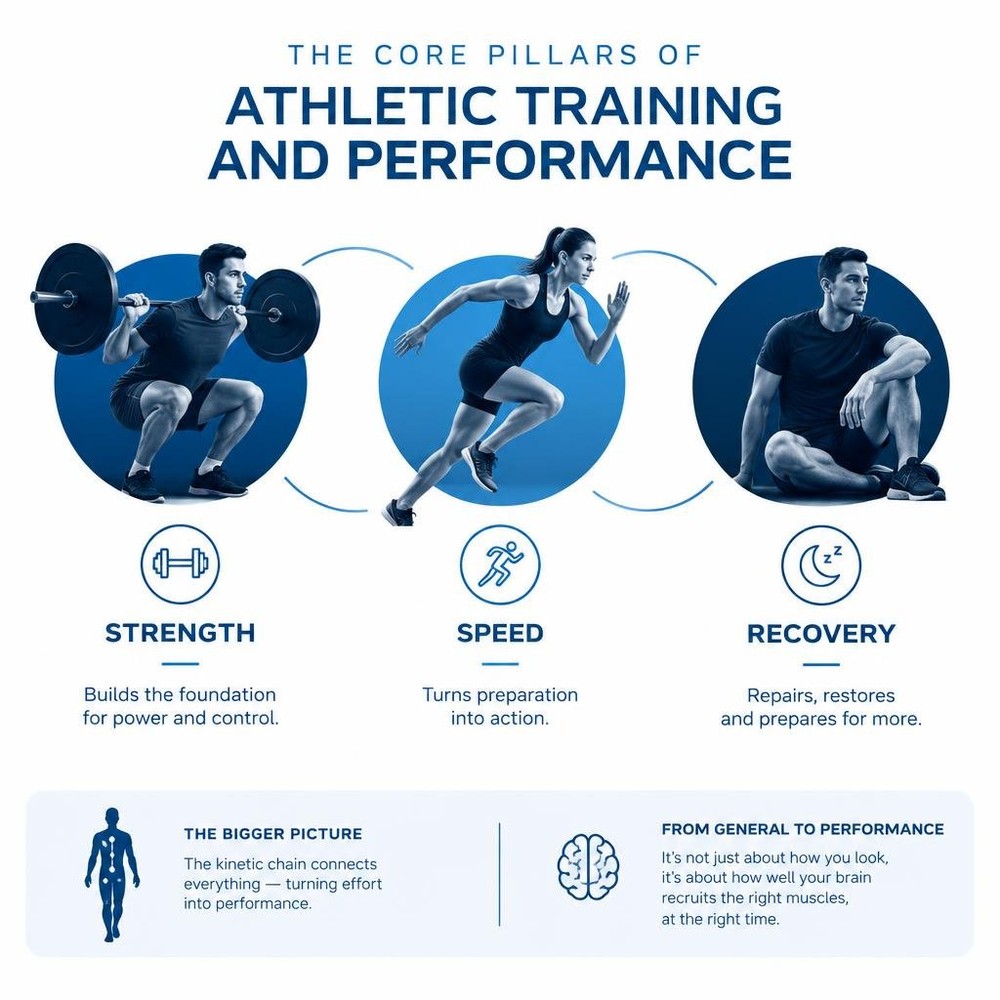
While general fitness might focus on hypertrophy or weight loss, athletic performance training focuses on neuromuscular efficiency. This is the ability of your brain to recruit the right motor units at the right time. The following table highlights the fundamental shift in perspective required when moving from general exercise to performance-based conditioning.
| Feature | General Fitness Training | Athletic Performance Training |
|---|---|---|
| Primary Goal | Aesthetics or weight management | Movement efficiency and output |
| Movement Focus | Isolation (single-joint) | Multi-planar and compound movements |
| Intensity | Constant or moderate | Periodized and high-intensity |
| Outcome Metric | Physical appearance | Measurable performance (speed, power) |
Functional Strength and Power Development
True power is the product of force and velocity. To develop this, we utilize progressive overload, systematically increasing the demands on the musculoskeletal system. Olympic lifting and plyometric exercises are staples here because they require the rapid recruitment of fast-twitch muscle fibers. By training the body to produce force quickly, we improve our rate of force development, which is critical for everything from jumping for a rebound to reacting to a stumble on the stairs.
Speed, Agility, and Quickness (SAQ)
SAQ training is not just for track stars; it is about teaching the body to accelerate, decelerate, and change direction safely. Deceleration is often the most overlooked component of injury prevention. When we train an athlete to stop on a dime, we are strengthening the tendons and ligaments to handle high eccentric loads. These principles are fundamental in youth soccer development, where teaching young players how to move efficiently and safely sets the stage for a lifetime of athletic longevity.
Mobility, Stability, and Injury Mitigation
Mobility is the marriage of flexibility and strength. It is not enough to have a large range of motion; you must have the stability to control your body throughout that range. We implement pre-hab protocols—exercises designed to address common imbalances—before the main workout. This ensures that when you push your body to its limits, your joints are supported by a balanced, resilient muscular system.
Evidence-Based Conditioning and Programming Methodologies
Performance is dictated by the efficiency of your energy systems. Whether you are relying on the phosphagen system for explosive movements or the aerobic system for endurance, your training must be specific to the demands of your goals.
High-Intensity Intervals and Energy System Development
High-Intensity Interval Training (HIIT) and Sprint Interval Training (SIT) are highly effective at improving VO2max and running economy. By pushing the body to its anaerobic threshold and allowing for recovery, we force the heart and lungs to adapt. This metabolic conditioning ensures that when you are under pressure, your body can recover faster and maintain a higher level of output for longer periods.
Integrating Velocity-Based and Complex Training
Velocity-Based Training (VBT) allows us to use technology to monitor the speed of every repetition. By measuring mean propulsive velocity, we can adjust the weight on the bar in real-time based on how the athlete feels that day—a process known as auto-regulation. Combined with complex training, where we pair a heavy strength lift with an explosive movement (like a heavy squat followed by a vertical jump), we can exploit post-activation potentiation to increase power output significantly.
Periodization and Load Management
Periodization is the strategic planning of training phases to peak at the right time. We use undulating models to rotate focus between strength, power, and endurance within a single week. By carefully monitoring the acute-to-chronic workload—the ratio of your recent training load to your long-term average—we can manage fatigue effectively and prevent burnout or overtraining.
The Science of Resistance Training Across Populations
Scientific evidence confirms that resistance training produces significant improvements in sport-specific performance. For elite athletes, the benefits are clear, but the magnitude of these gains varies based on training age and competitive level.
| Athlete Tier | Expected Performance Gain | Focus Area |
|---|---|---|
| National Elite | High | Maximum strength and power |
| International Elite | Moderate | Refinement and injury resilience |
| Beginner/Non-Athlete | High | Fundamental movement and bone density |
Adapting Athletic Training and Performance for Non-Athletes
You do not need to be a professional athlete to benefit from these methods. For the desk worker, performance training means correcting postural alignment and strengthening the posterior chain to combat the effects of sitting. For older adults, it means maintaining bone mineral density and balance. We scale these programs by focusing on movement quality first, then slowly introducing intensity as the individual’s functional capacity improves.
Dosing and Progression in Athletic Training and Performance
For beginners, consistency is the primary driver of adaptation. We recommend starting with 2 to 3 sessions per week. A typical entry-level progression involves baseline testing—measuring things like vertical jump, grip strength, and plank duration—followed by a consistent, periodized program that is re-tested every 6 to 8 weeks to ensure progress.
Nutrition, Recovery, and Modern Performance Technology
Training is the stimulus, but recovery is where the adaptation happens. Without proper nutrition and rest, the work you put in at the gym will not yield the desired results.

Nutritional Periodization and Targeted Supplementation
Nutrition should be treated as a fuel source that changes based on your training load. On high-intensity days, carbohydrate intake should be increased to support glycogen replenishment. On recovery days, the focus shifts to protein synthesis and anti-inflammatory nutrients. For those looking to bridge the gap in their nutritional intake, premium performance supplements can serve as a convenient way to ensure you are meeting your micronutrient and protein requirements.
Advanced Recovery Modalities and Data-Driven Tracking
We now have access to wearable technology that monitors heart rate variability (HRV), a key indicator of central nervous system recovery. By tracking these metrics, we can determine if an athlete needs a high-intensity session or an active recovery day. This data-driven approach removes the guesswork from training, ensuring that every session is optimized for the athlete’s current physiological state.
Frequently Asked Questions About Athletic Training and Performance
How does athletic performance training differ from standard gym workouts?
Standard gym workouts often prioritize cosmetic changes, such as muscle size or fat loss. In contrast, athletic performance training prioritizes motor coordination and the transfer of strength to real-world movement. It is about how well you move, not just how much weight you can move.
Can non-athletes safely engage in performance training?
Absolutely. When properly scaled, performance training is an excellent tool for improving functional longevity. By starting with movement screenings and emphasizing proper form, we can reduce injury risk and improve the quality of life for individuals at any fitness level.
What is the recommended training frequency for beginners?
We suggest a frequency of 2 to 3 sessions per week for beginners. This allows for adequate recovery windows, which are essential for the nervous system to adapt to new movement patterns. As the body becomes more resilient, the volume and intensity can be gradually increased.
Conclusion
Elevating your athletic performance is not about finding a shortcut; it is about committing to a system. By integrating functional strength, explosive power, and intelligent recovery, you can build a body that is not only capable of high-level performance but also resilient against the wear and tear of daily life.
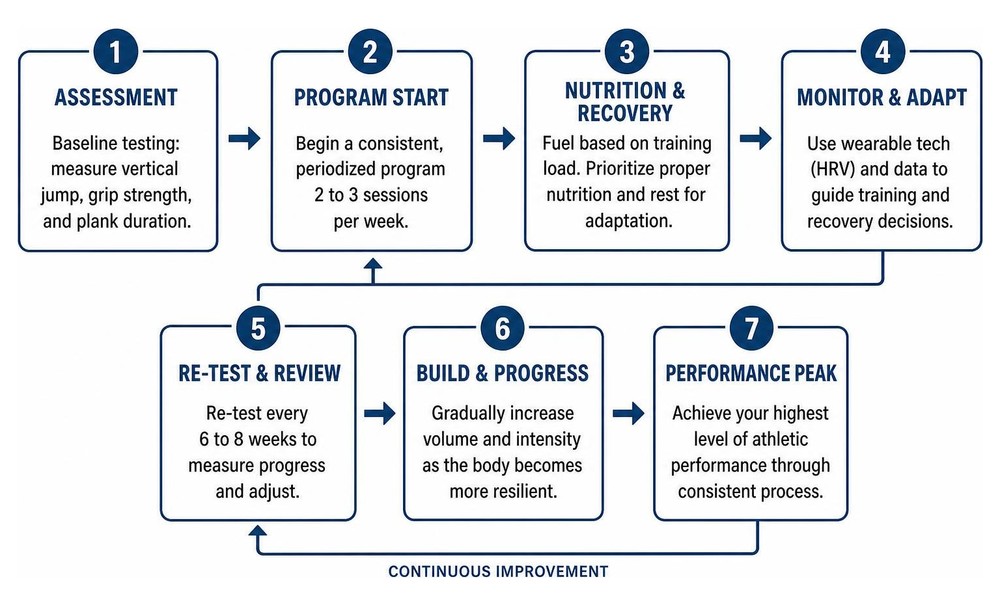
Whether you are seeking a competitive edge in your sport or looking to improve your functional health, the principles of athletic training and performance remain the same. Start with an assessment, focus on movement quality, stay consistent with your programming, and prioritize your recovery. The path to a better, stronger version of yourself is a journey of steady, measured progress.