Picture the last box on moving day. It holds a signed game ball, a jersey from a title run, and a framed ticket stub, and nobody wants to hand it to a stranger. It is also the box most likely to end up wrapped in newspaper and wedged between lamps.
Here is how to pack sports memorabilia for moving, in short. Sort items by value and fragility, wrap them in acid-free materials, give each piece its own rigid support, keep framed items upright, and tell your mover in writing about anything valuable. The sections below show how those steps work for jerseys, signed balls, framed pieces, and cards.
Start Here: Sort Your Collection Before You Pack
Sorting first tells you how much protection each piece needs and which ones should never ride on the truck. Split everything into three groups.
- Irreplaceable or high value: game-used items, authenticated autographs, graded cards, and anything with a certificate.
- Valuable but replaceable: signed items you could buy again, framed prints, and team jerseys with sentimental value.
- Fan gear: replicas, posters, and bobbleheads, which deserve care but not museum-level wrapping.
Photograph each item in the first two groups, front and back, with a close-up of every signature and certificate. Then write a short inventory with a rough value beside each line. That list helps you decide what to carry yourself, and it makes a claim easier to document if something goes wrong. Keep certificates of authenticity in one folder that travels with you, not sealed inside a box.
How to Pack Sports Memorabilia for Moving: The Right Materials
Use archival materials wherever something touches the item, and save ordinary cartons for the outer layer. Acid-free tissue is paper made to be chemically neutral, so it will not yellow or stain what it wraps. Newspaper and brown kraft paper do the opposite over time.
For a typical collection, gather these supplies:
- Plain, unprinted acid-free tissue paper
- Archival boxes for small flat items, plus sturdy cartons sized to fit pieces closely
- Foam sheets or polyethylene foam for cushioning
- Corner protectors and picture or mirror boxes for frames
- Ball cubes or small rigid boxes for signed balls
- Soft sleeves and rigid top-loaders for cards
Be careful about what you leave out, too. The National Archives warns against rubber bands, tape, unknown glues, non-stainless metal clips, and PVC plastics around papers and photographs, because they stain, corrode, or break down. That list makes sense for cards, tickets, and signed photos too. Choose boxes that let items lie flat or stand without bending, and fill extra space so nothing slides. Overstuffing is as risky as loose packing.
How to Pack Autographed Jerseys
Lay a jersey flat, fold it as few times as possible, and keep every fold away from the signature. A fold through ink can crack it, and the crease may never fully relax.
To pack autographed jerseys that are not framed, work through these steps:
- Start with clean, dry hands and a clean sheet to work on.
- Lay the jersey face up and place a sheet of acid-free tissue over the signature and numbers.
- Fold the sleeves in loosely, padding each fold with a crumpled roll of tissue.
- Fold the body once or twice at most, keeping the folds well clear of the autograph.
- Set it flat in a box that fits it, with a sheet of stiff card behind it for support.
The Library of Congress recommends storing textiles flat in boxes when possible. It also suggests neutral-pH packing materials, meaning paper that is not buffered, for silk and wool pieces, which matters if you own a vintage wool jersey. Skip the dry cleaner’s plastic bag, because plastic can trap moisture against the fabric, and skip thin hangers, which can stretch the shoulders.
If a jersey is already framed, treat it as a framed piece instead.
How to Pack Signed Balls and Other Hard Items
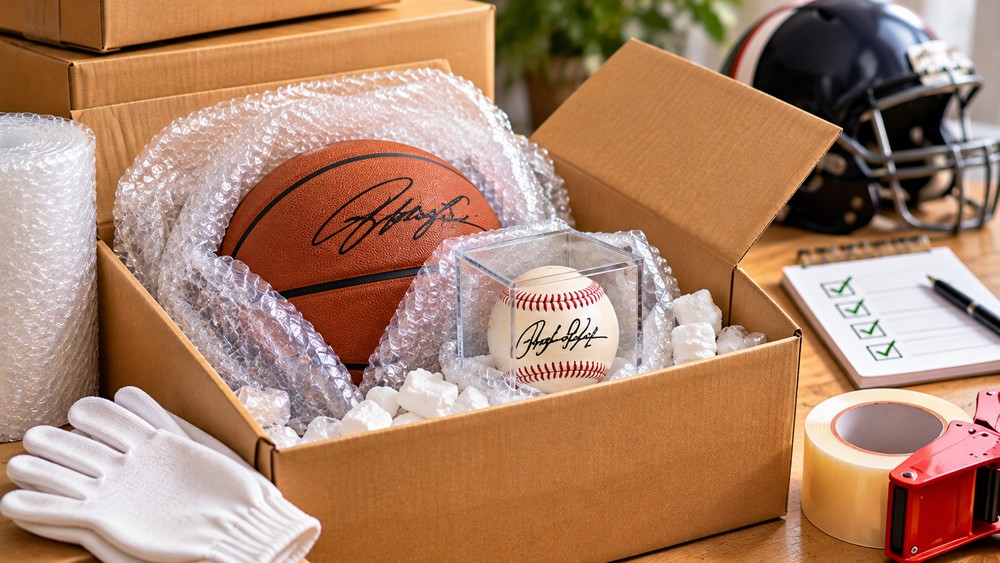
A signed ball needs to stay still and stay out of contact with anything that could rub the autograph. Good signed baseball protection starts with a snug container, so the ball cannot roll or knock against its neighbors.
Follow these steps for each ball:
- If the ball sits in a UV-filtering display cube, leave it in the cube and pack the cube.
- If it is not in a cube, wrap it loosely in acid-free tissue. Never put tape on the ball itself.
- Place it in a small rigid box and fill the gaps with foam so it cannot move.
- Pack each ball on its own. Two signed balls touching can rub each other’s ink.
- Keep ordinary plastic wrap as an outer layer only, since it can trap moisture and may stick to leather or ink in a hot truck.
Bats and helmets follow the same logic. Wrap bats in tissue, then foam, with tape only on the outer wrap. Stuff a helmet with tissue, then pad it on all sides in a box that fits. Put labels on the box, never on a signed item.
How to Move Framed Memorabilia
Framed pieces travel best on their edge, with the corners protected and the glass covered. To move framed memorabilia safely, take these steps:
- Take each frame off the wall and check that the backing, hanging wire, and any shadow box mounts are secure before packing.
- Fit a corner protector on all four corners.
- Cover the glass with a sheet of foam board or cardboard so a stray bump does not meet bare glass.
- Use a picture or mirror box when you can. This is a telescoping carton built for flat framed items.
- Stand frames upright on their long edge and never stack them flat. Slide padding between neighboring frames.
- Label the box as fragile, with the words “glass” and “this side up.”
Shadow boxes deserve an extra look. If a heavy item is held by only a few pins, ask a framer to reinforce it before the move.
If you plan to reframe a piece anyway, the Library of Congress suggests UV-filtering acrylic, because light damage builds up and cannot be undone. Acrylic also does not shatter like glass.
Sports Cards, Tickets, and Paper Keepsakes
Paper items suffer from bending, moisture, and contact with the wrong materials, so keep them flat, dry, and in stable sleeves. A sports card collection move goes best in layers: each card in a soft sleeve, each sleeve in a rigid top-loader, and the top-loaders standing on edge in a box that holds them snugly without squeezing.
The National Archives advice on containers applies here. Pick boxes sized so items neither shift nor get crushed, and add a spacer board when a box is not full. Graded cards in hard cases should get their own padded box. For tickets and photos, the Archives lists polyester, polypropylene, and polyethylene as stable plastics for sleeves.
Moisture matters too. The Archives recommends keeping relative humidity, the amount of water vapor in the air, below 65 percent to prevent mold. So keep card boxes out of damp basements and hot attics, even for a night.
What to Carry Yourself, and Where to Unpack
Carry the small, high-value, hard-to-replace pieces yourself: graded cards, game-used items, certificates, and your inventory photos. Keep them in the car cabin, not in a hot trunk. The National Archives suggests keeping papers and photographs below 75°F, and a parked car in summer can easily climb past that.
When the boxes arrive, unpack into a stable room. The Library of Congress advises keeping relative humidity between 30 and 50 percent and avoiding attics, basements, and garages. Open the boxes soon, check each item against your photos, and note any damage right away.
Ask About Valuation and Coverage Before Moving Day
Ask your mover how loss or damage is valued, because the free default can pay far less than a collectible is worth. For interstate moves, the Federal Motor Carrier Safety Administration explains that movers must offer two levels of liability. Under Full Value Protection, the mover is responsible for the replacement value of lost or damaged goods. Under Released Value, the free option, the mover owes no more than 60 cents per pound per article.
The agency gives a plain example: a 25-pound TV that is lost or damaged would pay out just $15 under Released Value. A baseball weighs about five ounces, so Released Value would pay roughly 19 cents for one. Do the math on your own pieces before signing.
The agency also says movers can limit liability for items of “extraordinary value,” meaning more than $100 per pound, unless you list them on the shipping documents. You have nine months after delivery to file a written claim. Rules for moves within one state vary, so check with your state’s consumer agency or moving association.
Packing your own boxes can also affect a claim. If something you packed is damaged, it may be harder to prove your case against the mover. For a large or high-value collection, some people hire packers instead. Superior Moving & Storage, a family-owned Philadelphia moving company, is one example, and its site lists white glove packing in Philadelphia along with boutique services for high-value items.
The Library of Congress also advises appraising and insuring objects of significant monetary value. Ask your homeowners or renters insurer whether items are covered in transit, and whether a separate collectibles policy makes sense. Terms differ by mover and policy, and this is general information, not legal or insurance advice.
Frequently Asked Questions
Can I wrap sports memorabilia in newspaper and bubble wrap?
Not directly against the item. Newsprint is acidic and can transfer ink, and plastic can trap moisture or stick to leather and autographs in heat. Use acid-free tissue as the first layer, then foam or bubble wrap as an outer cushion, and finish with a rigid box that fits snugly.
Should I fold a signed jersey for a move?
Fold it as little as possible, and never through the autograph. Lay it flat with tissue over the signature, pad any folds with rolled tissue, and set it in a fitted box with a stiff backing board. A jersey that is already framed should stay framed and travel upright like any other frame.
Is a storage unit safe for memorabilia during a move?
Only if it is climate controlled. Archives and library guidance warns against attics, basements, and garages because temperature and humidity swing widely there. A standard unit can behave much the same way. For anything valuable, choose a climate-controlled unit, keep boxes off the floor, and check them every few weeks.
Does my mover automatically cover my signed items?
Not necessarily. On interstate moves, Full Value Protection is the default unless you choose Released Value in writing, and movers may limit liability for items of extraordinary value unless you list them. Ask for the terms in writing, and consider a separate collectibles policy for your most valuable pieces.
Should I move my trading cards myself?
Yes, for the valuable ones. Graded cards, rookie cards, and anything hard to replace are best carried in your own car, in a padded box, out of heat and direct sun. Common cards can go with the movers if they are sleeved, boxed snugly, and labeled so they do not end up under heavy cartons.
A Simple Plan for Moving Day
Start a week or two ahead. Sort, photograph, and list your pieces, buy the right materials, and pack the high-value group first so you are not rushing. Then confirm in writing what your mover covers and which items you will carry yourself.
On the day, keep your own box with you and open it once the house settles. A few hours of careful packing is cheap compared with replacing a signature that cannot be replaced.