Walk into most commercial buildings today, and you’ll notice the same thing: noise everywhere, and nowhere to escape it. Open floors, hard surfaces, and packed workstations have turned many offices, hotels, and retail spaces into environments where concentration is a daily struggle.
The conversation around workplace design has shifted a lot over the past decade. Lighting, air quality, and ergonomics got their moment in the spotlight, and now acoustic comfort is getting the same treatment, largely because the data on how noise affects people is hard to ignore.
The Hidden Cost of Noisy Workplaces
Background noise does a lot more damage than most people assume. Studies tracking cognitive performance in noisy office environments consistently show declines in focus, accuracy, and output, and the effects compound over the course of a workday. Workers in high-noise settings make more errors, take longer to complete tasks, and report feeling more mentally drained by the end of their shifts than colleagues in quieter spaces.
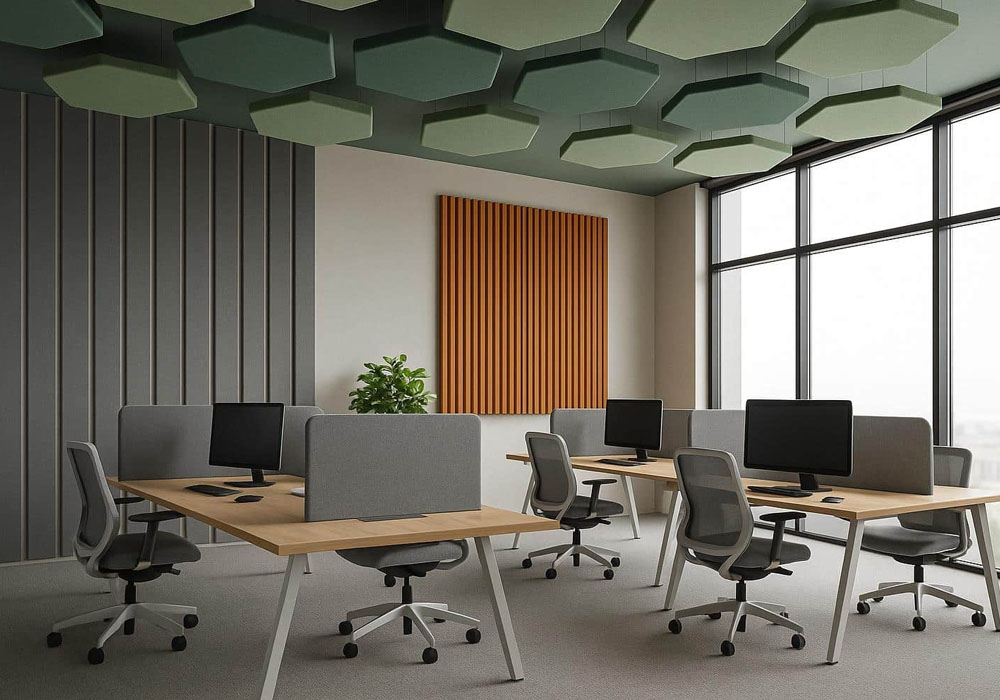
The companies that start addressing this early tend to reach for a mix of solutions, from room layout changes to surface-level treatments. An acoustic wall treatment, for instance, is one of the more common first steps, absorbing reflected sound that hard walls would otherwise bounce around the room. It sounds like a small fix, but in open-plan spaces with high ceilings and minimal soft furnishings, it noticeably changes the feel of the room.
You see, the brain doesn’t filter out background noise the way we’d like it to. Even when you’re not actively listening to conversations around you, your auditory system keeps processing them, which eats into the mental resources you’d otherwise spend on the task in front of you. Researchers sometimes call this the irrelevant speech effect, and it’s particularly bad for work that involves reading, writing, or any kind of sequential thinking.
The stress angle is just as serious. Chronic exposure to noise at levels common in busy open offices raises cortisol levels, disrupts sleep quality over time, and is associated with higher rates of reported burnout. HR teams are increasingly connecting these dots when they look at attrition data, and the link between uncomfortable work environments and staff turnover is getting harder to dismiss.
Open Floor Plans and the Noise Problem They Created
Open-plan offices were sold as a way to get people talking to each other, and in that narrow sense, they worked. What the original pitch didn’t account for was how sound behaves when you strip out walls, drop ceilings, and soft partitions, and replace them with exposed concrete, glass, and polished flooring. Sound travels fast and far in those conditions, and there’s very little to stop it.
The way sound behaves in large commercial spaces depends heavily on what surfaces it meets. Hard, flat materials reflect it; soft, porous ones absorb it. Most of the materials that define modern commercial interiors are on the wrong side of that equation. Glass facades, polished stone floors, and open steel ceilings look good in renderings, but they’re acoustically brutal. Every conversation, phone call, and keyboard click bounces off those surfaces and adds to the general din.
Also worth noting is that the shift to open layouts happened fast and at scale. A generation of offices was redesigned around the concept before anyone had gathered much real-world data on how workers actually felt about the noise. By the time the research caught up, millions of people were already sitting in spaces that made concentration harder than it needed to be, and retrofitting those spaces became a much more complicated job than designing them right would have been.
The retrofit market has grown considerably as a result. Acoustic consultants, interior designers specializing in sound control, and manufacturers of absorptive materials have all seen demand rise steadily as building owners try to address problems baked into the design stage. It’s not a cheap fix after the fact, which is part of why acoustic performance is now showing up much earlier in commercial development conversations.
What Workers and Tenants Are Actually Demanding
Workplace surveys have been pointing in the same direction for years now: noise is consistently ranked among the top complaints employees raise about their physical work environment, often above temperature, lighting, and desk space. The fact that it keeps appearing at the top of these lists year after year is a strong signal that the issue isn’t being resolved quickly enough.
The connection between noise and retention has become clearer as hybrid work has changed what people compare their offices to. When someone spends two or three days a week working from a quiet home setup, they notice the contrast sharply when they come back to a loud, open floor. That comparison makes it easier for people to articulate what they’re missing, and it raises the bar for what an office needs to offer to justify the commute.
Tenants are starting to push on this during lease negotiations, which is a relatively new development. Acoustic performance specs, previously the kind of thing only specialist occupiers like recording studios or healthcare providers cared about, are appearing in requirements from standard commercial tenants. Building owners and developers are responding because a space that can’t meet basic acoustic expectations is harder to let at a premium rate.
Facilities managers and HR teams are also meeting somewhere in the middle on this, which wouldn’t have happened as readily five years ago. The overlap between physical workspace comfort and employee wellbeing strategy has brought acoustic upgrades into conversations about retention, recruitment, and culture, rather than treating them purely as a maintenance or infrastructure question.
Building Codes, Certifications, and the Regulatory Push
The WELL Building Standard includes acoustic performance as one of its ten core concepts, with specific requirements around background noise levels, reverberation times, and sound isolation between spaces. LEED also addresses acoustics, though less extensively. What these frameworks collectively do is give designers and building owners a measurable target to work toward, rather than leaving acoustic quality a vague aspiration.
Measuring acoustic performance involves several metrics. Sound transmission class ratings describe how well a partition blocks sound from passing through it. Noise reduction coefficients describe how well a surface absorbs sound rather than reflecting it. Reverberation time measures how long a sound lingers in a space after the source stops. Each of these tells you something different about how a room will actually feel to the people inside it, and each can be specified and tested independently.
The regulatory landscape becomes more stringent in sectors where acoustic conditions directly affect outcomes. Healthcare facilities, for one, face real consequences when noise levels rise: patient recovery times lengthen, medication errors increase, and staff performance suffers. Schools face similar dynamics, where poor classroom acoustics consistently correlate with lower comprehension scores, particularly for younger students and those learning in a second language.
You see, there’s a gap between building to code and building something people actually find comfortable to work in. Minimum compliance thresholds are set to avoid the worst outcomes, not to create genuinely good acoustic environments. The certifications go beyond the baseline, and a growing number of commercial developers are treating them as a market differentiator rather than just a checkbox, particularly in competitive office markets where tenants have options.
Conclusion
Acoustic comfort has moved from a niche design concern to something that affects recruitment, retention, lease values, and regulatory compliance in commercial real estate. The reasons are fairly straightforward: people work better in quieter spaces, and the data to back that up has become impossible to overlook.
The good news is that the solutions are well understood and increasingly accessible. From smart zoning at the design stage to material upgrades in existing buildings, there are practical ways to bring noise levels down without gutting an interior. The harder part is getting acoustic performance treated as a priority from the start, rather than a problem to fix after people start complaining.